

Analog Devices states that high-performance analog products make up roughly 80% of its revenues in 2025,2026. That single number explains why this topic matters: the bridge between the physical world and digital systems runs through analog silicon.
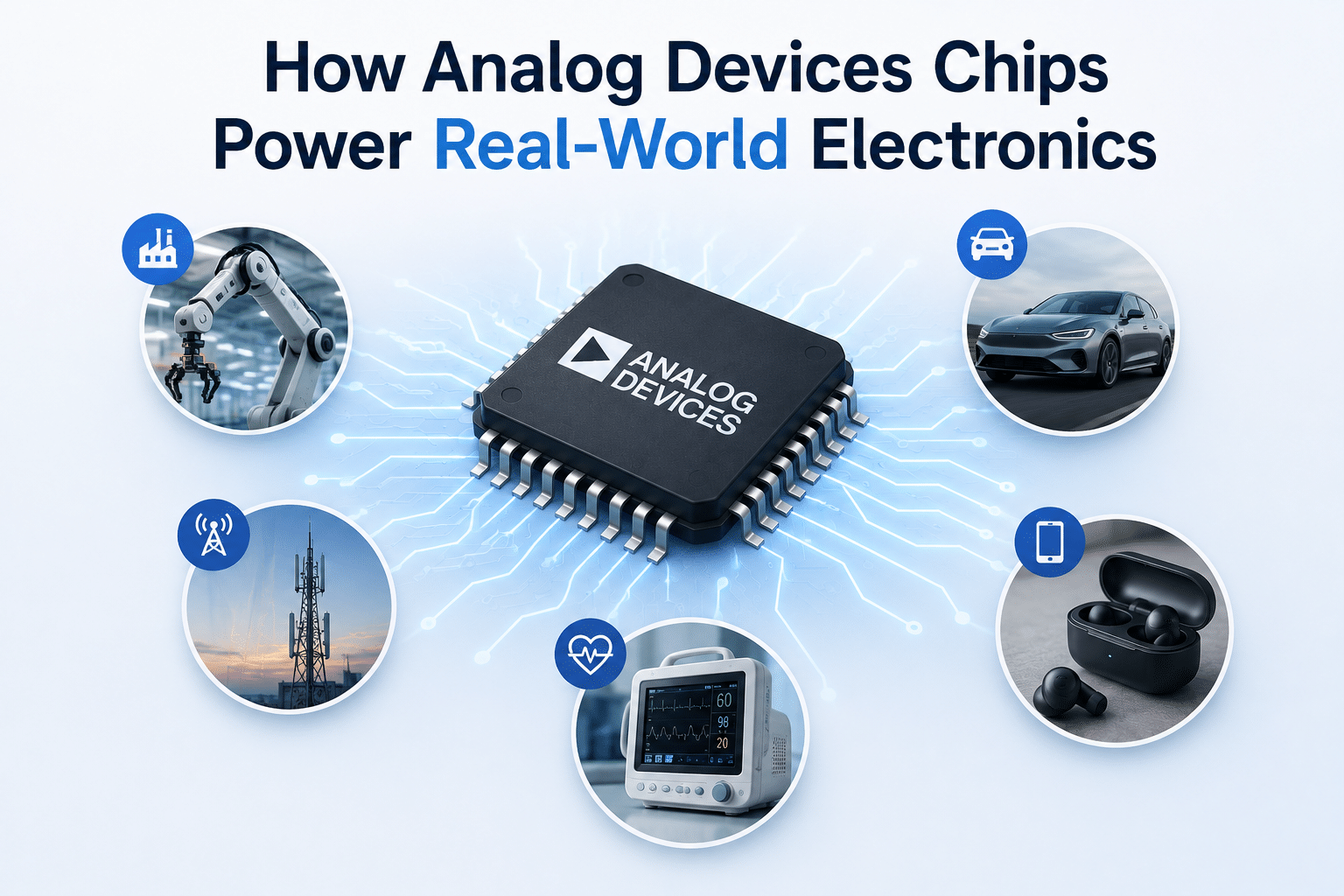
The applications of analog chips from Analog Devices reach almost every device you touch, from the heart monitor in a hospital to the radar in a self-driving car.
Here is the short answer. Analog chips convert real-world signals, sound, light, temperature, pressure, motion, into electrical data that processors can read, and they push power and signals back out to the physical world.
Analog Devices builds the converters, amplifiers, and signal processors that make this possible across healthcare, automotive, industrial automation, and 5G communications.
Quick Takeaways
- Analog chips convert real-world signals like sound, light, and pressure into digital data.
- Analog Devices earns approximately 80% of 2025-2026 revenue from high-performance analog products.
- Data converters drive over 30% of Analog Devices revenue, holding approximately 40%+ market share.
- Analog front ends amplify weak sensor signals, filter noise, then feed ADCs.
- Key markets include EVs, medical imaging, RF/5G, audio, and industrial IoT.
What Analog Devices Chips Actually Do in Real Electronics
Analog chips translate real-world physical signals,voltage, temperature, pressure, light, and radio waves,into digital data your processor can use, then convert the answers back into actions like driving a motor or charging a battery. Nothing digital matters until something analog senses the world first.
This article maps the applications of analog chips across five end markets: electric vehicles, medical imaging, RF and 5G, audio, and industrial IoT.
The world doesn’t speak in ones and zeros. A pressure sensor outputs millivolts. A microphone outputs a wiggling voltage. An analog front end has to amplify that tiny signal, filter the noise, and hand a clean version to an analog-to-digital converter (ADC,the chip that turns continuous voltage into numbers).
This isn’t a niche role. Texas Instruments states analog semiconductors make up the majority of chips in an electronic system,from a hearing aid to a data center power supply.
And Analog Devices reports data converters alone drive over 30% of its revenue, with the company holding above approximately 40% market share in that category.
Skip the analog-versus-digital debate that fills most articles. The useful question is: which application needs which chip?
A defibrillator and a 5G base station both use precision converters, but their noise, speed, and temperature demands differ wildly,a defibrillator captures microvolt heart signals at low frequency, while a base station digitizes hundreds of megahertz of bandwidth. The application-first view tells you what to actually buy.
The Signal Chain Where Analog Chips Live
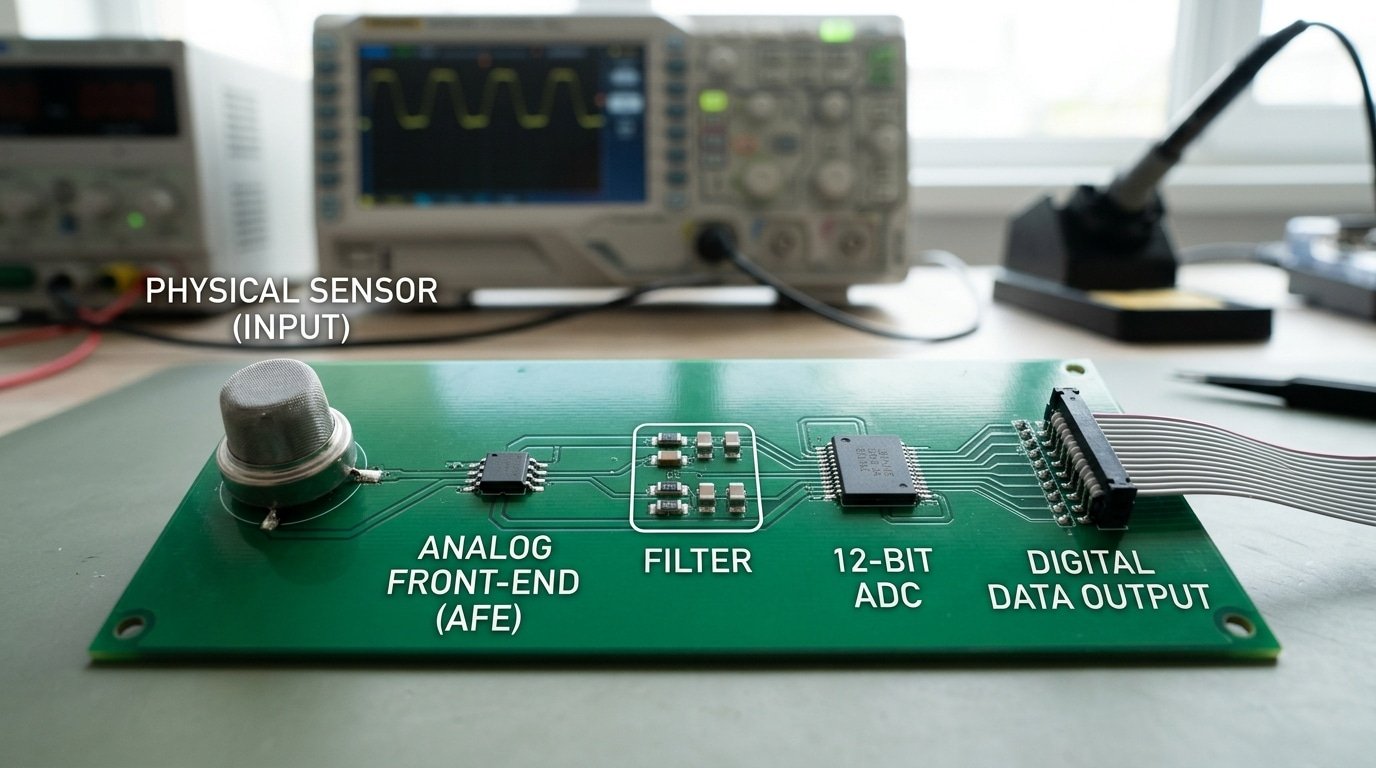
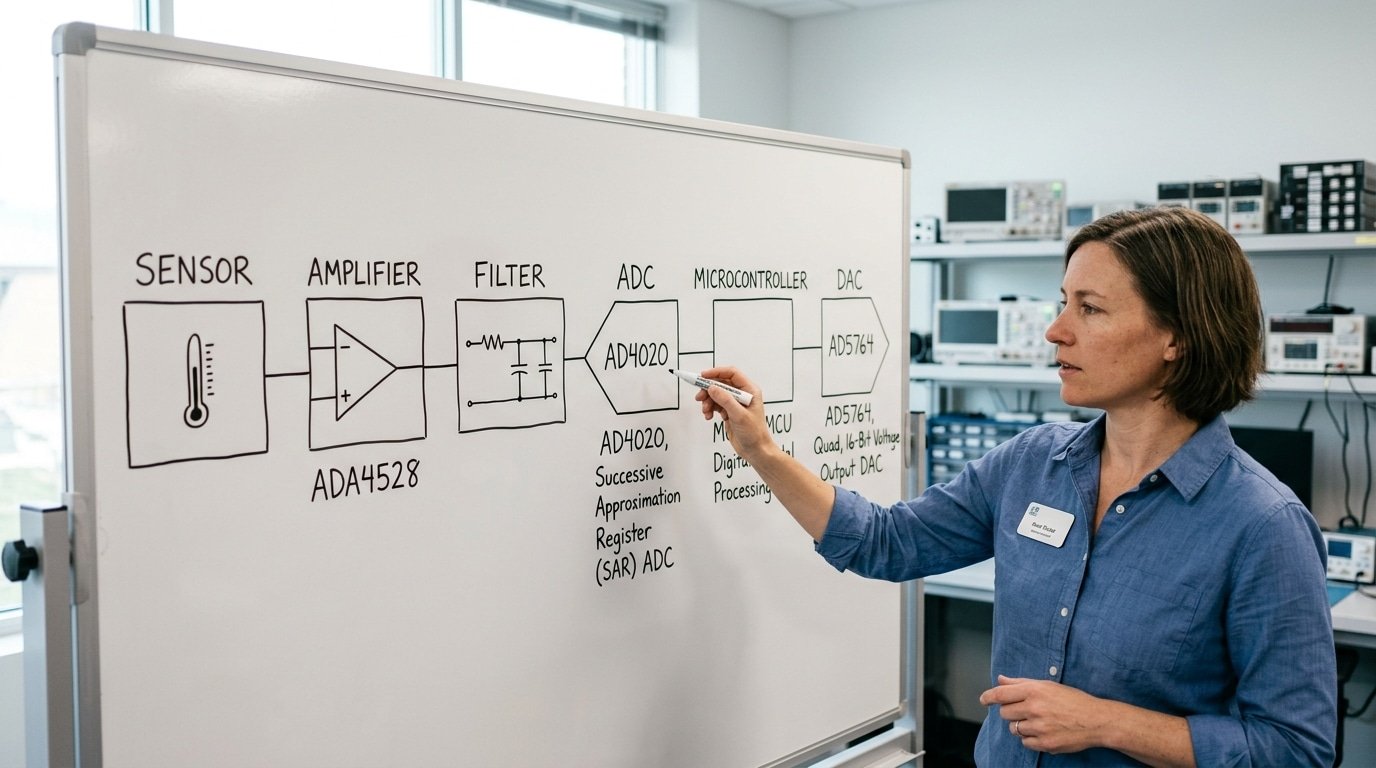
So picture this. The signal chain is basically the route a real-world measurement travels before it reaches a processor.
There are six stages lined up in order: sensing, then amplification and filtering, then turning the analog into digital numbers, then the digital processing, and finally converting it back out to analog again.
Analog Devices actually builds chips for almost every link in that chain except the purely digital middle part.
That is really why data converters by themselves pull in more than 30% of the company’s revenue, and Analog Devices says it holds over 40% of the market in that category (Analog Devices, 2026).
Let me paint a picture. Imagine a temperature sensor wired up to a small controller chip.
The sensor puts out a tiny voltage, often just thousandths of a volt. That signal is honestly too weak to read straight away, so three analog stages clean it up before any code even runs:
- Amplification: A measurement amplifier like the AD8221 boosts that tiny voltage without adding much electrical noise to it.
- Filtering: A cleanup filter strips out the high-frequency junk before sampling, and that prevents false readings from sneaking in.
- ADC conversion: A precise converter such as the AD7124 takes the clean analog voltage and turns it into digital counts.
Here is the insider tip, and it matters. Garbage in, garbage out. A 24-bit converter promises really fine detail, but if the amplifier tosses in 10 microvolts of noise, you lose 4 usable bits before the processor ever sees a single number.
The analog front end is what sets your accuracy limit, not the digital math afterward. That is essentially why every sensor reading hangs on clean conditioning before any code touches it.
Up next, I will line up specific ADI product families with the real applications they fit. And honestly, that is where Analog Devices: Applications of Analog Chips starts to make a lot more sense.
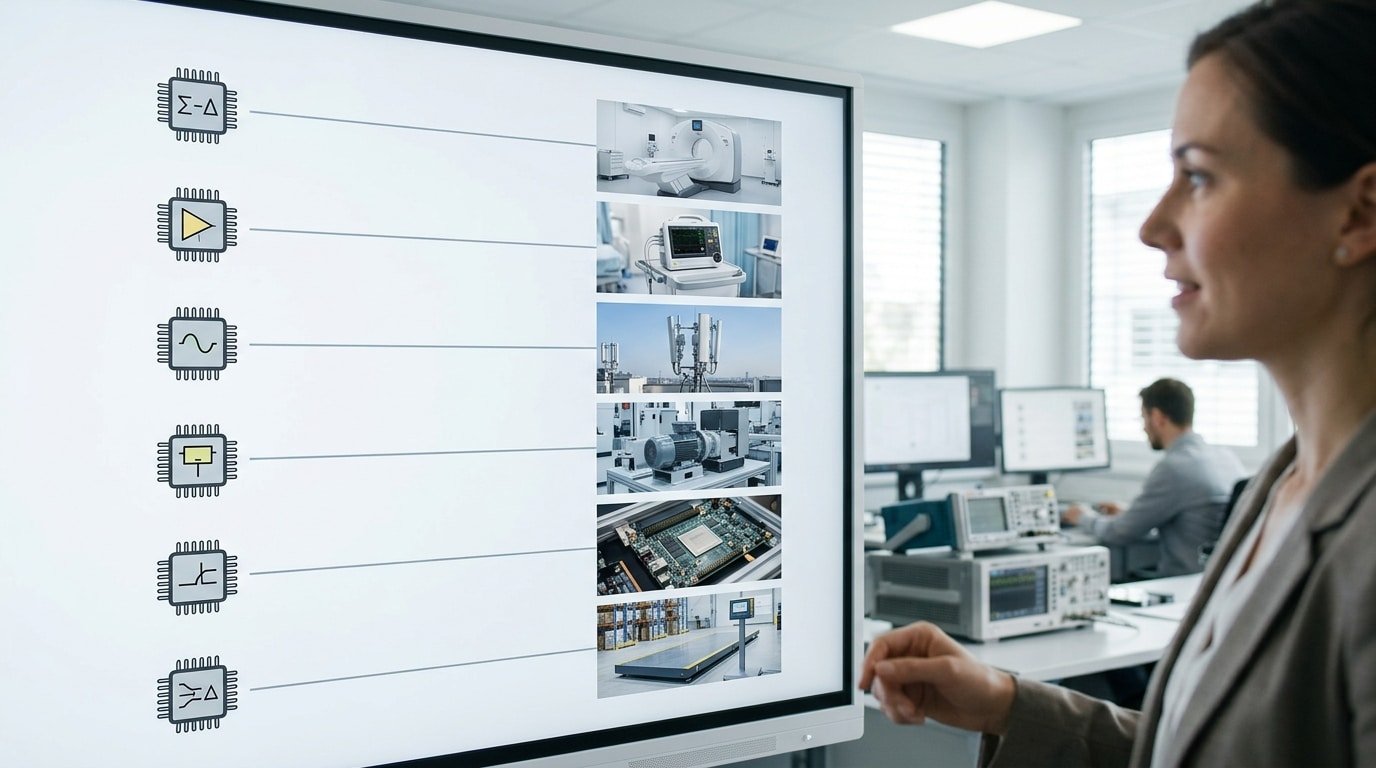
Which ADI chip family solves which real-world problem? The table below links six core categories to concrete jobs.
Each row maps a chip type to the physical task it handles and the role it plays inside a finished product,so you can match a problem to a part instead of guessing.
The categories cluster tightly around a few high-value families, which is why data converters alone account for over 30% of Analog Devices’ revenue, with more than 40% market share in 2026.
| ADI Chip Family | Real Problem It Solves | Product Role |
|---|---|---|
| Precision ADCs (analog-to-digital converters) | Turning a tiny sensor voltage into clean digital data | Reads weigh-scale and CT scanner detector output at 24-bit resolution |
| Low-noise op-amps | Boosting weak signals without adding hiss | Amplifies microvolt ECG signals before the converter sees them |
| Power management ICs (LDOs, DC/DC converters) | Delivering stable, clean voltage rails | Powers an FPGA’s approximately 0.8V core from a 12V supply |
| MEMS sensors | Measuring motion, tilt, and vibration | Detects machine bearing faults in industrial monitors |
| RF transceivers | Sending and receiving wireless signals | Handles the radio front end in 5G base stations |
| Isolators | Blocking dangerous voltage between circuit sections | Separates a motor drive from its control logic |
One field tip: never pick a 24-bit ADC when your sensor noise floor only justifies 16 bits. The extra resolution is wasted,and you pay for it in cost and slower sample rates.
ADI’s own product pages confirm these parts sit in MRI scanners, radar systems, and cellular radio base stations, the exact use cases mapped above.
EV Battery Management Worked Example
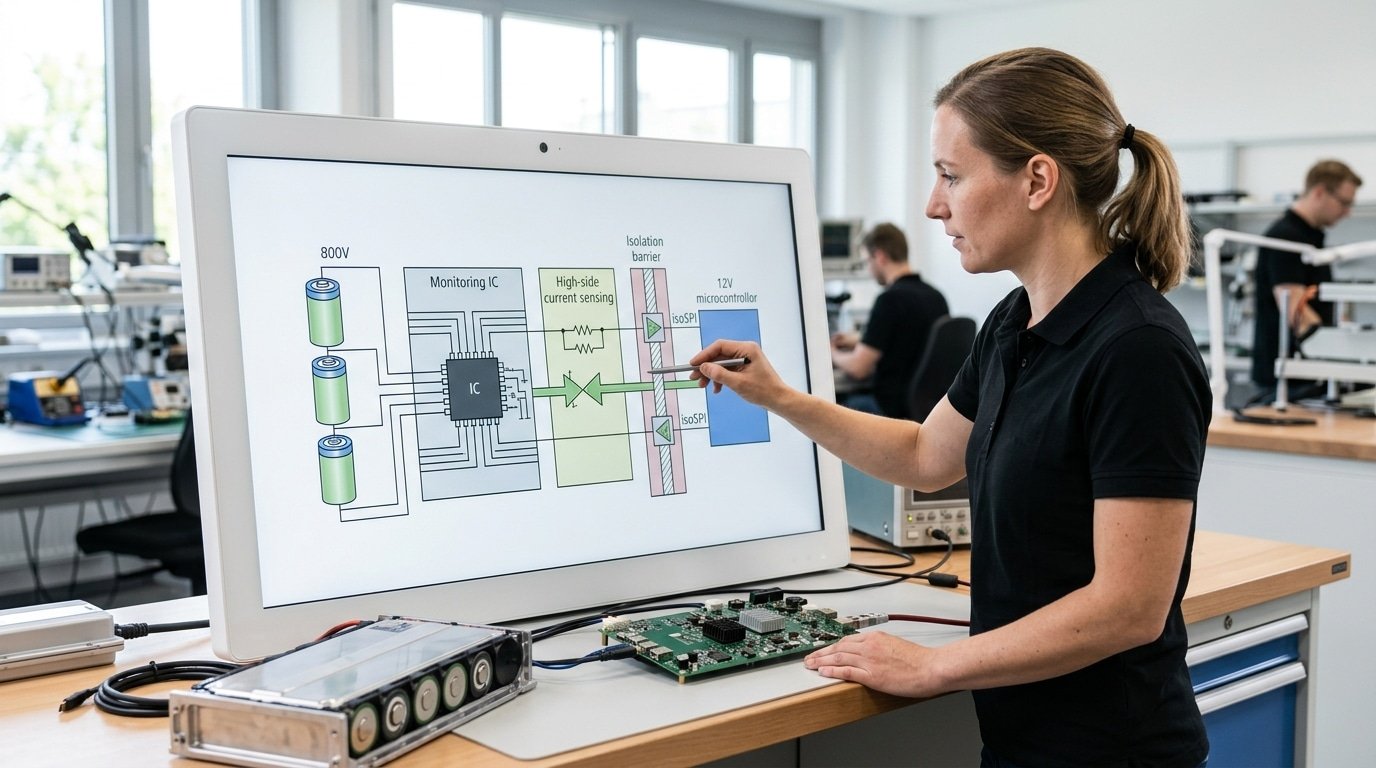
An electric vehicle battery management system, which people usually just call a BMS, measures every single cell, keeps track of the charge going in and coming out, and makes sure the high-voltage pack stays safely separated from the low-voltage electronics around it.
This is honestly one of the clearest examples of what analog chips actually do. The precise way it watches each cell decides how accurate your range estimate ends up being and whether the whole pack stays safe.
Let’s start with cell voltage. A modern EV pack stacks 96 or more lithium cells in series, one after another.
The BMS has to read each cell to better than 1 millivolt. Why so tight?
Because a 1 mV error on every cell can shift the state-of-charge math, which is basically the fuel gauge, by several percent of your driving range. ADI’s stacked cell monitors, like the LTC6813, measure 18 cells with errors under 2 mV across the full temperature range.
So why does temperature matter so much here? A car cell sees ,approximately 40°C in the dead of winter and approximately 85°C during fast charging. A converter that drifts with heat will ruin the reading at exactly the moment you depend on it most.
Charge tracking relies on coulomb counting, which really just means measuring the current flowing in and out, then adding it all up over time. A high-side current sensor and a precise analog-to-digital converter count every electron.
That way the system knows how much capacity is actually left instead of guessing from voltage alone, which sags under load and then recovers when the car sits at rest.
The third piece is galvanic isolation. Think of it as a wall that blocks the approximately 400V or approximately 800V pack from reaching the 12V control board, so a fault can’t electrocute anything further down the line. ADI’s isoSPI links and digital isolators carry cell data straight across that barrier.
These precision and isolation parts live inside the high-performance analog group that Analog Devices reports makes up roughly 80% of its 2025,2026 revenue. It’s a good reminder of how central these applications of analog chips have become to the way cars get designed today.
Medical Imaging and Vital-Sign Signal Chains
Medical signal chains pick up biological signals that are honestly tiny, measuring just microvolts, which are millionths of a single volt. An ECG, which is short for electrocardiogram and basically records the electrical activity happening in your heart, sits at around 1 millivolt.
An EEG, which records your brain waves, drops even lower to 10 microvolts or even less than that. So to read these really tiny signals without any mess, the people designing these things stack up amplifiers that add almost no noise, plus instrumentation amplifiers and high-resolution analog-to-digital converters.
Those converters, by the way, are the parts that turn voltage into actual numbers a computer can use.
The toughest enemy here is noise. A signal of 10 microvolts is basically useless if the amplifier itself throws in 5 microvolts of its own electrical hiss.
So the front-end parts in medical equipment use amplifiers that keep their noise floor under 1 nanovolt per square-root hertz. That measurement is really just a way of saying how little noise the part generates for each little slice of frequency.
And something called common-mode rejection matters even more than that. Your body actually acts a bit like an antenna, and it picks up 50/approximately 60 Hz interference from the power lines, which can completely drown out the real signal by something like 1,000 times.
An instrumentation amplifier with a common-mode rejection ratio, or CMRR, above 100 dB cancels out that shared interference while still keeping the true heartbeat intact. Consumer audio chips, on the other hand, rarely need more than 70 dB to do their job.
Analog Devices: Applications of Analog Chips reach pretty deep into this field. ADI says its precision analog parts show up in portable defibrillators, MRI and CT scanners.
Ultrasound front-ends push things even further, since they need 12-to-14-bit converters sampling at tens of megasamples per second just to image soft tissue.
Here’s one tip from the field. You really want to route the right-leg-drive feedback trace away from the ADC clock.
Clock coupling injects jitter that pretends to be a muscle artifact, and from what I’ve seen, it has fooled more than one design team into blaming the patient instead of the wiring.
RF, Wireless, and 5G Base Station Use Cases
In a 5G base station, analog chips set the ceiling on data speed and signal clarity. Wideband ADCs and DACs digitize and rebuild radio signals across hundreds of megahertz.
RF transceivers, phase-locked loops (PLLs), and clock chips control frequency and timing. Get any one wrong, and the whole radio drops calls or wastes power.
Sampling rate decides how much bandwidth a converter can capture. A 5G radio handling a approximately 400 MHz channel needs an ADC sampling well above 1 gigasample per second (GSPS).
Data converters are a core part of Analog Devices: Applications of Analog Chips, accounting for over 30% of company revenue with more than 40% market share in that category.
Three constraints drive part selection for high-frequency wireless gear:
- Dynamic range — measured by SFDR (spurious-free dynamic range, the gap between the wanted signal and the worst false tone). Below 70 dB, weak signals vanish under noise.
- Phase noise — clock jitter that smears the carrier. A 1 picosecond timing wobble at high frequency can break the strict EVM (error vector magnitude) limits 5G demands.
- Sampling rate — too low and you lose bandwidth; too high and power draw climbs fast.
Practical tip: clock the converter from a low-jitter PLL, not the FPGA. Engineers often blame a bad ADC when the real fault is a noisy clock source. The same chips power radar systems, where phase noise sets the smallest target the radar can pick out of clutter.
Audio, Industrial IoT, and Automotive Sensing
Three markets, three different priorities. High-fidelity audio chases low distortion. Industrial IoT chases reliability over long cable runs. Automotive sensing chases speed and temperature tolerance. The same vendor’s Analog Devices: Applications of Analog Chips playbook bends to fit each one.
In audio, the key spec is THD+N, total harmonic distortion plus noise. A studio-grade DAC (digital-to-analog converter, which turns digital audio back into sound) targets THD+N below -110 dB.
That means unwanted noise sits more than 100,000 times quieter than the music. Codecs combine an ADC and DAC on one chip to save board space in headphones and mixing consoles.
Industrial IoT runs on the 4,20 mA current loop, a decades-old standard still dominant on factory floors. Why current, not voltage?
Current stays constant over hundreds of meters of cable, so wire resistance doesn’t corrupt the reading. A 4 mA signal also confirms the sensor is alive; 0 mA means a broken wire.
For condition monitoring, MEMS accelerometers (tiny vibration sensors etched in silicon) flag failing bearings weeks before they seize.
Automotive sensing flips the priority to speed and heat. Radar front-ends must process approximately 77 GHz signals while surviving approximately 125°C under the hood.
IMUs (inertial measurement units combining accelerometers and gyroscopes) feed lane-keeping and rollover detection. ADI notes its precision products appear in radar systems and industrial measurement and control systems alike.
Practical tip: never spec an audio-grade op-amp for a approximately 125°C automotive loop. Its offset voltage drifts past tolerance. Match the chip’s temperature grade to the real environment first.
How to Choose an Analog Chip — Precision, Noise, Power, and Temperature Tradeoffs
Start with your application’s worst-case priority, not the highest spec on the datasheet. Match the chip to the one parameter that breaks your design if it slips,then accept tradeoffs everywhere else. Over-specifying costs money and rarely improves the product.
Here is the decision logic that actually works in practice:
- If you measure tiny DC signals (sensors, weigh scales): then prioritize low offset drift over raw resolution. A 24-bit ADC is wasted if your amplifier drifts 5 µV/°C across temperature.
- If you run on a coin-cell battery (wearables, IoT): then chase quiescent current in microamps. Power management ICs—LDOs and DC/DC converters—decide battery life more than the processor does.
- If you handle fast RF or high-speed data: then optimize for SNR and noise figure. Resolution matters less than dynamic range here.
- If the product ships into a car or factory: then specify the full −approximately 40°C to +approximately 125°C grade and check drift, not just the approximately 25°C numbers.
The most common mistake? Picking a 16-bit converter when board noise already limits you to 12 effective bits.
You pay for resolution the system can never use. The second trap is ignoring temperature drift,the spec hides on page 4, and a hot enclosure quietly erases your accuracy.
The third is a mismatched power budget, where a low-noise part draws more current than the rail can supply.
Data converters sit at the center of these choices, and Analog Devices reports over 40% market share in that category in 2025,2026,a sign of how central precision conversion is across the applications of analog chips in modern designs.
Read the noise spec at your actual bandwidth, not the headline figure.
Frequently Asked Questions
Short answers first, then the detail. These cover the questions designers and students ask most about analog chips and where they fit in real products.
What are the applications of analog chips?
Analog chips appear anywhere a physical signal meets electronics. Analog Devices lists its precision parts inside portable defibrillators, MRI and CT scanners, space vehicles, broadband network switches, cellular base stations, and sonar systems.
Every device also needs power management,LDOs (low-dropout regulators), DC/DC converters, and battery chargers. That breadth is why the applications of analog chips touch nearly every product category.
How does an analog chip differ from a digital chip in practice?
A digital chip processes 1s and 0s. An analog chip handles continuous voltage,say, a microphone signal that smoothly rises and falls.
In practice, analog parts care about noise, offset, and drift; digital parts care about clock speed and logic. One missing analog stage, like an anti-aliasing filter, breaks the whole signal chain even if the processor is flawless.
Which ADI families suit beginners?
- Op-amps—the AD8605 line teaches gain, offset, and bandwidth basics.
- Voltage references—ADR series shows why a stable baseline matters.
- SAR ADCs—the AD7124 family pairs well with a microcontroller for a first signal-chain build.
Where do I find ADI datasheets?
Search the part number on analog.com. Each page lists the datasheet, evaluation board, and SPICE model. Note that data converters drive over 30% of ADI revenue, so those product pages are the most detailed and worth studying first.
Choosing the Right Analog Solution for Your Application
Start with your end market, not the chip catalog. Match your product to one of the families covered above,data converters for measurement, amplifiers for tiny signals, power management for every supply rail,then validate the candidate part against its datasheet before you commit to a prototype.
The application picks the chip. The datasheet confirms it.
Here is the map in one pass. Building a battery system? Look at precision sense amplifiers and converters. Capturing biological signals in the microvolt range? Start with low-noise instrumentation amplifiers and high-resolution ADCs. Pushing 5G data? Wideband converters set your speed limit.
The breadth here is real. Across Analog Devices’ own product map, precision parts show up in portable defibrillators, MRI scanners, cellular base stations, radar, and space vehicles.
One amplifier family, dozens of end markets. That’s why the applications of analog chips look so scattered until you trace them back through the signal chain.
Three validation steps before you order samples:
- Check the worst-case spec, not the typical. Datasheets list “typical” and “max” columns. Design to max. A typical offset voltage means nothing on a bad unit.
- Confirm the temperature grade. Automotive needs −approximately 40°C to +approximately 125°C. A commercial-grade part rated to +approximately 70°C will fail in an engine bay.
- Verify supply and package fit. A part that needs ±approximately 15V rails is useless in a approximately 3.3V single-supply design.
Data converters earn special attention,they account for over 30% of ADI revenue and hold above approximately 40% category share, per the source above. If your design hinges on measurement accuracy, that’s where to spend your selection time first.
Pick the family. Read the worst-case numbers. Then prototype.
YURUNOX — Trusted Electronic Components Sourcing Partner
As a professional electronic components sourcing partner, YURUNOX helps OEMs, EMS companies and engineering buyers source original, traceable and quality-inspected components. Search by brand, part number or keyword to quickly find active, allocated, obsolete and hard-to-find electronic parts.
- ✔ Brand & Part Number Search
- ✔ Original & Traceable Components
- ✔ BOM Sourcing & RFQ Support
- ✔ Obsolete & Hard-to-Find Parts