

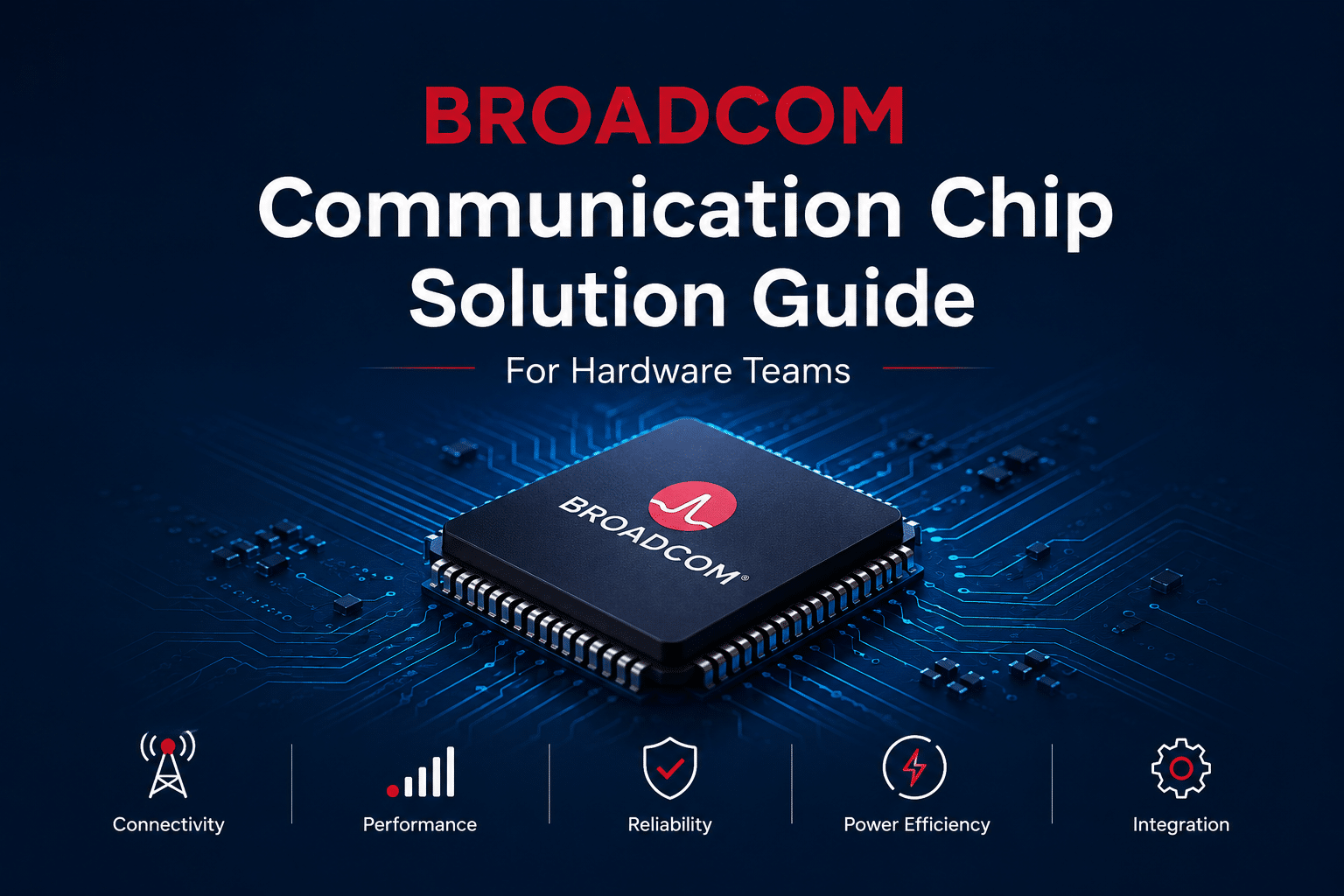
A Broadcom Communication Chip Solution bundles the silicon chip, reference designs, and software stack that move data across Wi-Fi, Bluetooth, Ethernet, and fiber links. In 2026, Broadcom released three Wi-Fi 8 chips—the BCM6772, BCM6774, and BCM6776—each shipping with a quad-core CPU for routers, gateways, and access points. These solutions fall into four buckets: Wi-Fi/Bluetooth combo SoCs, Ethernet switch and PHY silicon, automotive connectivity, and 5G/6G RF front-end parts, selected by throughput, power draw, and software fit.
Basically, it covers the actual silicon chip, the example designs you can build from, and the software that moves your data around over Wi‑Fi, Bluetooth, Ethernet, and those fiber links.
For the teams building hardware, picking the right one really comes down to three things. How much data it can handle, how much power it uses, and how nicely the chipmaker’s software lines up with the board you’ve already designed.
This guide will walk you through which Broadcom chip families work best for which jobs. And it covers which example designs help you get your product out the door faster, plus the integration mistakes that tend to trip up people doing this for the first time.
Quick Takeaways
- Match Broadcom’s four chip buckets to your board before starting layout work.
- Choose Wi-Fi 8 chips (BCM6772/6774/6776) for routers, gateways, and access points.
- Pick Tomahawk 6 Ethernet switches for data center and AI fabric boards.
- Evaluate every chip by throughput, power draw, and software-to-board fit.
- Use Broadcom reference designs to speed product launch and avoid integration errors.
What Broadcom Communication Chips Cover And Where They Fit
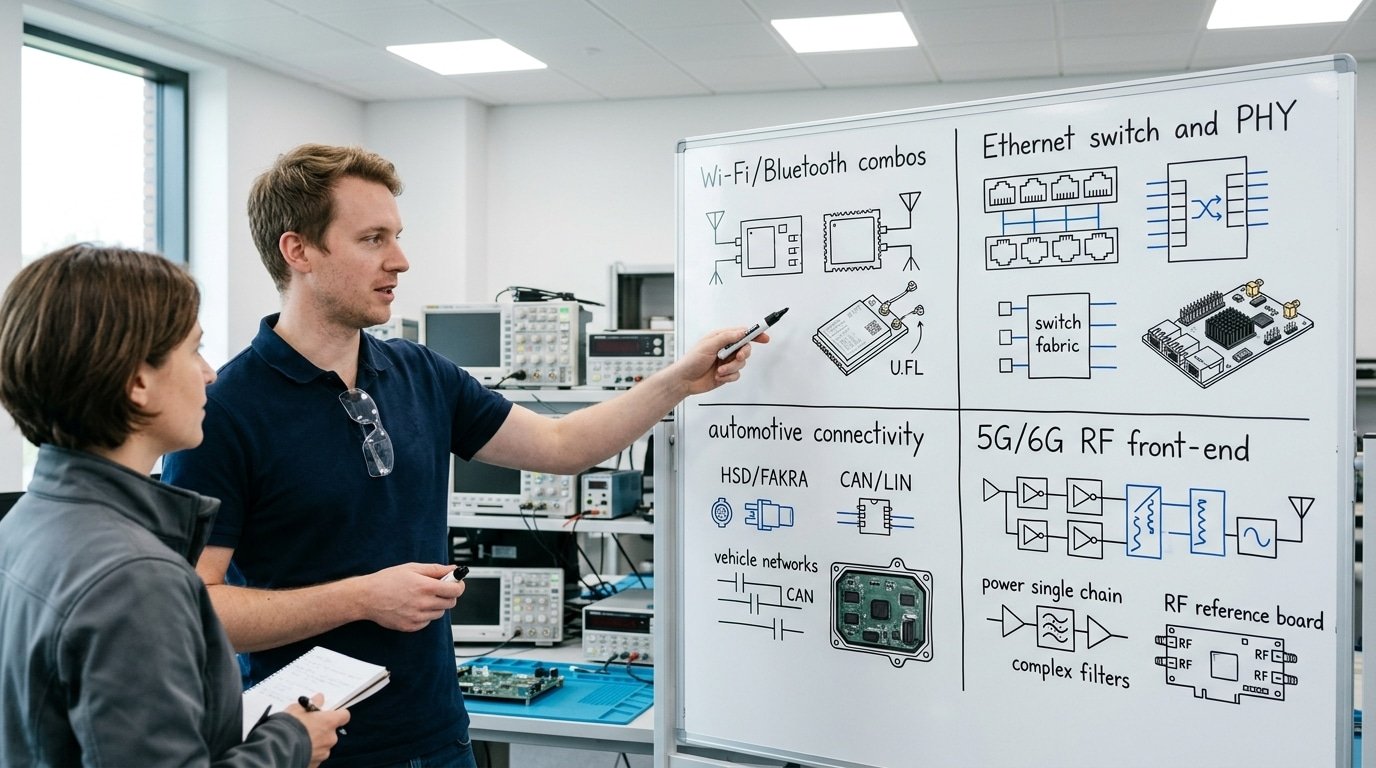
A Broadcom Communication Chip Solution falls into four practical buckets: Wi-Fi/Bluetooth combo SoCs, Ethernet switch and PHY silicon, automotive connectivity, and 5G/6G RF front-end parts. Match the bucket to your board first. The wrong bucket wastes weeks of layout work.
Wi-Fi/Bluetooth combos suit consumer routers, gateways, and edge devices. In 2026 Broadcom launched three Wi-Fi 8 chips, the BCM6772, BCM6774, and BCM6776, each shipping with a quad-core CPU. If your design is a home or enterprise access point, start here.
Ethernet switch and PHY chips belong in data center and AI fabric boards. The Tomahawk 6 switch moves 102.4 terabytes of bandwidth, that scale only makes sense for rack-level switching, not edge gear. Pick this bucket when you route high-density backplanes.
Automotive connectivity covers in-vehicle Ethernet and ADAS data links. These parts carry strict temperature and EMC grades, so a consumer combo chip will fail qualification. Don’t substitute across buckets here.
The 5G/6G RF front-end bucket handles power amplifiers and filters for handsets and small cells. It rarely shares a board with switch silicon, so most hardware teams touch only one or two buckets per project.
Quick rule: edge AI gateway designs lean on the Wi-Fi/PON line, while AI cluster boards need the switch family. Knowing your board class tells you which bucket, and which datasheet, to open first.
Broadcom Chip Families Mapped To Concrete Design Use Cases
So once you’ve sorted those four buckets, the next step is digging into the specific families that live inside each one. Pick your family based on the board you’re actually building, not the fancy marketing tier they slap on it.
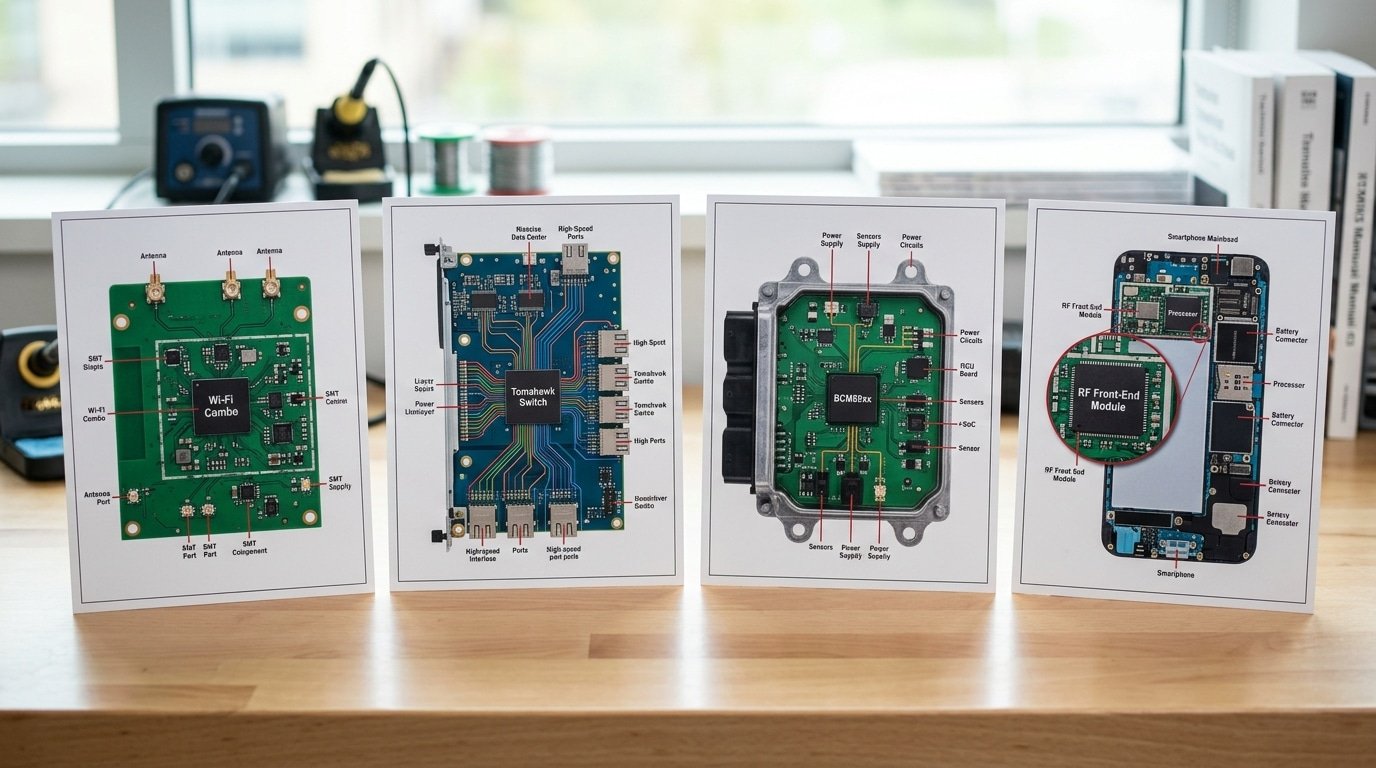
BCM43xx Wi-Fi/Bluetooth combos show up in smart speakers and cameras. You’ll find them in home gateways too. They basically pair a radio with a host connection, either SDIO or PCIe, so a tiny controller chip can hand off all the wireless work to them.
For router builds in 2026, the fresh Wi-Fi 8 parts, the BCM6772, BCM6774, and BCM6776, each come with a four-core processor built in, so the chip runs the whole networking software on its own without needing a separate processor sitting next to it.
Tomahawk and Trident switch silicon handle the wiring inside big data centers. The Tomahawk 6 switch delivers 102.4 terabytes of bandwidth, and that’s really the backbone layer for AI training clusters where thousands of graphics chips all chatter at the same time.
Honestly, skip these for small edge boxes. They need over 600W of cooling and some seriously heavy power layouts.
BCM89xx automotive Ethernet is aimed at the networks inside cars. These little signal converters push sensor and camera data over a single twisted pair of wires, which cuts down wiring weight compared to the old CAN bus setups.
They carry AEC-Q100 qualification, and that means they survive the −approximately 40°C to 125°C range that cars actually demand.
RF front-end modules manage the transmit chains in handsets. Think power amplifiers and filters and switches, all crammed in close to the antenna. The tricky part? Matching the electrical resistance across LTE and 5G bands without completely draining the battery.
Side-By-Side Selection Matrix By Application Segment
Need one screen to compare Broadcom families before you commit to a board layout? Score each family on the four specs that actually break designs: throughput, power budget, temperature grade, and package footprint.
The matrix below maps a Broadcom Communication Chip Solution to its target segment so you stop cross-referencing a dozen PDFs.
| Segment | Example family | Throughput target | Power budget | Temp grade | Package size |
|---|---|---|---|---|---|
| Data center switching | Tomahawk 6 | 102.4 Tbps switch bandwidth (Broadcom, 2026) | High (forced air) | 0–approximately 55°C commercial | Large BGA, >approximately 70mm |
| Consumer Wi-Fi router | BCM6772 / BCM6776 (Wi-Fi 8, quad-core CPU) | Multi-gigabit per radio | Mid, fanless designs common | 0–approximately 70°C | Mid FCBGA |
| Broadband gateway | BCM68850 PON | 10G PON, CPU + NPU on-die | Mid | 0–approximately 70°C | Mid FCBGA |
| IoT edge node | Combo Wi-Fi/BT | Sub-gigabit, low duty cycle | Low, battery-friendly | −40–approximately 85°C industrial | Small WLCSP |
| Automotive telematics | Auto-grade combo | Mid | Mid, thermal-managed | −40–approximately 105°C AEC-Q100 | QFN/LGA |
One trap I see hardware teams fall into: picking a router-grade part for an automotive build. A approximately 0,70°C commercial chip will throttle or fault in a approximately 105°C engine bay.
Always confirm the AEC-Q100 grade before routing, not after. The BCM68850’s on-die neural processing unit (NPU) handles edge inference, so gateway designs skip a separate accelerator.
Section four breaks down each spec column in depth.

Key Specs That Actually Drive Selection Decisions
Stop looking at the headline data rate first. A chip that’s rated for approximately 5 Gbps PHY, which is really just the raw radio speed, will often give you about half of that as actual usable TCP throughput once protocol overhead and the limits of your host system kick in.
The numbers that actually decide which chip works for your board are the quieter ones buried on page three of the datasheet.
So check the host interface before you look at anything else. PCIe Gen3 can keep up with Wi-Fi 7 traffic, though SDIO 3.0 tops out near 200 Mbps and will choke your radio no matter how fast the PHY claims to be.
USB sits somewhere in between. Match the interface to the throughput you actually need, which is how much data it really moves per second, not the marketing number.
Three specs cause the most respins:
- Deep-sleep current the tiny amount of power the chip draws while idle. A 100 µA difference completely kills battery life in wearables. Confirm the figure with the actual host-wake setup, not the ideal lab value.
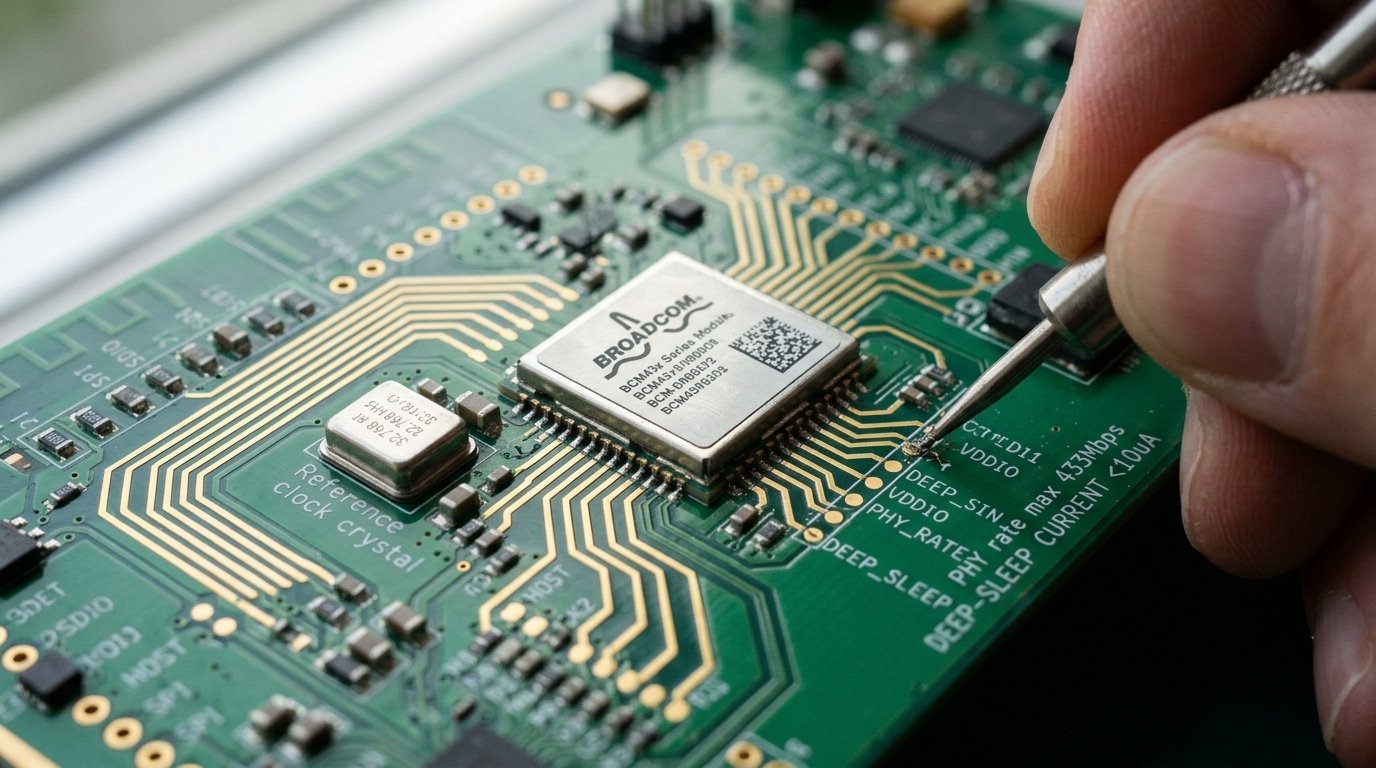
- Reference clock tolerance how precise the timing crystal needs to be. Many Broadcom parts demand ±20 ppm. Pick a cheaper ±50 ppm crystal and you fail Wi-Fi association at temperature extremes.
- Antenna diversity using two antennas for a better signal. Datasheets assume two well-isolated antennas. Cram them together and your real range drops sharply.
MAC offload matters for power too. When the chip handles ARP and multicast filtering on its own, the host CPU stays asleep longer. Broadcom’s 2026 Wi-Fi 8 chips (BCM6772, BCM6774, BCM6776) each pack a quad-core CPU, which essentially pushes more of the processing work onto the chip itself.
Thermal limits are the silent killer. A Broadcom Communication Chip Solution rated to a junction temperature of approximately 105°C can still slow itself down inside a sealed plastic enclosure. So verify your thermal headroom against your worst-case ambient temperature, not room temperature.
Integration And Reference Design Considerations Engineers Miss
Most schedule slips on a Broadcom Communication Chip Solution come from three places: power sequencing, RF keep-out zones, and software readiness. Get the hardware right and you can still lose six weeks waiting on driver maturity. Reference designs help, but only for the parts they actually cover.
⚠️ Common mistake: Starting board layout before matching your design to one of Broadcom’s four chip buckets (Wi-Fi/BT combo, Ethernet switch/PHY, automotive, 5G/6G RF). This happens because teams pick by raw throughput specs alone and ignore software-to-board fit, then discover the chosen silicon doesn’t align with their existing design. The fix: confirm the bucket and reference design match your board before routing a single trace—it saves weeks of rework.
Power-up order matters. Many Broadcom Wi-Fi/BT combos need the core rail stable before the I/O rail, or the chip latches into a bad state. Skip the sequencing IC and you chase phantom boot failures. Follow the reference timing exactly here.
RF layout is where copying the reference pays off most. Keep-out zones under the antenna feed, ground stitching vias spaced under a quarter wavelength, and a clean 50-ohm trace are non-negotiable.
The 2026 Wi-Fi 8 chips like the BCM6772 family ship with quad-core CPUs and tighter BGA pitch, often approximately 0.4 mm, which demands microvias and a fab that can hold them.
The software side trips up first-timers. Broadcom SDK access usually sits behind an NDA, and Linux driver support runs months behind silicon launch.
Android HAL layers add more lead time. I have seen teams budget two weeks for bring-up and need eight, purely because the driver branch wasn’t upstreamed yet.
- Reuse from reference: RF matching network, power sequencing, decoupling
- Expect to redo: board-specific antenna tuning, thermal pads, firmware config
Confirm NDA and SDK timelines before you commit a layout. See the next section for how rivals compare.
Broadcom Versus Nvidia, Qualcomm, MediaTek, And Marvell
Stop comparing Broadcom to Nvidia. They rarely fight for the same socket.
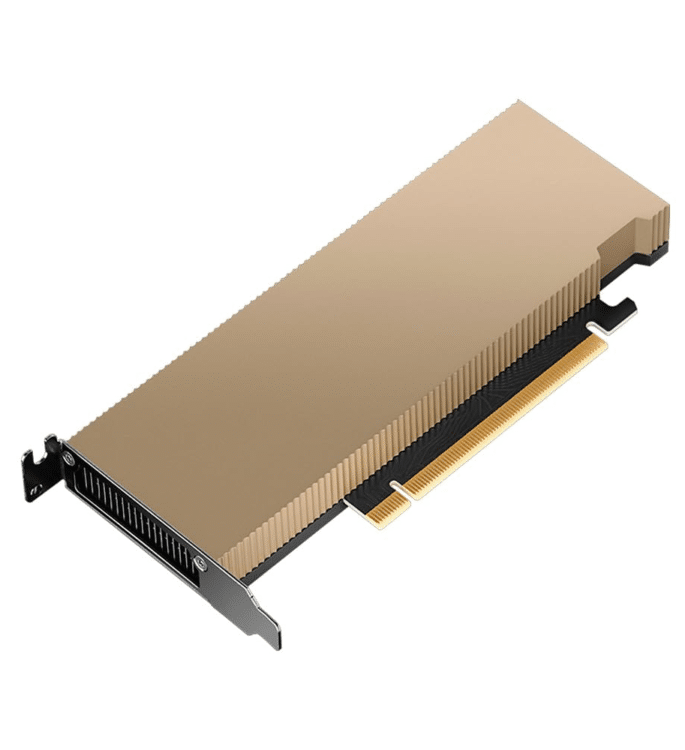
Nvidia owns GPU and AI compute; a Broadcom Communication Chip Solution owns the networking and connectivity silicon that feeds those GPUs. In an AI server rack, both ship together, Nvidia does the math, Broadcom moves the data.
Broadcom’s Tomahawk 6 Ethernet switch pushes 102.4 terabytes of bandwidth precisely to interconnect those compute nodes.
Your real cross-shopping list is Qualcomm, MediaTek, and Marvell.
| Rival | Strongest socket | Pick them when |
|---|---|---|
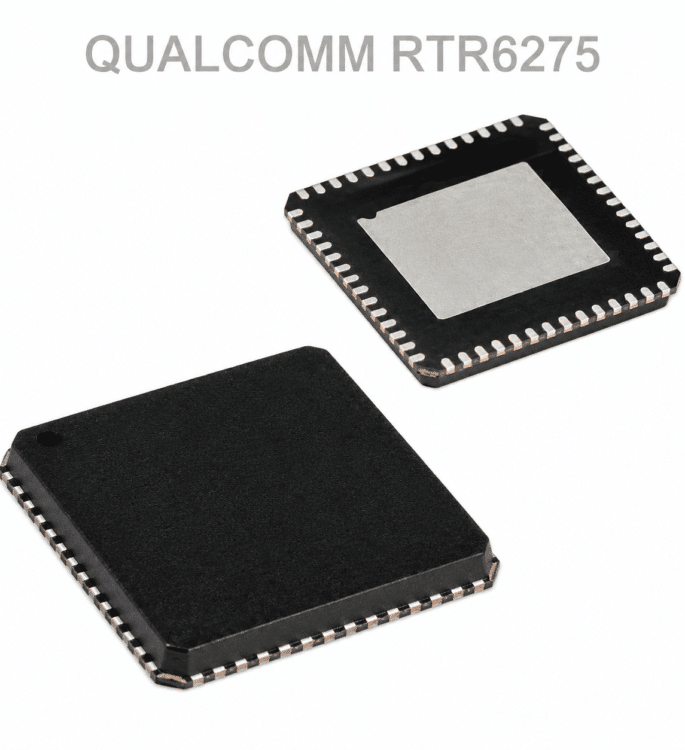
| Qualcomm | Mobile-class Wi-Fi/BT plus cellular modem on one die | You need integrated 5G in a battery device |
| MediaTek | Cost-tuned Wi-Fi for consumer routers and TVs | BOM cost beats every other spec |
| Marvell | Auto Ethernet, PHYs, and data-center DPUs | You build automotive or storage networking |
Here is the practical rule I apply: Broadcom wins when you need proven driver maturity and Wi-Fi 8 readiness in carrier and enterprise gear. Broadcom announced its first enterprise Wi-Fi 8 access product in 2026, while MediaTek still leads on raw unit price for home routers.
Marvell, not Broadcom, dominates automotive Ethernet PHYs, don’t force a Broadcom part into a car switch design.
The pitfall? Teams pick by brand loyalty, then fight a driver port that costs six weeks. Match the rival to the socket, not the logo. See the selection matrix in Section 3 for hard scoring criteria.
Real-World Design Example And Common Selection Mistakes
Picture a battery-powered industrial gateway that reads sensor data and uplinks it over Wi-Fi. The right Broadcom Communication Chip Solution here is a Wi-Fi/Bluetooth combo, not the latest high-throughput part. Why? The radio sits idle most of the day. Sleep current matters more than peak speed.
Run the trade-off math. The gateway sends approximately 2 KB every 30 seconds, about 0.5 kbps average.
A chip rated for approximately 1.2 Gbps gives you zero benefit here. What you want is low deep-sleep current (often under 10 µA on combo parts) and fast wake-from-sleep, so the radio drains the battery only during the millisecond burst.
One specific lever: pick a part with target wake time (TWT), a Wi-Fi power-saving feature that lets the device schedule when it talks to the router. TWT can cut active radio time sharply on low-duty sensors.
Mistakes That Wreck The Schedule And Budget
- Ignoring SDK licensing cost. The chip price isn’t the full bill. Driver SDKs, BSP support, and per-unit royalties can add real money. Ask for the term sheet before you commit a board layout.
- Underestimating RF certification time. FCC and CE radio approval routinely takes 8–12 weeks. FCC equipment authorization isn’t a rubber stamp — book the lab early.
- Over-speccing throughput. Paying for a quad-core Wi-Fi 8 part like the 2026 BCM6772 on a battery sensor burns power and money you never recover.
Match the part to the duty cycle, not the spec sheet headline. The flow in the next section turns this logic into a repeatable decision path.
Decision Flow For Picking The Right Broadcom Solution
Start with one question, not a datasheet: what does this board actually do? The right Broadcom Communication Chip Solution drops out of five branching decisions, taken in order. Skip a step and you risk a re-spin.
Run this if-X-then-Y flow:
- Application type. If it’s a home router or service-provider gateway, look at the Wi-Fi/PON SoC line — for example, the 2026 BCM6772/BCM6774/BCM6776 Wi-Fi 8 chips, which each ship with a quad-core CPU (SiliconAngle, 2026). If it’s a data-center fabric, you’re in Tomahawk switch territory instead.
- Power profile. If the device runs on battery, cap your search at parts with documented deep-sleep current under 50 µA. Mains-powered? Power budget rarely blocks you — move on.
- Host interface. If your SoC speaks PCIe, pick a PCIe-native part. If it only has SDIO, don’t force-bridge — throughput drops hard and certification gets messier.
- Certification needs. If you sell into the EU and US, confirm the module carries pre-existing FCC and CE grants. A self-certified radio adds roughly 8–12 weeks of test-lab time.
- Software stack. If your team runs Linux/OpenWrt, check that a current driver and DTS exist. No mainline support means you maintain a fork forever.
Final pre-commit checklist before you lock a part number: confirmed reference schematic, available driver for your kernel, documented antenna tuning notes, second-source availability, and a sample order with quoted lead time. Tick all five, then commit.
Frequently Asked Questions
Short answers to the questions hardware teams ask most before they lock a Broadcom Communication Chip Solution into a bill of materials.
How do Broadcom chips differ from Nvidia chips?
They solve different problems. Nvidia builds GPUs and AI accelerators that crunch math.
Broadcom builds the radios, switch silicon, and connectivity that move data between those chips. Broadcom’s Tomahawk 6 Ethernet switch moves 102.4 terabytes per second inside AI clusters, it feeds Nvidia GPUs, it doesn’t replace them.
Does Broadcom manufacture its own chips?
No. Broadcom is fabless. It designs silicon, then contracts foundries like TSMC to produce the wafers. This keeps capital costs low and lets Broadcom focus on architecture and IP.
What products does Broadcom own?
Wi-Fi, Bluetooth, GPS combo chips, Ethernet PHYs and switches, broadband gateway processors, and PON silicon. In 2026 Broadcom added three Wi-Fi 8 parts, the BCM6772, BCM6774, and BCM6776, each shipping with a quad-core CPU.
Who uses Broadcom chips, and where do they show up on Android?
Phone makers, router brands, set-top box vendors, and carriers. On many Android phones the Wi-Fi/Bluetooth combo chip is Broadcom silicon. Check your kernel logs, a driver string like bcmdhd confirms a Broadcom radio. That same driver name helps you match firmware blobs during board bring-up.
Choosing Confidently And Next Steps
Lock your choice on three things: the radio standard your board needs, the host interface it must speak, and the thermal budget you can actually cool. Get those right and the rest of the Broadcom Communication Chip Solution falls into place. Skip the spec-sheet bragging rights.
One detail many teams overlook in 2026: Wi-Fi 8 silicon now ships with serious compute on board. All three of Broadcom’s new Wi-Fi 8 parts, the BCM6772, BCM6774, and BCM6776, include a quad-core CPU.
That changes your firmware and power planning before you ever route a trace. Budget for it early, not after first silicon.
Before you start a prototype, pull these three documents in order:
- Datasheet — confirm package, supply rails, and certified module options against your enclosure and antenna plan.
- SDK or driver package — verify it matches your OS kernel version; a mismatch here costs weeks, not days.
- Reference design — copy the proven RF layout and BOM rather than reinventing matching networks from scratch.
Request all three through your authorized distributor or directly from Broadcom’s official products page. Quote your annual volume up front, pricing and NDA access tiers change sharply once you confirm a forecast.
One pitfall worth flagging: don’t order samples before the SDK license clears. Hardware without driver access is a paperweight. Lock the software path first, then commit to the board spin.
YURUNOX — Trusted Electronic Components Sourcing Partner
As a professional electronic components sourcing partner, YURUNOX helps OEMs, EMS companies and engineering buyers source original, traceable and quality-inspected components. Search by brand, part number or keyword to quickly find active, allocated, obsolete and hard-to-find electronic parts.
- ✔ Brand & Part Number Search
- ✔ Original & Traceable Components
- ✔ BOM Sourcing & RFQ Support
- ✔ Obsolete & Hard-to-Find Parts