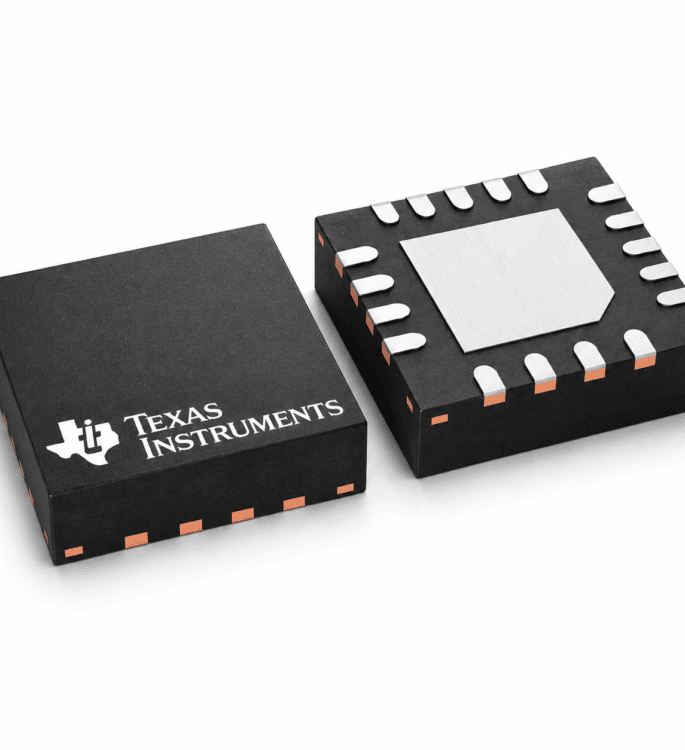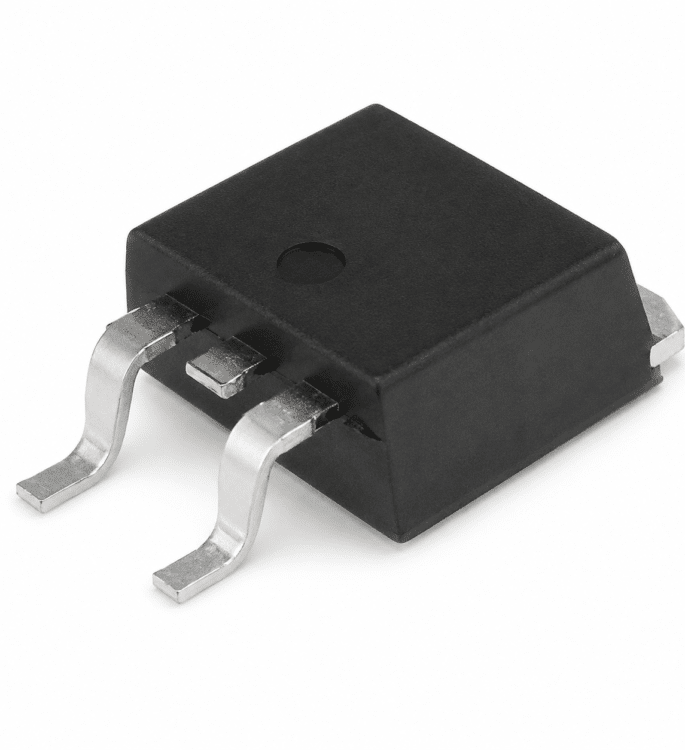


Analog chips process continuous signals like sound, light, and temperature, while digital chips handle discrete binary states (0 and 1)—this analog vs digital chips explained distinction shapes design, cost, and application. Analog ICs excel at capturing real-world signals with precision; digital ICs win at fast, repeatable computation and easy scaling. Your smartphone uses both: analog front-ends for the microphone and radio, then digital processors for everything after. This guide breaks down the 7 differences that matter in 2026, from noise tolerance to manufacturing cost.
That single distinction shapes everything else: how each chip is designed, what it costs, and where engineers choose to use it.
So which one belongs in your project? The short answer: analog chips win when you need to capture or shape real-world signals with precision, and digital chips win when you need fast, repeatable computation and easy scaling.
This guide on analog vs digital chips explained breaks down the 7 differences that actually matter in 2026, from noise tolerance and power draw to manufacturing cost and design time.
Most modern devices use both. Your smartphone has analog front-ends for the microphone and radio, then digital processors for everything after. Understanding where one ends and the other begins is what separates a working design from an expensive mistake.
Quick Takeaways
- Analog chips process continuous signals; digital chips handle discrete binary 0s and 1s.
- Choose analog to capture real-world signals; choose digital for fast, repeatable computation.
- Most devices use both: analog front-ends feed microphones and radios, digital processors compute after.
- Compare 7 factors in 2026: noise tolerance, power draw, cost, design time.
- Match chip type to your project’s needs to avoid costly design mistakes.
What Actually Makes A Chip Analog Or Digital
The difference comes down to one thing: how the chip represents information. An analog chip works with continuous voltage signals, values that can be anything within a range.
A digital chip works with discrete binary states, usually just two: logic 0 and logic 1. That’s the core of any honest analog vs digital chips explained discussion.
It’s not about which is newer or smarter.
Picture a volume knob you can turn to any position. That’s analog. Now picture a light switch, on or off, nothing between. That’s digital. Both move information, just in opposite styles.
In an analog chip, voltages and currents can take any value within a range. A digital chip only treats a small set of levels as meaningful, typically two. Anything in between gets snapped to the nearest one.
Real examples make this concrete:
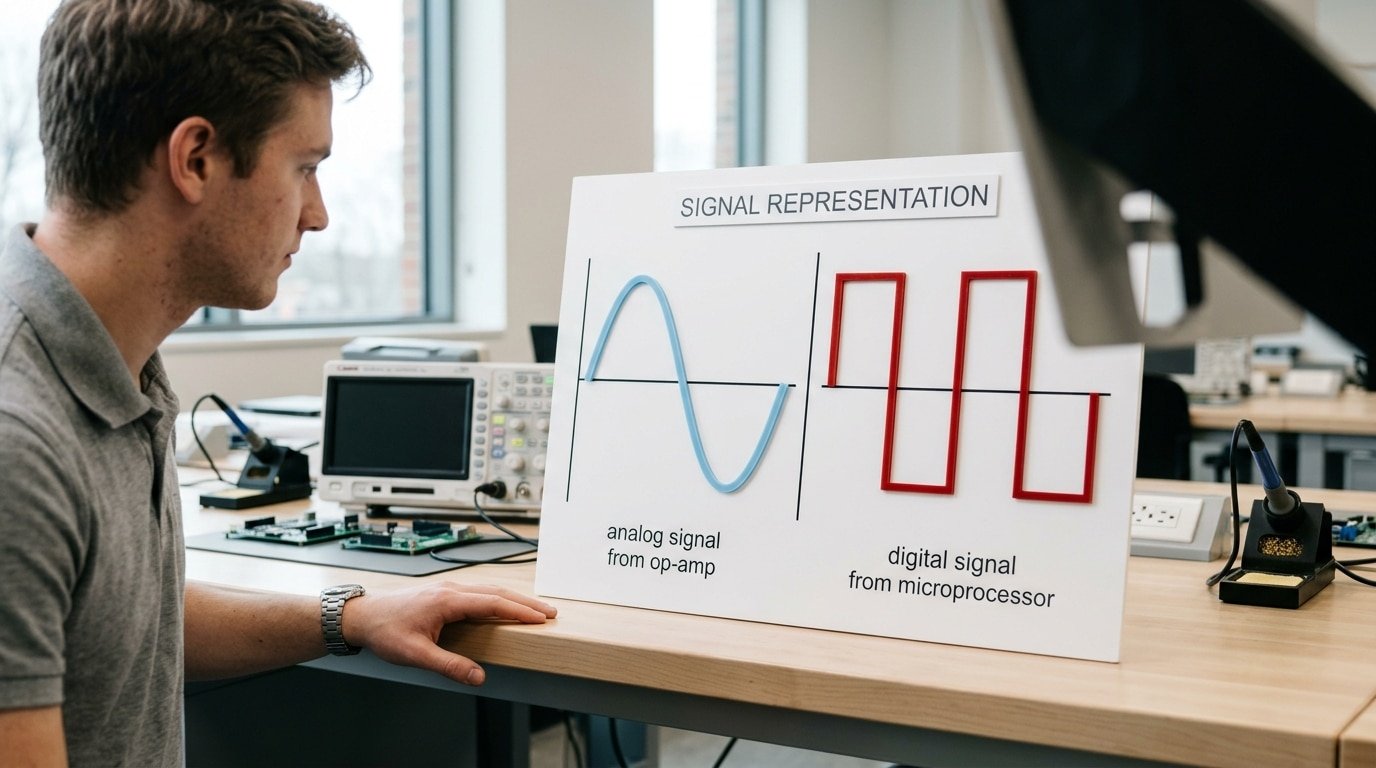
- Op-amps (operational amplifiers) — classic analog chips that boost tiny sensor signals.
- Microprocessors and microcontrollers — digital chips running on 0s and 1s.
- Voltage regulators and RF front-ends — analog, handling power and radio signals.
Most digital chips use CMOS technology built from repeated logic gates and flip-flops. Analog chips, by contrast, use diverse, less-repetitive blocks like amplifiers, filters, and regulators.
That structural gap, a digital block can copy-paste one gate a billion times while an analog block needs each amplifier tuned individually, shapes every other difference we’ll cover.
Difference 1 — Signal Representation, Continuous Voltages Versus Binary 0s And 1s
An analog chip carries information as a smooth, unbroken voltage that can sit at any value within its range. A digital chip throws all of that away. It forces every measurement into one of just two states, either a 0 or a 1.
That single choice really shapes everything else about these two chip families.
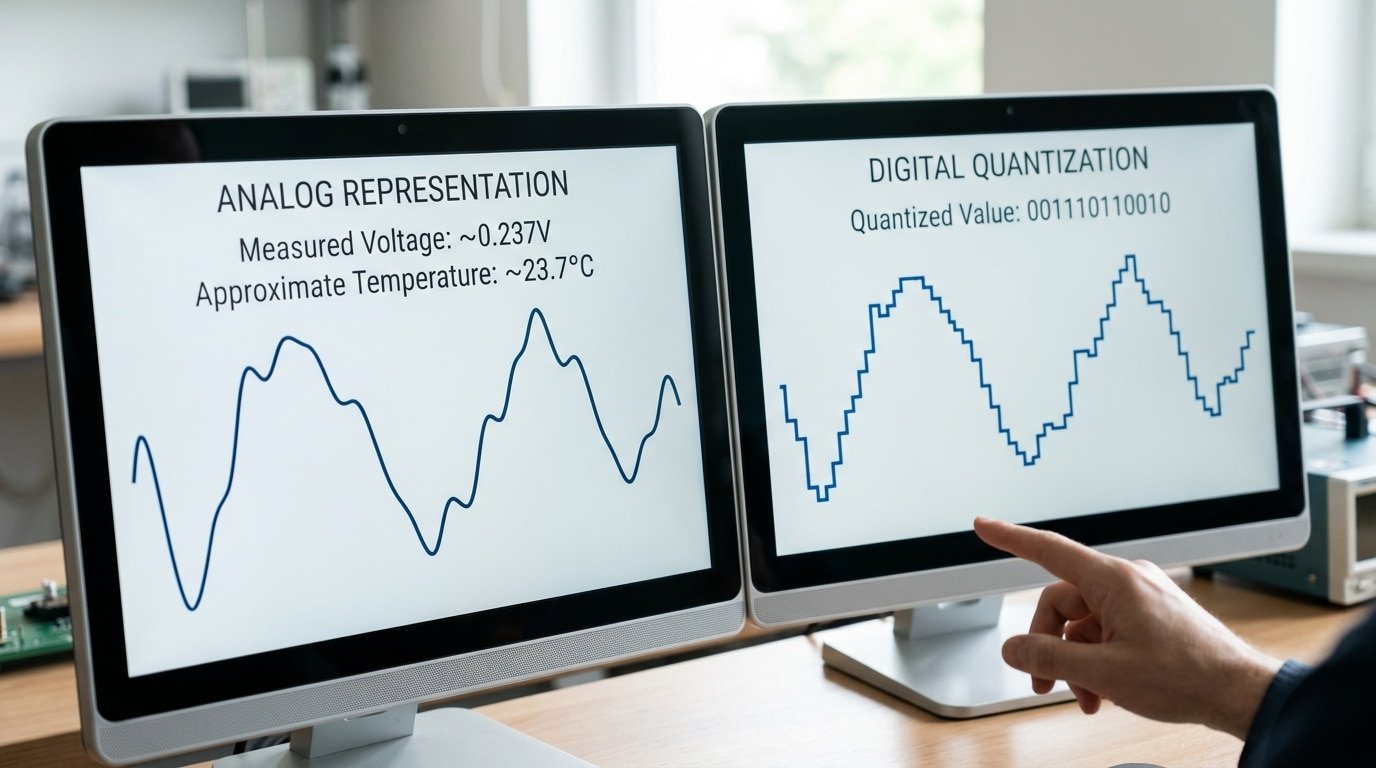
So picture a temperature sensor reading approximately 23.7°C[1]. Inside an analog chip, that reading might show up as exactly 0.237 volts, a continuous level that could just as easily be 0.2371 or 0.23702.
Nothing rounds it off. The voltage glides along a wave, tracking real-world heat the way a dimmer knob tracks brightness.
Now feed that same approximately 0.237 V[2] into a digital path. An analog-to-digital converter, basically a part that turns voltage into numbers, snaps it to the nearest step. A 12-bit version of that converter splits its range into 4,096 separate levels, which is 2 to the power of 12.
So approximately 23.7°C[3] becomes a fixed binary code like 001110110010, and approximately 23.7001°C[4] gets the exact same code. All the in-between detail is just gone.
That contrast is honestly the heart of analog vs digital chips explained. Analog keeps the endless resolution but inherits every little wobble, while digital trades the fine detail for clean, repeatable values.
As Wikipedia’s overview of digital signals points out, only a small set of voltage levels actually carry meaning in digital logic, usually just two of them.
This is also why pulse width modulation, a trick that mimics analog averaging, even exists. It fakes an analog-style average using fast digital on/off pulses, bridging the two worlds without any true analog stage.
The next difference shows what really happens when noise hits each of these. But what does that look like in practice?
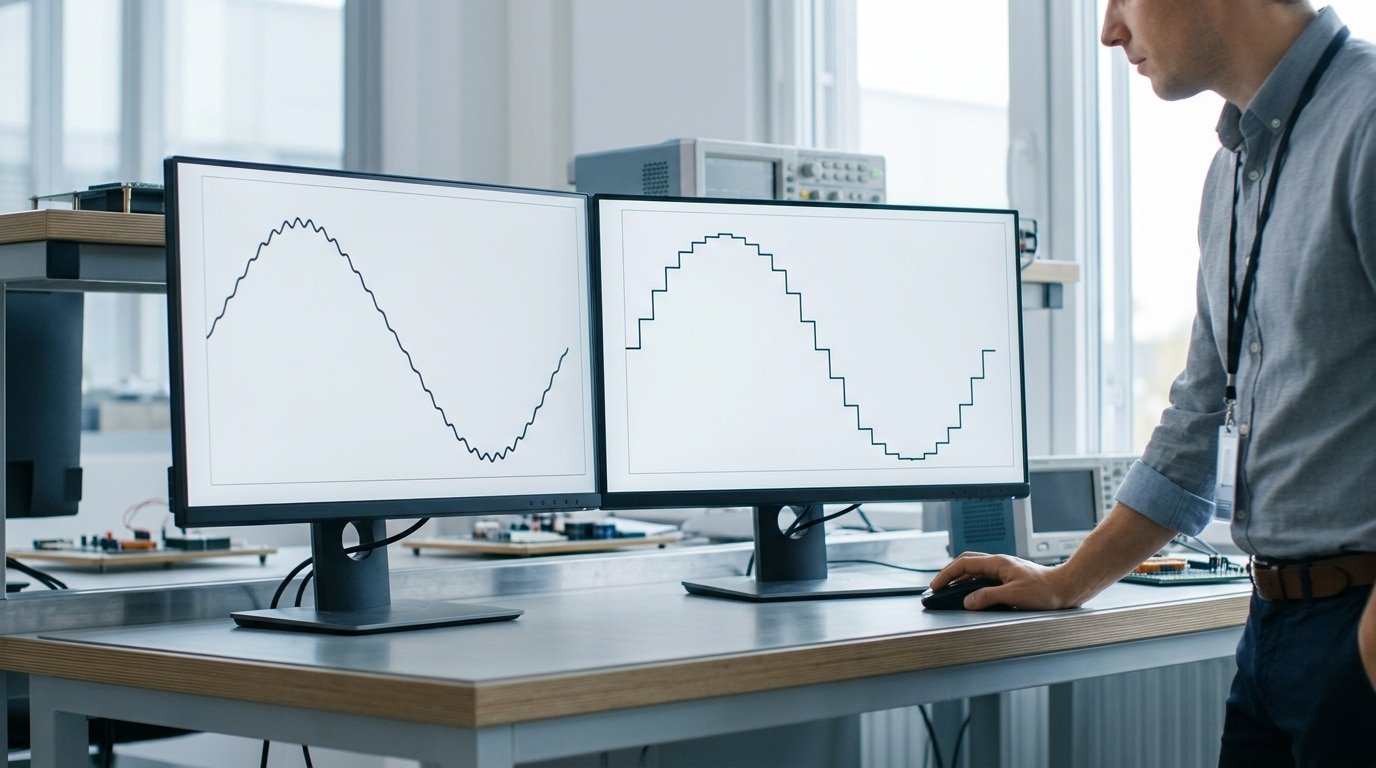
Difference 2 — Noise Immunity, Drift, And Quantization Error Side By Side
Analog chips lose accuracy from two enemies: noise pickup and component drift. Digital chips dodge both, but pay with a third flaw, quantization error, the rounding loss that happens when a continuous signal gets squeezed into fixed steps.
Those three failure modes, noise, drift, and quantization, are the practical scorecard for choosing between the two.
Noise is stray electrical interference that rides on top of your real signal. In an analog audio amplifier, that noise directly degrades the signal-to-noise ratio (SNR).
A consumer op-amp might hit 100 dB SNR, but pick up 6 dB of hum from a nearby power supply and you hear it. Digital chips ignore small noise entirely, any voltage near the logic threshold still reads as a clean 0 or 1.
This is why SparkFun notes digital circuits have far higher noise immunity.
Drift is the slow shift of a part’s value as temperature changes. A resistor with 100 ppm/°C drift moves approximately 0.1%[5] over a approximately 10°C[6] swing, enough to ruin a precision analog sensor reading.
Digital pays differently. An 8-bit ADC splits a signal into 256 steps, leaving about 49 dB of quantization SNR.
A 12-bit ADC gives 4,096 steps and roughly 74 dB, a 25 dB jump for 4 extra bits. Choose bit depth by your real precision need, not the highest number on the datasheet.
Difference 3 — Design Process, Hand-Crafted Layout Versus Synthesizable Logic
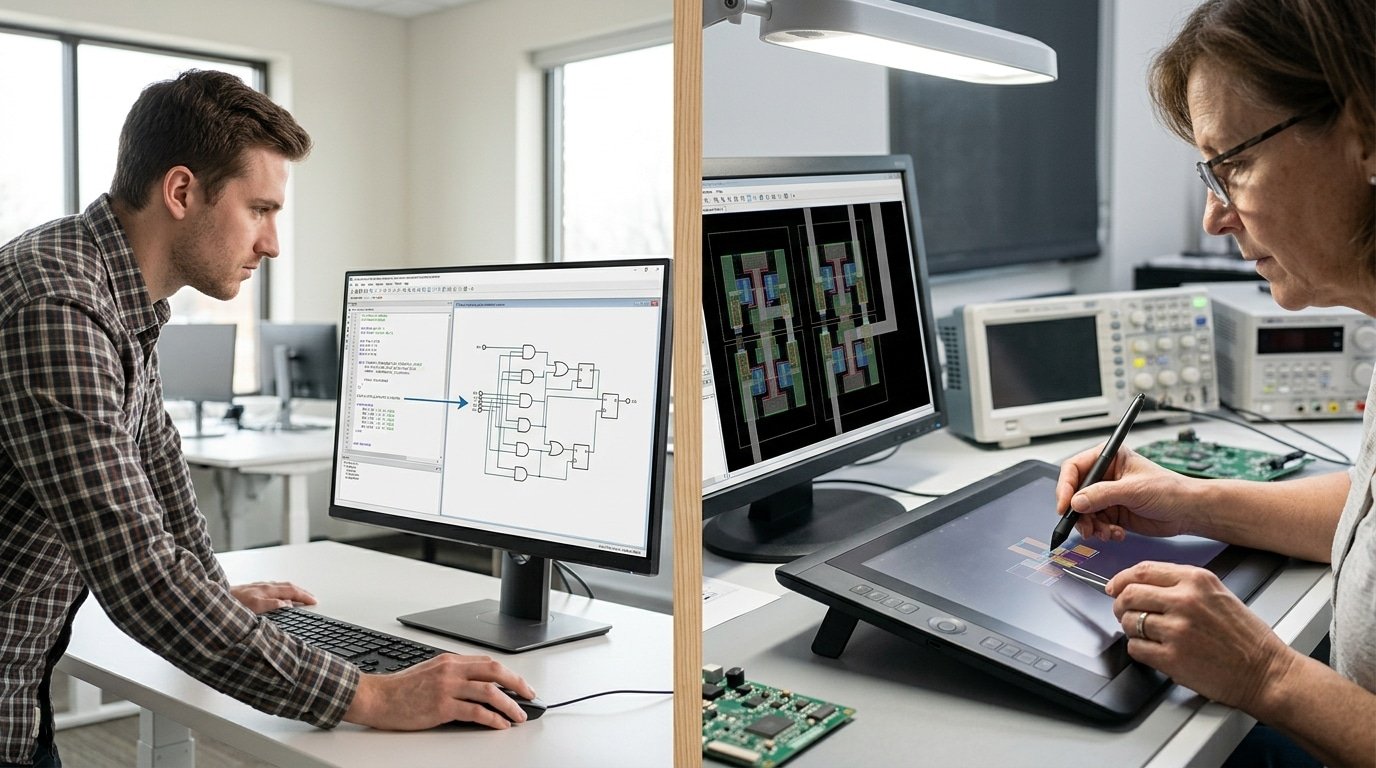
Digital chips are written like software. Analog chips are sculpted like art. That single split explains why a digital block can be generated overnight while an analog block can take months of manual tuning.
Digital engineers write RTL code (Register Transfer Level, a text description of logic behavior), then a synthesis tool maps it to gates automatically. Add a faster process node, and the same code shrinks and speeds up.
This automation rides directly on Moore’s Law, doubling transistor density roughly every two years.
Analog refuses to play along. There’s no reliable “compiler” for an amplifier.
Engineers place individual transistors by hand, matching pairs within nanometers, then tweak bias currents to hit gain and noise targets. As SparkFun notes, analog circuits are generally harder to design because every layout decision affects real-world continuous behavior.
The cost gap is real. Analog blocks often represent under 20%[7] of a mixed-signal die’s area yet eat the majority of the design schedule. Through team effort, digital scales with tools; analog scales with senior headcount. That bottleneck slows time-to-market and keeps experienced analog engineers in high demand.
Difference 4 — Performance Metrics, Bandwidth And Precision Versus Speed And Scalability
They aren’t even measured the same way. Analog chips are judged on gain, bandwidth, linearity, noise, and dynamic range.
Digital chips are judged on clock frequency, gate count, power, and throughput, according to Synopsys design references. So “better” means two different things depending on which side you’re standing on.
Analog wins on real-world fidelity. A radio front-end (the first circuit that grabs a faint antenna signal) needs huge dynamic range, the gap between the quietest and loudest signal it can handle without distortion.
A good receiver pulls in a microvolt-level signal sitting next to a transmitter a million times stronger. No clock speed fixes that.
Only careful analog precision does.
Pulse width modulation (PWM) shows the same point. PWM controls power by switching on and off fast, but the exact width of each pulse, measured in nanoseconds, decides motor torque or LED brightness. A approximately 1%[8] timing error becomes a visible flicker.
Digital wins on repeatability and shrinking. A logic gate that worked on one wafer works on a billion others, and it keeps getting smaller node after node, something analog circuits stubbornly resist because their exact voltages and matched pairs don’t survive the shrink.
That scaling gap is the heart of analog vs digital chips explained.
Difference 5 — Power Consumption And Cost Per Function Compared
Here is the short answer: analog burns a steady trickle of power but does the job with a handful of parts. Digital sips almost nothing when idle, yet its power climbs with switching speed. For a single fixed task, analog often wins on both part count and price.
An analog chip draws constant bias current, a small fixed current that keeps transistors in their working zone, even when nothing changes. A digital chip works the opposite way.
Its power follows the formula P ≈ C × V² × f, so power rises with switching frequency (f). Run the clock twice as fast, and dynamic power roughly doubles.
| Trait | Analog chip | Digital chip |
|---|---|---|
| Idle power | Constant bias, ~µA to mA | Near-zero (CMOS leakage only) |
| Power driver | Fixed bias current | Clock frequency × capacitance |
| Part count for one function | 5–20 components | Thousands of logic gates |
| Typical unit price | approximately $0.30[9]–approximately $2 for a power IC | Higher when emulating the same analog task |
This is the heart of analog vs digital chips explained on the cost axis. A single analog power-management IC can regulate voltage with a few transistors and a feedback loop.
Doing the same job digitally needs a microcontroller, an ADC, software, and PWM (pulse width modulation) output, far more silicon and code for one regulated rail.
Difference 6 — Scalability And Reuse, Why Digital Shrinks But Analog Resists
Digital blocks ride Moore’s Law down to smaller nodes almost for free. Analog blocks fight every step of the way.
The reason is physics: digital logic only cares whether a transistor is on or off, so it shrinks cleanly. Analog circuits depend on exact voltages, matched transistor pairs, and tiny parasitic effects that change wildly at each new node.
This is the part of analog vs digital chips explained that surprises newcomers. A digital design described in code can be re-synthesized for a new process in weeks because the tools handle the layout. Analog is hand-sculpted, as covered earlier, and that hand-work doesn’t transfer.
Two physics problems block analog migration:
- Matching — analog needs two transistors to behave identically. Smaller transistors mismatch more because random dopant fluctuation grows as area shrinks.
- Parasitics — stray capacitance and resistance from nearby wires (parasitic capacitance) shift gain and bandwidth, forcing a full redesign.
The practical cost is steep. Migrating an analog IP block to a new node can take 6 to 12 months of engineer time, while the same digital block ports in a fraction of that.
This is why foundries keep mature nodes like 180nm and 130nm alive for analog and power chips well into 2026, the older geometry gives better transistor matching and cheaper masks.
Difference 7 — Where They Live In A Real Device, Mixed-Signal Chips On One Die
Analog and digital don’t compete inside your phone. They share the same silicon. A modern mixed-signal chip packs an analog front-end, one or more ADCs, and a digital core onto a single die. That hybrid is the rule now, not the exception.
Take a smartphone radio. The antenna feeds a tiny analog signal into a low-noise amplifier and filter. An ADC (analog-to-digital converter, the bridge that turns a voltage into bits) then hands clean numbers to the digital baseband. One die, two worlds.
The hard part is partitioning, deciding where analog stops and digital begins. Designers physically separate the two domains because fast digital switching dumps noise into the substrate. That noise wrecks a sensitive amplifier sitting microns away.
Three tricks keep them apart:
- Guard rings — grounded silicon barriers that soak up stray current.
- Split power rails — separate supplies so digital spikes never reach analog pins.
- Floor-planning distance — putting clocks far from the ADC’s input.
This is the heart of analog vs digital chips explained at the device level: not a fight, but a careful truce on one piece of silicon. Skip the isolation work and your 12-bit ADC behaves like an 8-bit one.
Get it right, and a sensor SoC reads temperature, runs a CPU, and talks Bluetooth from one chip.
When To Use Analog, Digital, Or Mixed-Signal — A Decision Guide
The rule of thumb is simple: pick analog when you touch the physical world, digital when you crunch numbers, and mixed-signal when you do both. That covers most chip choices an engineer faces.
Here is the decision matrix in plain language:
- If you read sensors or amplify weak signals → go analog. Analog ICs handle sensor interfaces, audio amplifiers, power management, and RF front-ends better than any digital block can.
- If you compute, store, or move data → go digital. CPUs, GPUs, memory, and DSPs (digital signal processors that filter data math-style) live here.
- If you bridge the two — like turning a microphone’s voltage into bits → go mixed-signal. ADCs and DACs (the converters between continuous and binary) sit on one die.
There’s a twist worth knowing. Analog computing is making a comeback for AI inference and edge sensing. Instead of moving data to a digital processor, analog chips do matrix multiplication directly inside memory cells using physics, Ohm’s law and Kirchhoff’s law. This skips costly data shuffling.
Why does that matter? Analog in-memory compute can hit far better energy efficiency for the multiply-accumulate operations that drive neural networks.
IBM’s analog AI research demonstrated this approach delivering big power savings on inference workloads, as detailed in their analog AI chip work. For battery-powered edge devices, that efficiency wins.
So the old “digital always beats analog” assumption breaks down. This is the part of analog vs digital chips explained that most beginners miss: the choice depends on the task, not on which is “newer.”
Common Mistakes And Counterintuitive Truths About Analog Versus Digital
The biggest myth? “Digital is always more accurate.” It isn’t.
A digital reading is only as good as the analog-to-digital converter (ADC) that fed it. If that ADC has 12 bits, you get just 4,096 possible steps.
Anything between steps gets rounded off, that rounding is called quantization noise, and no amount of clever code removes it.
People treat digital as “noise-free.” On a real circuit board, it isn’t.
Fast clock edges radiate interference, ground bounce shifts logic thresholds, and power supply ripple sneaks into nearby pins. Digital chips simply tolerate noise better because they only need to tell a 0 from a 1, as SparkFun explains, they don’t escape noise entirely.
Here’s the counterintuitive truth that trips up new engineers: analog limits cap your whole digital system. A 16-bit ADC sounds great, but if your front-end amplifier only delivers 11 effective bits of clean signal, those extra 5 bits just digitize noise. The analog floor wins.
Another stubborn myth in “analog vs digital chips explained” debates is that analog is obsolete. Wrong. Every sensor, antenna, and power rail still needs analog. You can’t digitize a signal that was never captured cleanly first.
Skip the spec-sheet bragging. Measure effective number of bits (ENOB) on your real board, not the datasheet maximum.
Frequently Asked Questions About Analog And Digital Chips
Quick answers to the questions people actually type when searching for analog vs digital chips explained.
What are analog chips used for?
Analog chips handle anything that touches the physical world. They power sensor interfaces, audio amplifiers, power management, and RF front-end circuits.
Your phone’s battery charger, the microphone amp, and the voltage regulator on every board are all analog. They turn real signals, sound, heat, light, pressure, into something a circuit can read.
Who makes analog chips?
The big names are Texas Instruments and Analog Devices. TI alone held the largest share of the analog IC market, which reached roughly $89[10] billion in 2023 per Statista’s semiconductor data. Other major players include Infineon, STMicroelectronics, and Skyworks.
What are examples of analog ICs?
- Op-amps (operational amplifiers) — boost weak signals
- Voltage regulators — keep power steady
- ADCs and DACs — convert between analog and digital
- RF transceivers — send and receive radio waves
Are analog chips used for AI?
Yes, increasingly so. Analog in-memory computing performs matrix math directly in the chip, which can cut power use sharply for AI inference. It’s still a young field, but startups and labs are betting hard on it.
Key Takeaways And Choosing The Right Chip Strategy
Analog and digital chips are partners, not rivals. Analog touches the messy physical world; digital crunches the clean math.
The seven differences all trace back to one root cause: continuous voltages versus binary 0s and 1s. Everything else, noise behavior, design flow, scaling, cost, flows from that single choice.
Here is the recap in one breath:
- Signal: analog is smooth voltage; digital is discrete levels.
- Noise: analog drifts and accumulates error; digital corrects within thresholds, per Synopsys design analysis.
- Design: analog is hand-sculpted; digital is synthesized like software.
- Metrics: analog by gain and bandwidth; digital by clock speed and gate count.
- Power and cost: analog sips steadily; digital scales cheaply per function.
- Scaling: digital shrinks with Moore’s Law; analog resists smaller nodes.
- Coexistence: mixed-signal dies put both on one chip.
Your actionable next step? Map your signal chain on paper first.
Mark where the real world enters (a microphone, a sensor) and where data leaves as bits. The boundary is your ADC or DAC, that line tells you exactly how much analog and digital you need.
If you want a hands-on path into analog electronics, build a simple op-amp filter before touching any digital synthesis tool. Analog intuition is the rarer, harder-won skill, and it makes you a sharper engineer in any analog vs digital chips explained debate.
References
- [1]eletimes.ai
- [2]learn.sparkfun.com
- [3]en.wikipedia.org
- [4]pcbaaa.com
- [5]synopsys.com
- [6]ipcb.com
- [7]linkedin.com
- [8]youtube.com
- [9]wikipedia.org
- [10]pcbaaa.com/digital-chips-vs-analog-chips/