

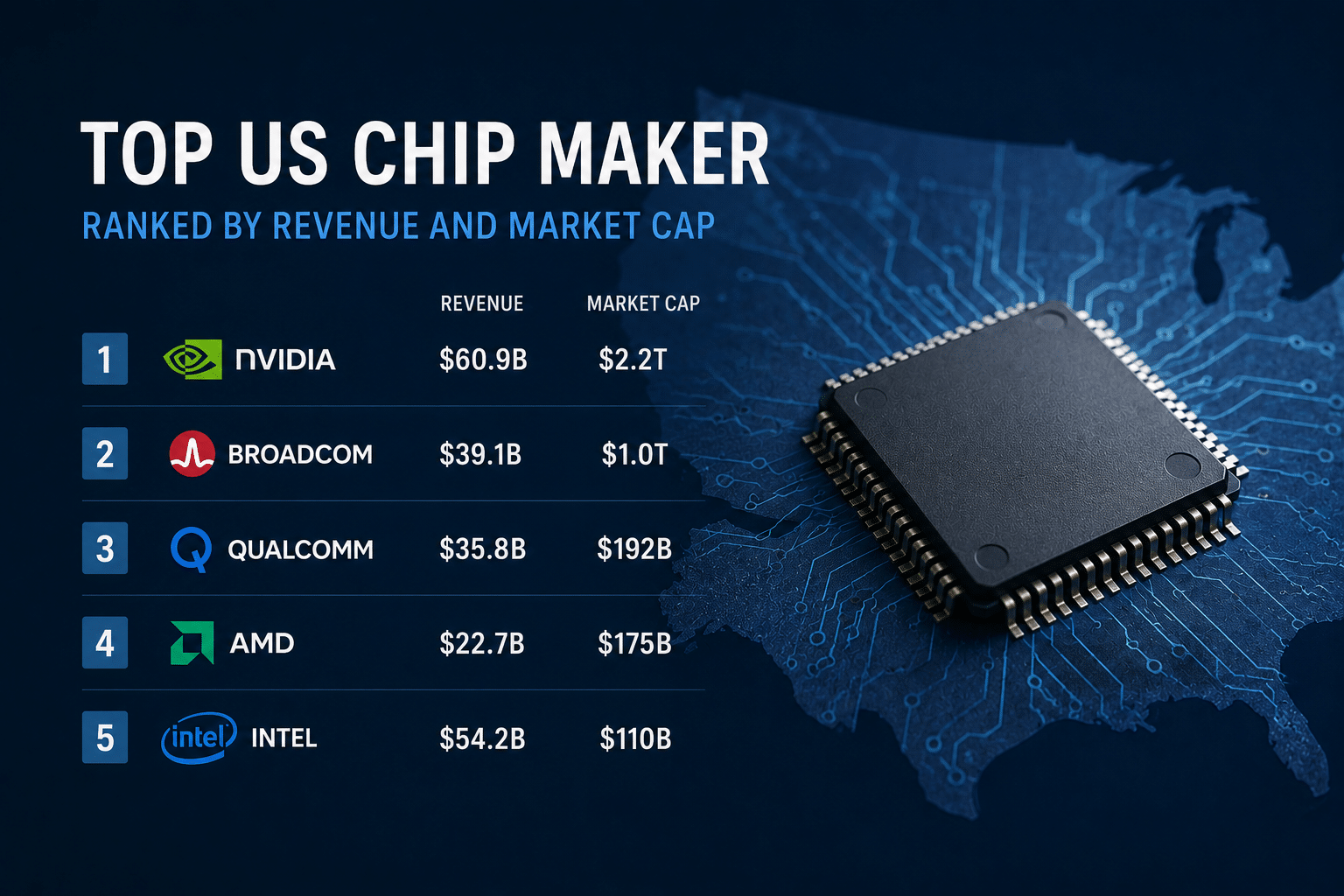
Which is the largest chip manufacturer in the United States? The answer is Nvidia, the largest US semiconductor company by both revenue and market capitalization. Nvidia reported revenue above approximately $130[1] billion in 2025, the highest of any US chip firm, and its market value sits well above rivals like Broadcom and Intel. However, Nvidia is “fabless”—it designs chips but outsources production to foundries. By actual US manufacturing capacity, Intel leads. The right answer depends on whether you count dollars earned or wafers produced.
, the short answer is Nvidia, which crossed into trillion-dollar territory on the back of AI accelerator demand.
But “largest” depends on how you measure it. Revenue, market cap, manufacturing output, and wafer capacity each tell a different story, and companies like Intel, Broadcom, and Qualcomm rank differently on each scale.
This guide ranks the top US chip makers across those metrics so you can see exactly who leads where.
Quick Takeaways
- Nvidia leads US chipmakers with over $130[2] billion revenue in 2025.
- Nvidia is fabless—it designs chips but outsources manufacturing to foundries.
- Intel leads US chip-making capacity as an integrated device manufacturer (IDM).
- “Largest” varies by metric: revenue, market cap, or wafer capacity.
- Broadcom and Qualcomm rank differently depending on the measurement used.
The Short Answer Depends on How You Measure Largest
Which is the largest chip manufacturer in the United States? Nvidia leads by revenue and market value. Intel leads by actual chip-making capacity inside the U.S. Both answers are correct. The right one depends on whether you count dollars earned or wafers produced.
Nvidia reported revenue above $130 billion in 2025, the biggest of any U.S. semiconductor firm. By market capitalization, it sits well above rivals like Broadcom and Intel. So if “largest” means money, the question is settled.
But here is the twist most rankings miss. Nvidia doesn’t build its own chips. It designs them and pays a foundry to manufacture them. A foundry is a factory that makes chips for other companies. This makes Nvidia “fabless”, no fabrication plant of its own.
Intel works differently. It both designs and manufactures its chips.
Intel calls itself the only leading-edge U.S. company that develops and builds its own technology.
That model is called an IDM (integrated device manufacturer). So by domestic wafer fabrication capacity, the silicon disks chips are cut from, Intel still wins.
One number can’t crown a single winner. That fabless-versus-IDM split, explained next, is why the ranking flips depending on your metric.
Fabless, IDM, and Foundry Defined and Why the Winner Changes by Metric
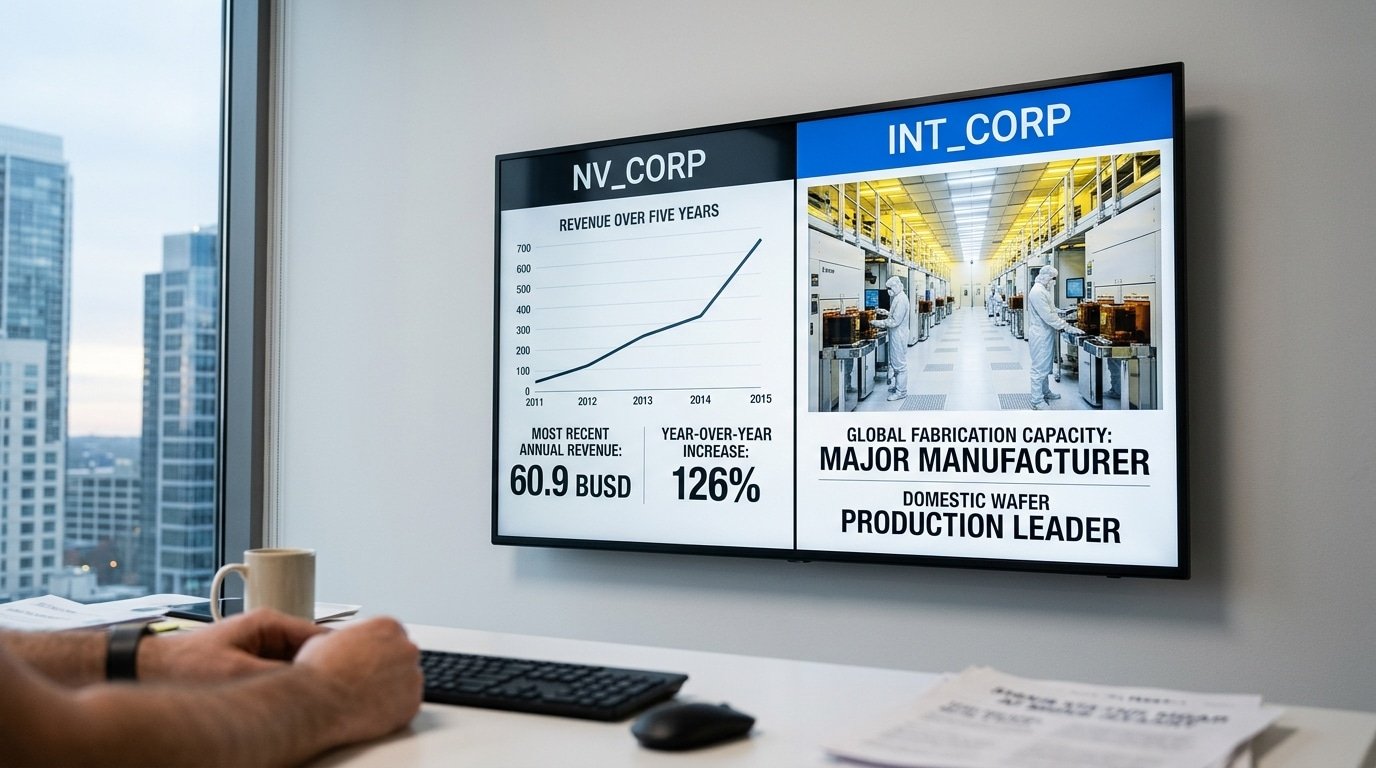
So here’s the thing. The chip industry actually splits into three business models, and the “largest” title flips around depending on which one you happen to measure. Fabless companies design chips but own no factories at all.
Then you have IDMs, which stands for integrated device manufacturers. These ones design and build chips in-house. Foundries, though, only do the manufacturing, building chips that other firms have already designed.
Nvidia sits at the top of the revenue charts while owning exactly zero U.S. factories, basically because it’s fabless.
Picture it like a restaurant for a second. A fabless firm writes the recipe. A foundry is essentially the kitchen that cooks it. And an IDM does both jobs under one roof.
| Model | Does design? | Owns fabs? | U.S. example |
|---|---|---|---|
| Fabless | Yes | No | Nvidia, Qualcomm |
| IDM | Yes | Yes | Intel, Micron |
| Foundry | No | Yes | GlobalFoundries |
Here is the gap that competitors tend to blur. Nvidia reported revenue north of $130 billion in 2025, and yet it builds nothing itself.
It actually pays TSMC over in Taiwan to make its GPUs for it. So when somebody asks “Which is the largest chip manufacturer in the United States?”, the answer really depends on what you mean.
By revenue, the finger points squarely at Nvidia. But by how much gets made in domestic factories, it points instead to an IDM.
Intel calls itself the only leading-edge U.S. company that both develops and makes its own chips. That single fact explains why the revenue rankings and the manufacturing rankings completely disagree with each other. Watch for it whenever some list claims there’s one “biggest” answer.
Nvidia Ranked Number One by Revenue and Market Capitalization
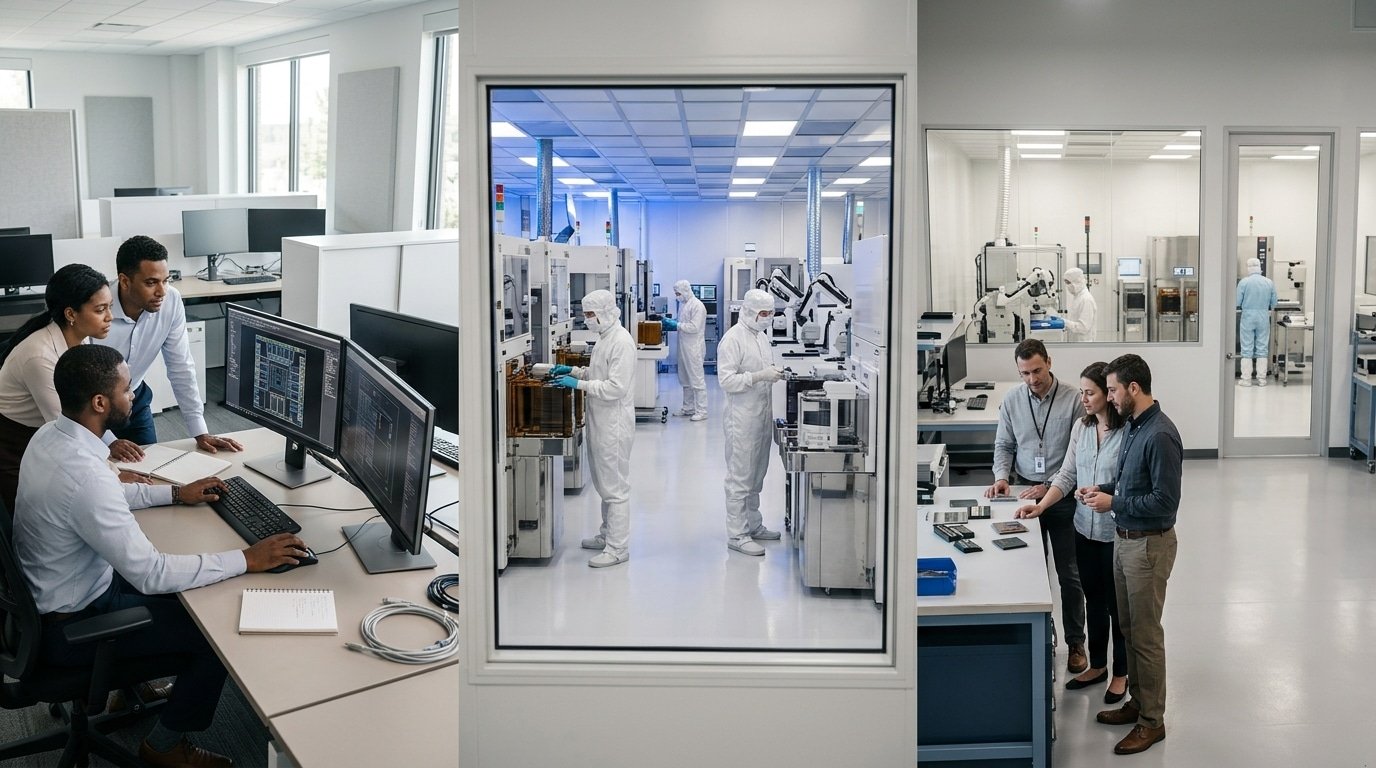
Nvidia is the largest chip maker in the United States by both revenue and market value. The company reported revenue north of $130 billion in 2025, and its market cap crossed into multi-trillion-dollar territory. No other U.S. semiconductor firm comes close on either number.
Where does that money come from? Mostly data centers.
Nvidia’s data-center segment, built around AI accelerator GPUs like the H100 and the newer Blackwell line, became the single biggest revenue driver. These chips train and run large AI models, and demand from cloud giants such as Microsoft, Amazon, and Google pushed sales far past gaming and graphics cards.
So how did a company founded in 1993 leapfrog older rivals? Timing. When the AI boom hit, Nvidia already owned the software layer (CUDA, its parallel computing platform) plus the hardware. That lock-in meant developers stayed even when competitors offered cheaper chips.
Here is the catch most rankings skip: Nvidia builds almost nothing itself. It’s a fabless company, meaning it designs chips but doesn’t own factories.
From its headquarters in Santa Clara, California, Nvidia sends its designs to TSMC in Taiwan for manufacturing.
So when people ask which is the largest chip manufacturer in the United States, the answer changes if you mean “designs the most valuable chips” versus “physically makes the most wafers on U.S.
soil.”
That distinction matters for the next ranking. By fab capacity, Nvidia ranks near zero.

Why Intel Is Still the Largest U.S. Chip Manufacturer by Fab Capacity
So let me ask you this. Which is the largest chip manufacturer in the United States?
If you frame the question strictly around how many chips actually get built inside American factories, the answer flips over to Intel. Nvidia owns zero of these plants.
Intel runs more U.S. wafer fabrication plants, which are the buildings where chips physically get made, than any other chipmaker, and that makes it the leader when you measure real, in-country manufacturing scale.
Here is the part that trips people up. A wafer fab is just the plant where raw silicon discs get turned into the finished chips you eventually use.
Intel describes itself as the only leading-edge U.S. semiconductor company that both develops and manufactures its own technology.
Nvidia, on the other hand, designs its chips and then pays TSMC over in Taiwan to actually build them. So when it comes to raw factory capacity, the amount they can physically produce, Intel wins outright.
Intel’s main U.S. manufacturing sites cluster across three states:
- Oregon — Hillsboro is where Intel develops its processes, basically the spot where brand-new transistor designs get proven out before they go into mass production.
- Arizona — Chandler hosts several of these factories, including the new Fab 52 built for advanced chip designs.
- New Mexico — Rio Rancho focuses on advanced packaging, which is the step where separate chips get stacked together into one single module.
Intel employs tens of thousands of people across these American campuses. That is a workforce Nvidia’s fabless model, meaning a company that designs chips but owns no factories, simply does not need.
Revenue and market value crown Nvidia, no question. But if your test is really “who actually makes the most chips on American soil,” then honestly that title belongs to Intel.
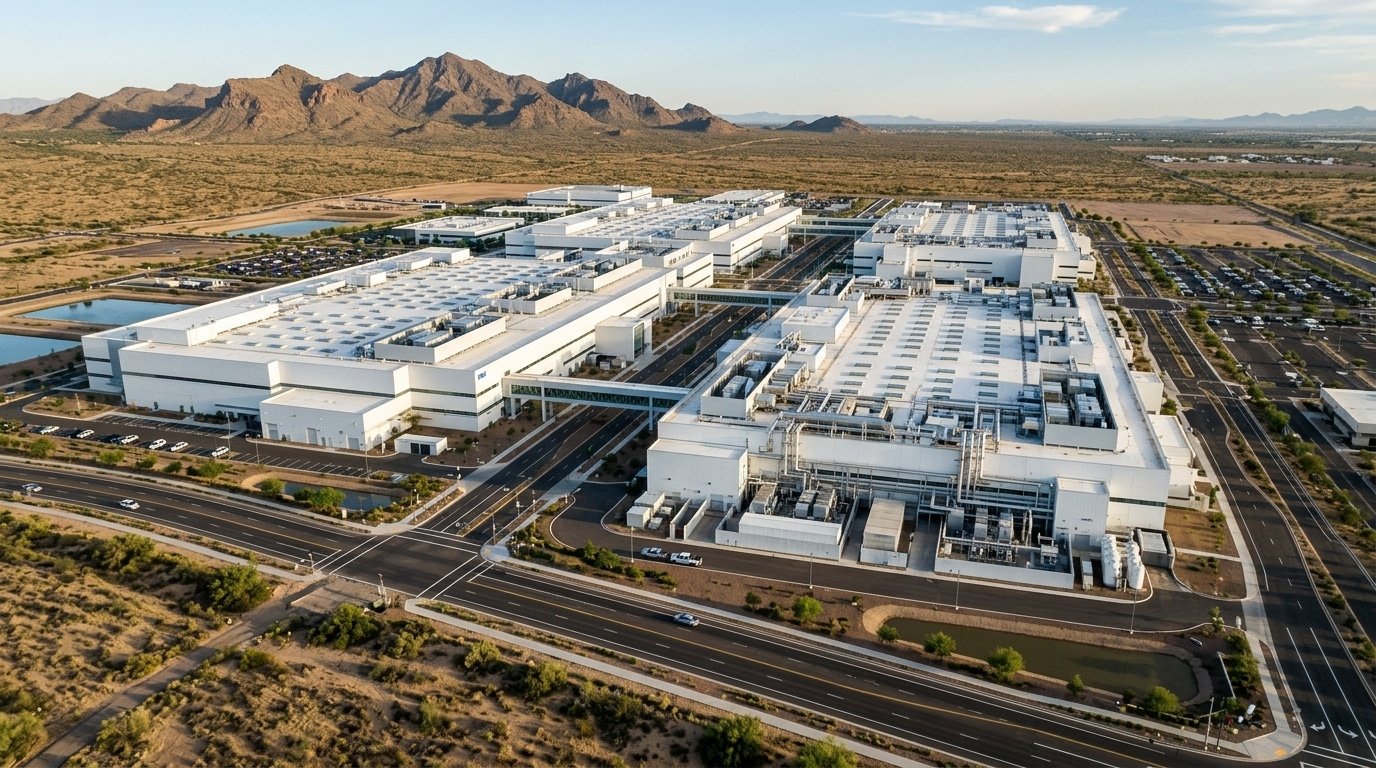
Domestic U.S. Wafer Fab Footprint Compared Side by Side
So you want to know who actually melts silicon down on American soil? Intel runs the most wafer fabs here in the U.S. of any company.
They have big sites in Arizona, Oregon, and New Mexico. Then there is Micron, which operates the only large memory factories in the whole country. And Texas Instruments runs these older fabs that make analog chips, and honestly they still make really good money.
GlobalFoundries makes the more mature, older-style chips up in New York and Vermont. TSMC Arizona is basically the newest player to show up.
Nvidia, on the other hand, actually owns zero factories of their own.
A “wafer fab” is really just the factory where blank silicon discs get carved up into working chips. The “node,” like 4nm or 28nm, is basically a measure of how tiny the transistors are.
Smaller numbers mean newer, faster, and more expensive technology. So here is how the actual U.S.
builders stack up against each other.
| Company | Main U.S. Fab Sites | Leading Node Made in U.S. | U.S. Employees (approx.) |
|---|---|---|---|
| Intel | Chandler AZ, Hillsboro OR, Rio Rancho NM | Intel 3 / 18A class | 50,000+ |
| Micron | Boise ID, Manassas VA | DRAM & NAND memory | ~25,000 |
| Texas Instruments | Richardson TX, Sherman TX, Lehi UT | Analog, 28nm-class | ~30,000 |
| GlobalFoundries | Malta NY, Essex Junction VT | 12nm-22nm mature nodes | ~6,000 |
| TSMC Arizona | Phoenix AZ (Fab 21) | 4nm (production since 2025) | ~3,000 ramping |
The difference here is pretty striking, really. Nvidia logged revenue above $130 billion in 2025 while owning no factories at all. They design the chips and then ship the orders off to TSMC to actually build.
So the answer to “Which is the largest chip manufacturer in the United States?” flips around completely depending on whether you are counting tons of silicon or just dollars of revenue.
Intel describes itself as the only leading-edge U.S. company that both designs and manufactures its own chips.
Here is a little tip though. When you are comparing these factories, look at the node and not the building itself.
TSMC Arizona’s single 4nm fab actually beats out GlobalFoundries’ entire setup when it comes to how tightly packed the transistors are, and that is even with far fewer workers on the floor.
Key US Semiconductor Players After Nvidia and Intel
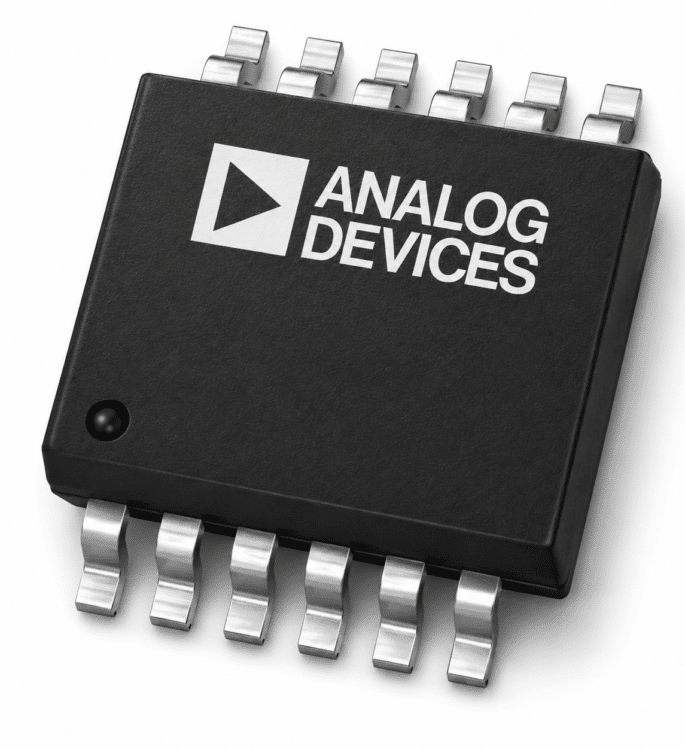
Behind Nvidia and Intel sit six companies that round out America’s chip top tier: Broadcom, Qualcomm, AMD, Texas Instruments, Micron, and Analog Devices. Broadcom ranks second by market cap among U.S.
semiconductor firms, trailing only Nvidia. The split that matters?
Four of these six own no factories. They design chips and pay foundries like TSMC to build them.
That design-only model is called fabless, the company draws the chip but never melts silicon itself. Broadcom, Qualcomm, AMD, and Analog Devices all run fabless or mostly-fabless.
So when someone asks which is the largest chip manufacturer in the United States, these four barely count as “manufacturers” at all. They’re designers.
Two of the six still own fabs. Texas Instruments builds most of its own analog and embedded chips, and Micron runs memory fabs for DRAM and NAND flash (the storage chips inside your phone and laptop).
| Company | HQ | Model | Main products |
|---|---|---|---|
| Broadcom | Palo Alto, CA | Fabless | Networking, custom AI chips |
| Qualcomm | San Diego, CA | Fabless | Mobile processors, modems |
| AMD | Santa Clara, CA | Fabless | CPUs, GPUs |
| Texas Instruments | Dallas, TX | IDM (owns fabs) | Analog, embedded |
| Micron | Boise, ID | IDM (owns fabs) | DRAM, NAND memory |
| Analog Devices | Wilmington, MA | Mostly fabless | Signal processing |
One trap when reading rankings: market cap and revenue tell different stories. 2026 industry coverage places Broadcom above Intel by market value, yet Intel still ships far more chips from its own American fabs. Reading both metrics together stops you from crowning the wrong company.
How CHIPS Act Funding Is Reshaping the Rankings
The CHIPS and Science Act is pouring federal money into new U.S. fabs, and that will reshuffle the fab-capacity rankings by 2028.
Intel, TSMC Arizona, Micron, Samsung Texas, and GlobalFoundries all won large awards. These grants fund new construction, so the question “Which is the largest chip manufacturer in the United States?”
gets a different answer depending on whose fabs finish first.
The U.S. Department of Commerce finalized up to $7.86[3] billion for Intel in late 2024, the largest single award.
Intel is using it for fabs in Arizona, Ohio, New Mexico, and Oregon. TSMC Arizona secured approximately $6.6[4] billion to build three fabs near Phoenix, with its first plant already producing 4-nanometer chips (the “nanometer” measures transistor size; smaller means faster, denser chips).
| Company | CHIPS award | Key new fab site |
|---|---|---|
| Intel | Up to $7.86B[5] | New Albany, Ohio |
| TSMC Arizona | approximately $6.6B | Phoenix, Arizona |
| Micron | approximately $6.1B[6] | Clay, New York |
| Samsung | approximately $4.7B[7] | Taylor, Texas |
| GlobalFoundries | approximately $1.5B[8] | Malta, New York |
Watch the timing. Fabs take three to five years from groundbreaking to volume output. Micron’s New York memory plant runs into the 2030s, while TSMC Arizona ramps faster. The capacity leader in 2026 may not hold the title once these plants go live.
Common Mistakes People Make When Ranking the Largest Chip Maker
Most wrong answers to “Which is the largest chip manufacturer in the United States?” come from mixing up four different things: stock price, design revenue, fab output, and corporate nationality.
Get the metric wrong and you crown the wrong company. Here are the errors that trip up even tech reporters, each fixed with the right framing.
Treating market cap as proof of manufacturing
Nvidia’s market value is enormous, but Nvidia is fabless. It designs chips and ships the blueprints to a foundry.
It melts zero silicon itself. So a high stock price tells you investors love the company, not that it runs a single fab.
When someone cites Visual Capitalist’s 2023 ranking of Nvidia at roughly $992[9] billion in market cap, that number measures Wall Street value, not wafers. For actual U.S.
manufacturing scale, Intel still leads by fab count and capacity.
Counting TSMC Arizona as a U.S. company
TSMC’s Arizona fabs sit on American soil, near Phoenix. That makes them U.S.
production sites. But TSMC is headquartered in Taiwan, so it doesn’t count as the largest U.S. chip maker.
Confusing “fabs located in America” with “American-owned companies” inflates foreign players into the domestic ranking. Same trap applies to Samsung’s Texas fab.
Forgetting memory makers like Micron
People list logic giants and skip memory. Micron, based in Boise, Idaho, is the only major U.S.-owned maker of DRAM and NAND flash. Any ranking that ignores memory misses a whole product category that powers every phone and data center.
Confusing design revenue with fab output
Nvidia booked over $130 billion in 2025 revenue, but that’s design and sales revenue,chips it conceived, not chips it physically made. Intel, by contrast, defines itself as the only leading-edge U.S.
company that both develops and manufactures its own technology. Revenue answers “biggest by sales.”
Fab output answers “biggest by manufacturing.” Different questions, different winners.
How We Ranked These Companies and Data Sources Used
We ranked these companies using three separate measures: annual revenue, market capitalization, and U.S. fab capacity.
Each metric pulls from a different primary source. Revenue comes from company annual reports and SEC filings.
Market cap reflects exchange data. Fab capacity draws from corporate disclosures and trade-group figures.
We never blended the three into one fake “overall” score.
For revenue, we used figures filed with the U.S. Securities and Exchange Commission (the agency that audits public company financials).
Nvidia’s revenue north of approximately $130[10] billion in 2025 comes from 2026 industry coverage citing those filings, per Z2Data. A 2026 CubeFabs guide listed a slightly different approximately $125.7 billion figure, which shows why fiscal-year cutoffs matter.
That gap isn’t an error. Nvidia runs a fiscal year ending in late January, so two sources can both be “right” while reporting different totals. We flag this kind of timing mismatch wherever it appears.
Our cutoffs and limits, stated plainly:
- Revenue: Most recent full fiscal year reported through early 2026.
- Market cap: A snapshot value, which swings daily with the stock price.
- Fab capacity: Self-reported, since no agency audits exact wafer-start numbers.
So when readers ask “Which is the largest chip manufacturer in the United States?”, our answer changes by metric on purpose. We treat each number as a claim with a date attached, not a fixed fact.
Private firms and foreign-owned U.S. fabs sit outside this scope unless they file public data.
Frequently Asked Questions
Which is the largest chip manufacturer in the United States? Nvidia. It tops both revenue and market value, reporting revenue north of $130 billion in 2025. Below are the questions people ask next.
Which country has the biggest chip manufacturers?
Two countries split the title by metric. The United States leads in chip design and high-value products, with Nvidia at the top.
Taiwan dominates actual production through TSMC, which makes most of the world’s leading-edge chips (the smallest, fastest transistors). South Korea (Samsung, SK Hynix) and the Netherlands (ASML, the only firm building EUV lithography machines) also hold critical positions.
What new chip plants are being built in the USA?
Several mega-fabs are under construction right now. TSMC is building three fabs in Phoenix, Arizona. Intel is expanding in Ohio and Arizona. Samsung is constructing a fab in Taylor, Texas. Micron plans memory fabs in New York and Idaho. These projects flow largely from CHIPS Act incentives covered earlier.
Where can I find a full list of top 50 and top 100 U.S. semiconductor companies?
For ranked lists beyond the top tier, check the Semiconductor Industry Association member directory, which tracks U.S. firms by category. Industry databases like IndustrySelect and z2data publish extended rankings. For market-cap sorting, screen the PHLX Semiconductor Index (SOX) constituents on any major brokerage.
Final Verdict on the Largest US Chip Maker
Which is the largest chip manufacturer in the United States? Nvidia, if you measure money. It tops both revenue and market value, with sales north of $130 billion in 2025. Intel wins a different crown: it owns the most leading-edge wafer fabs (chip factories) on American soil.
So pick your metric, then pick your answer. Here is a quick rule.
- You care about market size or stock value? Nvidia. No close second.
- You care about who physically makes chips in the U.S.? Intel, the only U.S. firm that designs and builds its own leading-edge silicon, per Intel’s own description.
- You care about supply chain resilience? Watch domestic fab capacity, not revenue charts.
The pro tip most rankings miss: revenue and fab capacity measure two different industries inside one. Nvidia outsources production to TSMC. It sells designs. Intel melts silicon. Confusing the two is how people get the wrong “largest” answer.
One thing to watch through 2026: CHIPS Act money is funding new fabs from Intel, TSMC Arizona, and Samsung Texas. As those plants reach volume production, the domestic-capacity ranking could shift. Revenue leadership, though, stays firmly with Nvidia for now.
Bookmark both answers. The right one depends entirely on the question you’re actually asking.
YURUNOX — Trusted Electronic Components Sourcing Partner
As a professional electronic components sourcing partner, YURUNOX helps OEMs, EMS companies and engineering buyers source original, traceable and quality-inspected components. Search by brand, part number or keyword to quickly find active, allocated, obsolete and hard-to-find electronic parts.
- ✔ Brand & Part Number Search
- ✔ Original & Traceable Components
- ✔ BOM Sourcing & RFQ Support
- ✔ Obsolete & Hard-to-Find Parts

References
- [1]z2data.com/insights/who-are-the-top-us-companies-in-the-semiconductor-industry
- [2]blackridgeresearch.com/blog/top-new-largest-semiconductor-companies-in-usa-un…
- [3]intel.com/content/www/us/en/corporate/usa-chipmaking/home.html
- [4]visualcapitalist.com/ranked-americas-largest-semiconductor-companies/
- [5]thomasnet.com/insights/biggest-us-semiconductor-manufacturers/
- [6]cubefabs.com/resources/2026-guide-to-american-chip-semiconductor-companies
- [7]intel.com
- [8]nvidia.com
- [9]sec.gov
- [10]z2data.com