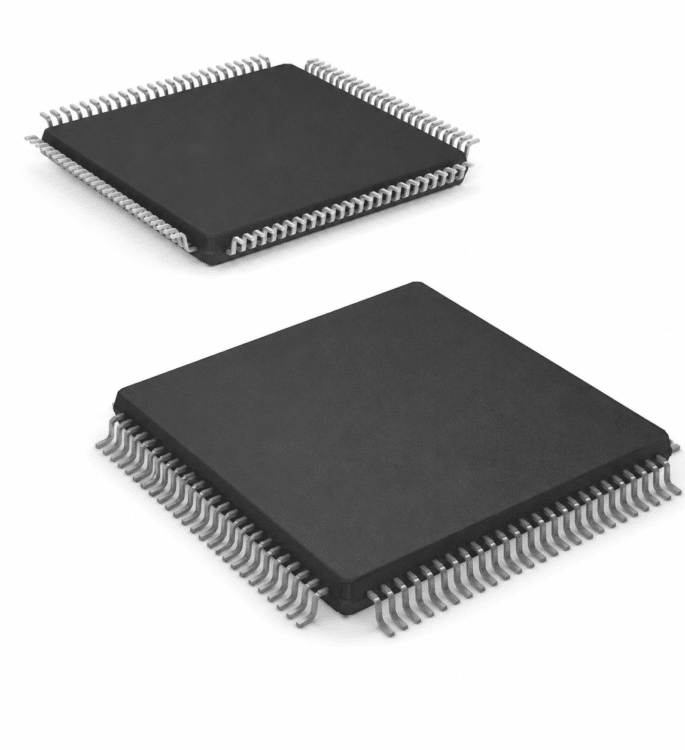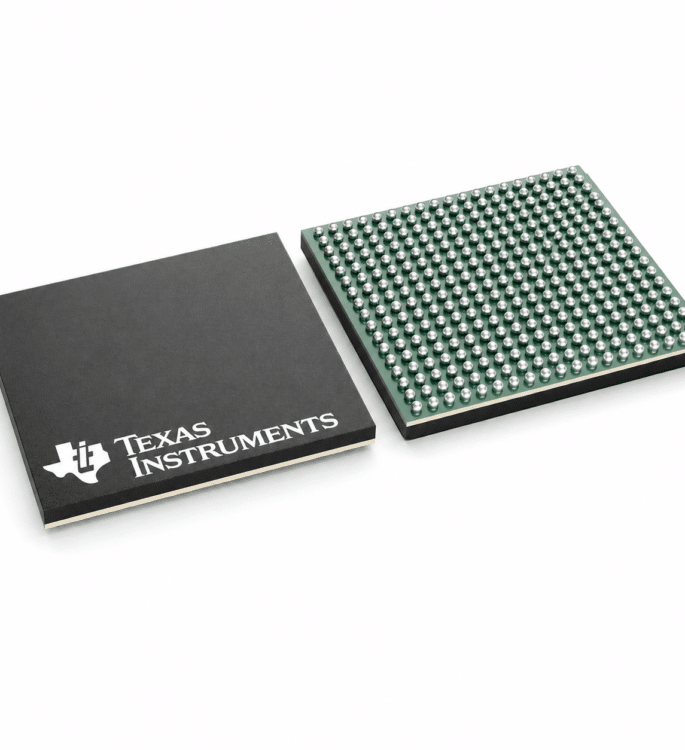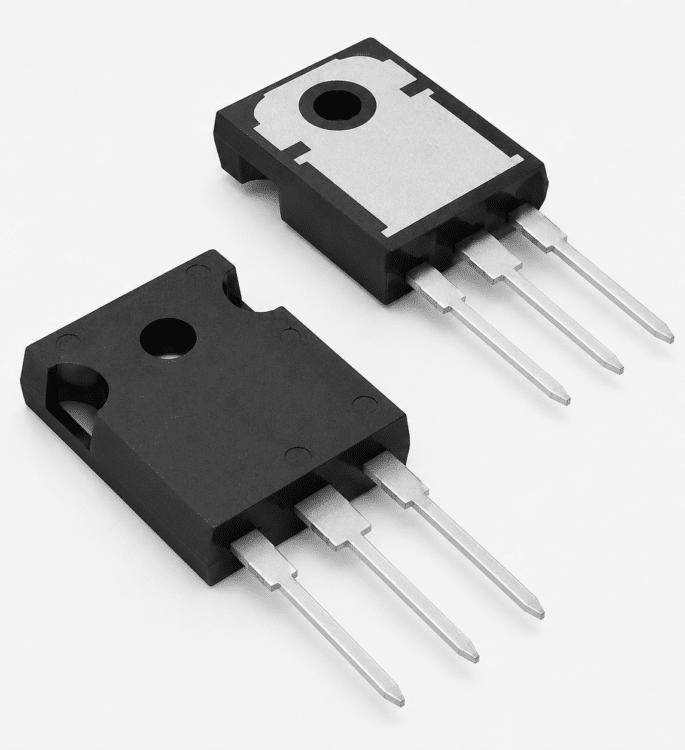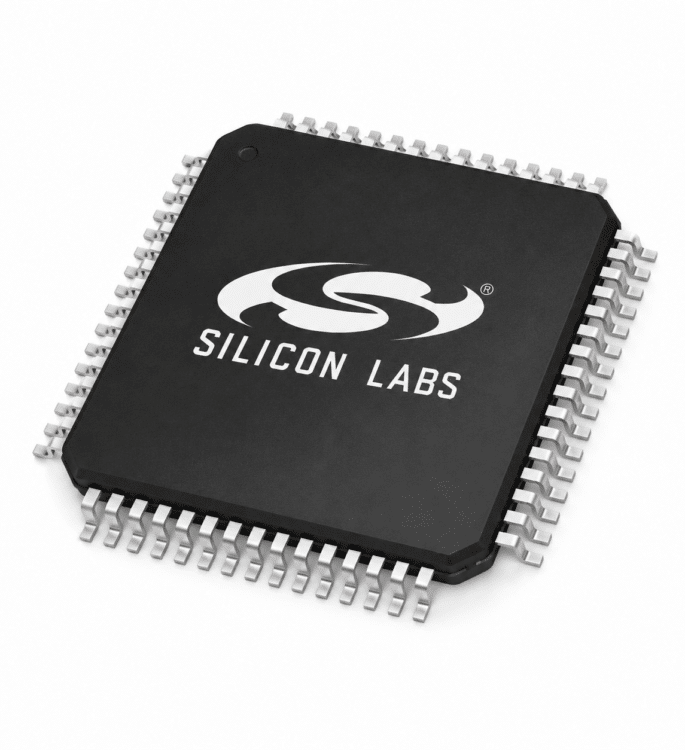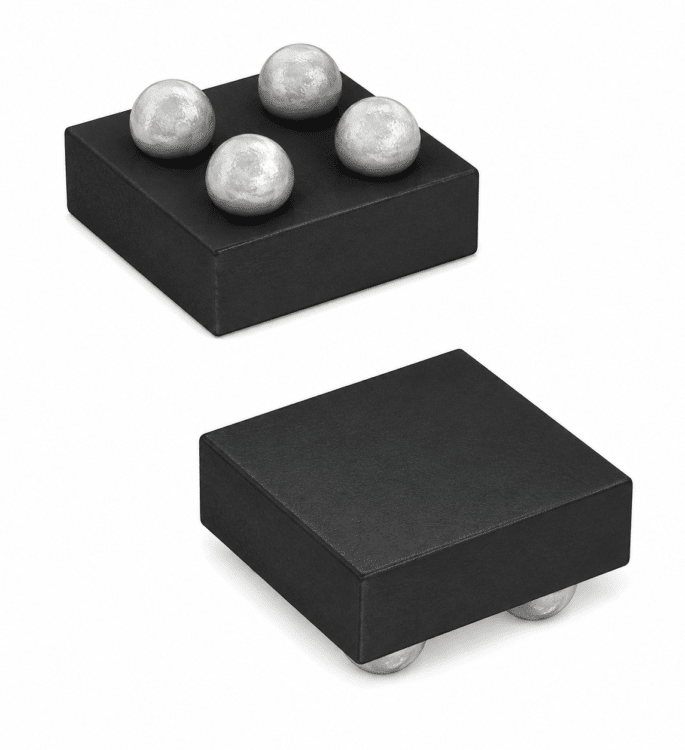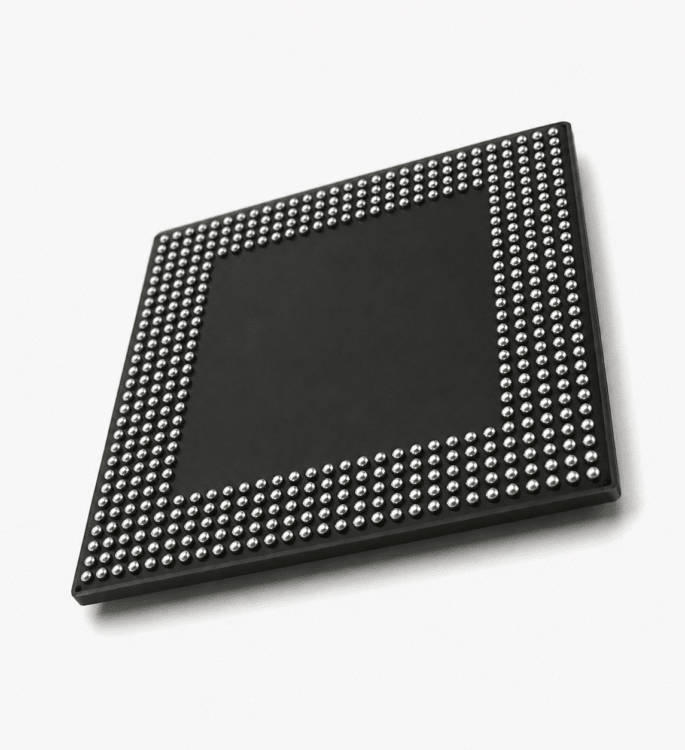


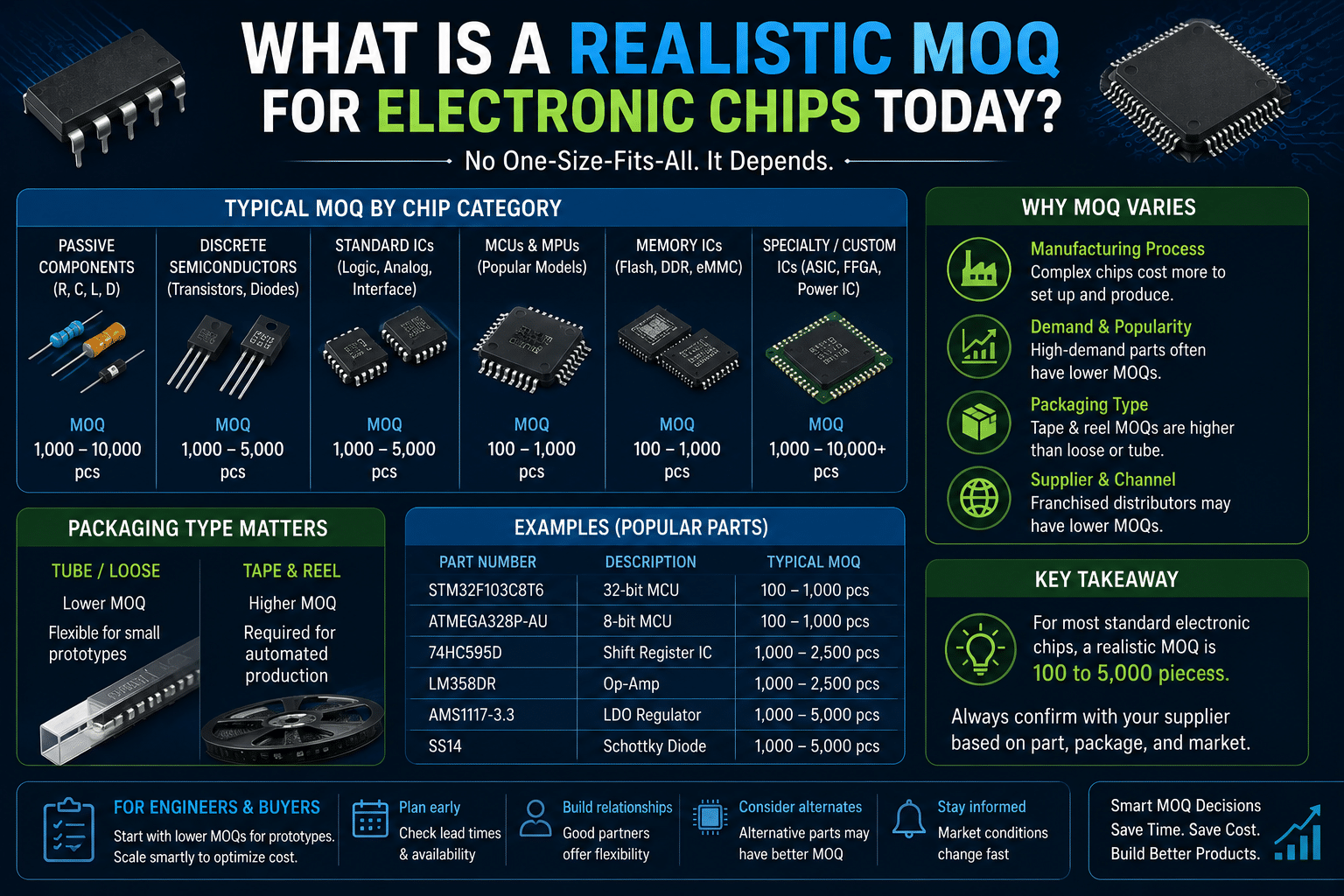
The minimum order quantity electronic chips suppliers expect in 2026 falls into clear tiers: standard off-the-shelf ICs run 100–500 units, custom-programmed ICs need 500–1,000 units, and specialized or obsolete parts can demand 1,000+ units (Alibaba Seller data, 2026). Distributors like DigiKey and Mouser, however, use cut-tape to sell as few as one piece, even when the part ships in standard tubes of 75. Your realistic number depends on the chip type, whether it’s programmed, and how much stock the distributor still holds.
So what counts as realistic for your project? It depends on the chip type, whether it’s programmed, and how much stock the distributor still holds.
A startup buying a common microcontroller faces very different numbers than a buyer chasing a discontinued part. The sections below break down each tier, the factors that push MOQs up or down, and the tactics that actually get you below a supplier’s stated minimum.
Quick Takeaways
- Distributors like DigiKey use cut-tape to sell single chips from full reels.
- Standard off-the-shelf ICs carry 100–500 unit MOQs manufacturer-direct in 2026.
- Custom-programmed ICs require 500–1,000 units; obsolete parts demand 1,000-plus.
- Expect full-reel minimums of 5,000 pieces from some distributors.
- Foundry wafer-lot orders for custom silicon start around 25,000 units.
What Counts As A Realistic Chip MOQ Today
There’s no single answer. The minimum order quantity for electronic chips runs across a tiered spectrum, from a single piece to tens of thousands. Where you land depends on who you buy from and how the part is packaged.
Buy one chip. It’s possible.
Distributors like DigiKey and Mouser use cut-tape, slicing parts from a full reel so you can order exactly one unit.
Digi-Key’s ordering guidelines note that some ICs ship in standard tubes of 75 pieces, yet the listed MOQ for that part can still be 1 piece when broken from packaging.
Step up to manufacturer-direct orders and the floor rises fast. Standard off-the-shelf ICs in 2026 typically carry MOQs of 100,500 units, while custom-programmed parts push toward 500,1,000.
Full-reel buys are common too, one sourcing guide describes distributors forcing a full reel of 5,000 pieces as the effective minimum.
At the top sit foundries. Wafer-lot minimums for custom silicon start around 25,000 equivalent units, because you pay to amortize mask sets and tooling. That gap, 1 piece versus 25,000, is why MOQ confuses first-time buyers.
| Source | Realistic MOQ |
|---|---|
| DigiKey / Mouser cut-tape | 1 piece |
| Standard off-the-shelf ICs | 100–500 units |
| Manufacturer reels | 1,000–5,000 pieces |
| Custom wafer lots | 25,000+ units |

What Minimum Order Quantity Actually Means For Electronic Chips
So when it comes to electronic chips, the minimum order quantity is basically the smallest batch a supplier will sell you at one time. But that number almost never comes from some simple warehouse rule, honestly.
It really comes from how the chips themselves get built, tested, and then packaged up. That’s exactly why a minimum order quantity electronic chips works nothing like a T-shirt minimum, where a clothing brand just picks a 200-unit floor so the picking and shipping stay profitable.
There are three cost drivers that shape these semiconductor minimums:
- Reel and tape packaging. The flat chips that mount onto boards ship on carrier reels. A distributor might make you buy a whole reel. One sourcing guide actually points out that a full reel of 5,000 parts can push the effective MOQ up to 5,000 pieces.
- Wafer economics. Chips get sliced out of round silicon wafers. The fixed cost of running one wafer gets spread across thousands of tiny chips, so a small order ends up carrying a pretty ugly price per piece.
- Test and handling. Every single part needs electrical testing on expensive machines. Programming a custom chip tacks on a setup fee for each batch, and that’s why those custom-programmed parts often need 500 to 1,000 units in 2026.
The packaging format on its own can override the whole thing, though. Digi-Key explains that a part normally sold in tubes of 75 pieces can still drop down to a 1-piece minimum once it’s broken out of the tube.
That proves the MOQ is essentially a supplier policy, not some fixed trait baked into the chip itself.
Once you know which driver is controlling your specific part, you know exactly where to push. The next section pulls apart MOQ from the reel and tape quantities that buyers mix it up with constantly.

MOQ vs MPQ vs Reel And Tape Quantities Decoded
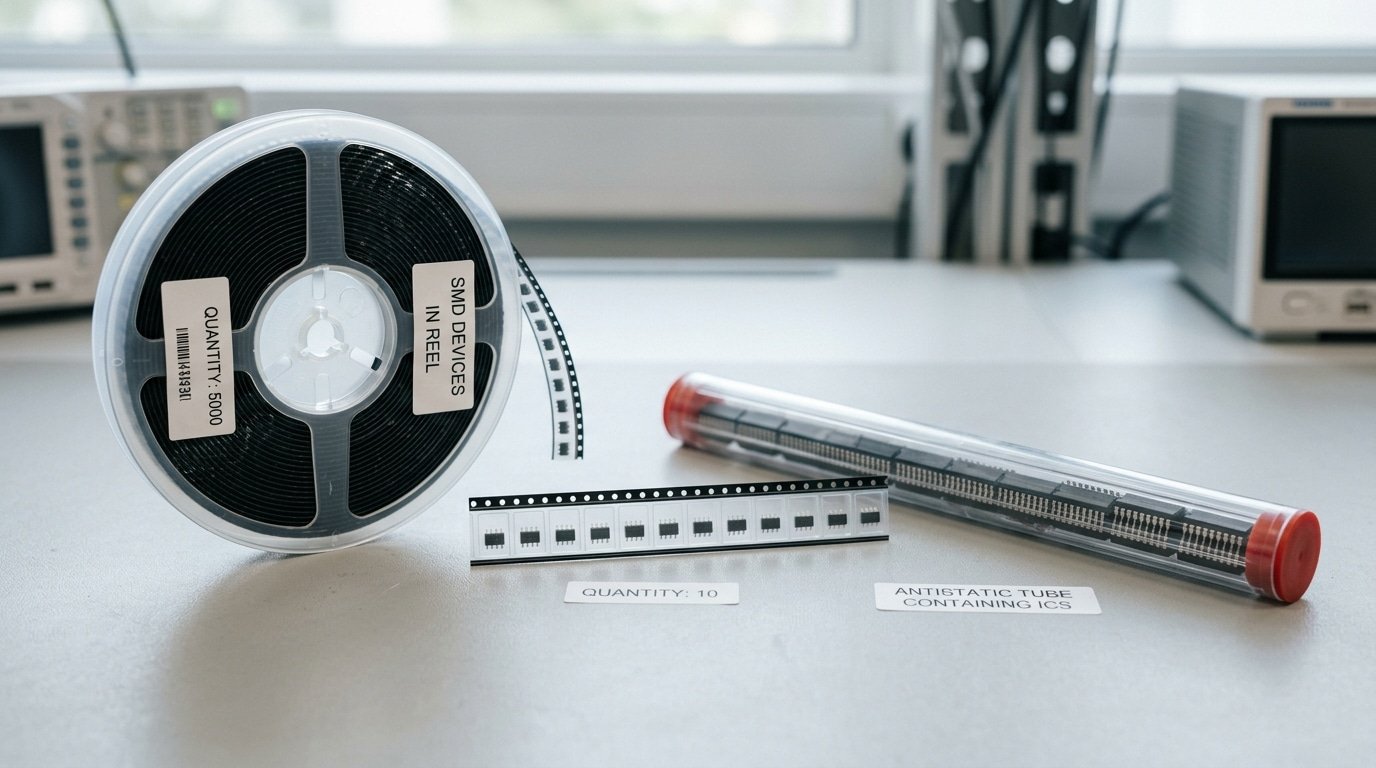
MOQ is the smallest number a supplier will sell. MPQ (minimum packaging quantity) is the unit they ship in.
These two numbers aren’t the same, and confusing them wastes money. A reel, a tube, or a cut-tape strip sets the MPQ, then forces you to round your order up to the nearest multiple.
Here is what “MOQ 30” really means. The supplier accepts orders of 30 pieces or more. But if that chip ships only in tubes of 25, you can’t buy exactly 30. You round up to 50, two full tubes. Your real spend jumps approximately 67% above the listed minimum.
Packaging type drives the gap:
| Format | Typical pack size | Best for |
|---|---|---|
| Full reel | 2,500–5,000 pcs | Automated SMT production |
| Cut tape | 1–100 pcs | Prototypes, hand assembly |
| Tube | 25–75 pcs | Through-hole, larger ICs |
| Tray (JEDEC) | 50–490 pcs | Fine-pitch BGA chips |
Distributors sometimes split packs. Digi-Key’s ordering rules show a part with standard tube packaging of 75 pieces can still ship at an MOQ of 1 when broken from the tube.
The catch goes the other way too: a 2026 sourcing guide notes distributors may force you to buy a full reel of 5,000, setting a hard MOQ no negotiation touches.
So always check both numbers before buying minimum order quantity electronic chips. Ask the supplier for the MPQ explicitly. A low MOQ means little if the pack multiple drags your order up anyway.
Typical MOQ Ranges Across Common Chip Categories
MOQ isn’t just one fixed number. It actually scales up depending on the package type and how complex the silicon inside is.
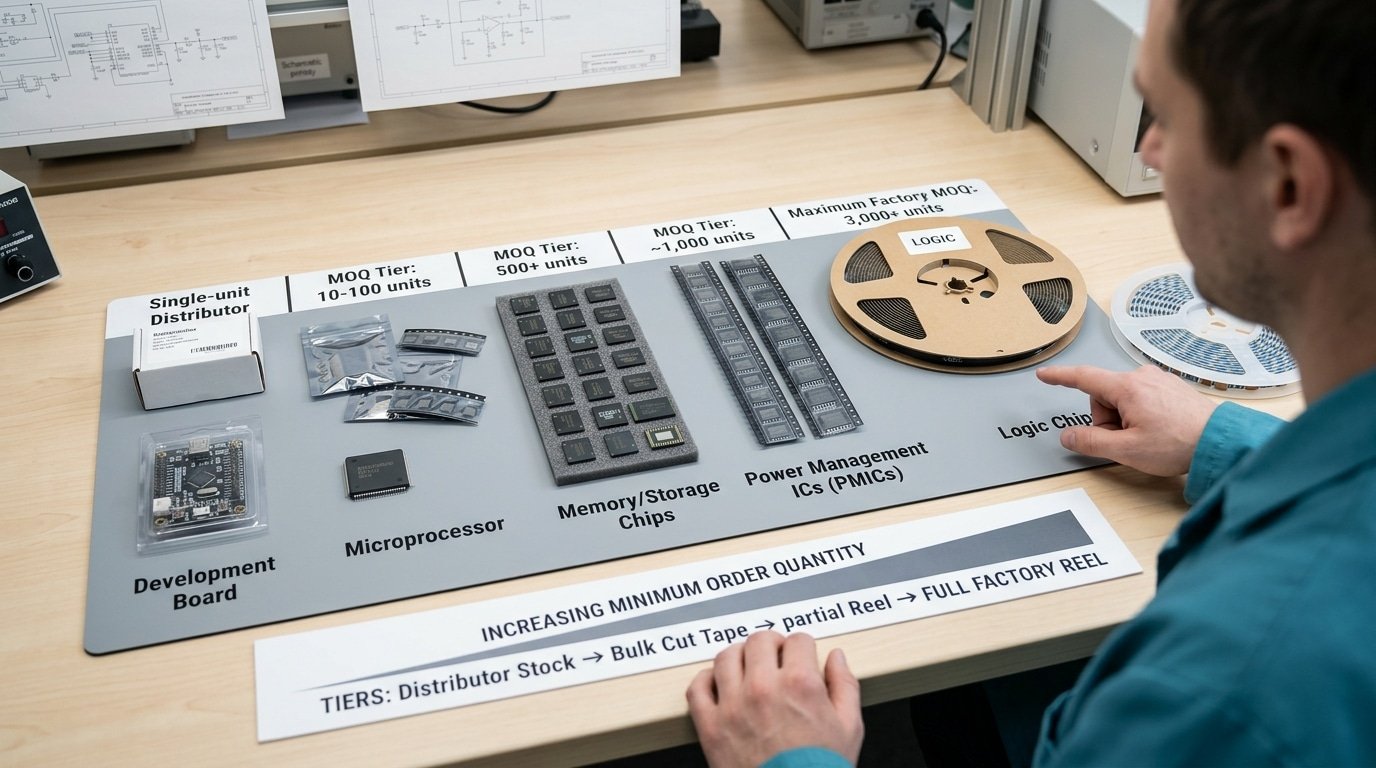
A passive component might ship as a single piece from a distributor, yet that same part could demand a 5,000-piece reel if you go straight to the factory.
A power IC or an RF transceiver pushes that floor much higher. So what do the real numbers look like? Here is how things break down across five common categories in 2026.
| Chip Category | Distributor Single-Unit | Factory Direct Reel Min | Typical Lead Time |
|---|---|---|---|
| Passives (resistors, caps) | 1 piece | 5,000 / reel | 1–2 weeks stock |
| Microcontrollers (e.g. ESP32) | 1 piece | 100–500 units | 4–8 weeks |
| Power ICs (regulators, gate drivers) | 1 piece | 1,000+ units | 8–16 weeks |
| Memory (NAND, DRAM) | 1 piece | 1,000–2,500 units | 12–26 weeks |
| RF chips (transceivers, PAs) | 1 piece | 1,000+ units | 12–20 weeks |
Distributors will break open full packaging just to sell you single units. Digi-Key confirms that an IC with standard 75-piece tube packaging can still ship as 1 piece when it gets cut down. That kind of flexibility basically disappears once you deal directly with the factory.
The minimum order quantity for electronic chips really does climb as the part gets more complicated. Standard off-the-shelf ICs sit around 100 to 500 units in 2026. Custom-programmed parts, though, jump up to somewhere between 500 and 1,000.
Here’s a practical tip I’ve found useful. Smaller packages like SSOP and QFN often carry lower factory minimums than the large BGA parts do. That’s essentially because the reel and tape feeders handle the smaller ones at a cheaper cost.
Why Custom ASIC And Foundry Minimums Dwarf Off-The-Shelf MOQs
Buying a catalog chip and ordering custom silicon are two different worlds. A standard ESP32 reel might cost approximately $200 with a minimum order quantity for electronic chips of just 100 to 500 units in 2026.
A custom ASIC (an application-specific integrated circuit, meaning a chip designed for one job) starts with six-figure commitments before a single working part ships.
The gap comes from fixed upfront costs that catalog parts already paid off years ago. Three line items dominate any custom quote:
- NRE (non-recurring engineering) — design, verification, and layout labor billed once. For a mature node, this alone runs from tens of thousands into the millions.
- Mask set — the photographic stencils that print your circuit onto silicon. A leading-edge mask set can exceed approximately $1 million; older nodes are far cheaper but still tens of thousands.
- Wafer-lot minimum — foundries rarely run fewer than 25 to 75 wafers per lot. One approximately 300mm wafer can yield thousands of small dies, so your “minimum” might be 50,000 chips you never asked for.
This is why a custom semiconductor production setup implies an effective floor near 1,000 sellable pieces in current guidance, and often far higher once wafer yields land.
Tape-out is your point of no return. Once the design ships to the foundry, NRE and mask spending is locked. Verify twice.
Need to bridge the gap? Multi-project wafer (MPW) shuttles let several customers share one mask set, slashing prototype cost. That option connects directly to prototype and low-volume build economics covered next.
How Chip MOQ Affects Prototype And Low Volume Build Costs
When you need 50 chips but the minimum order quantity for electronic chips is 3,000, your real per-unit cost can balloon 5x to 20x. The penalty isn’t the chip price, it’s the dead stock sitting on your shelf and the cash trapped inside it.
Picture a part that costs approximately $2.00 each on a full reel of 3,000. That’s approximately $6,000. Your prototype build needs 50 units. Spread the approximately $6,000 across the 50 chips you actually use, and your effective cost jumps to approximately $120 per chip. The other 2,950 sit idle.
Cut-tape solves part of this. Distributors like Digi-Key break standard packaging down to a single piece, even when the IC ships in 75-piece tubes.
That same approximately $2.00 chip might cost approximately $3.40 each as cut-tape. You pay a approximately 70% markup per unit, but you spend approximately $170 instead of approximately $6,000.
The math favors cut-tape until your volume crosses the break-even line.
| Sourcing path | Units bought | Total spend | Cost per used chip (50 needed) |
|---|---|---|---|
| Full reel (3,000 @ approximately $2.00) | 3,000 | approximately $6,000 | approximately $120.00 |
| Cut-tape (50 @ approximately $3.40) | 50 | approximately $170 | approximately $3.40 |
Now factor in carrying cost. Holding 2,950 dead chips at a typical approximately 20% annual carrying rate burns roughly $1,180 per year in storage, insurance, and obsolescence risk, before a single board ships.
Hidden trap: shelved prototype runs rarely reach mass production, and that reel becomes scrap. For low-volume work, always price cut-tape against the full reel before committing, since high minimum order quantity electronic chips can quietly double your prototype budget.
Strategies To Reduce Or Bypass High Chip MOQs
You can dodge most high MOQs through five proven routes: authorized cut-tape, franchised brokers, group buys, consignment, and assembly houses that pool parts. Pick the wrong one and you risk counterfeit chips. The safest two break full packaging without touching the gray market.
Cut-tape and reel-breaking. Authorized distributors like Digi-Key and Mouser snip parts off a full reel. Even when an IC ships in a 75-piece tube, Digi-Key’s own ordering rules let you buy a single unit when broken from standard packaging.
This is the cleanest way to beat a 5,000-piece reel minimum and carries near-zero counterfeit risk because the part never leaves the authorized chain.
Group buys and assembly-house pooling. A PCB assembly (PCBA) house, the factory that solders your board, often buys components for dozens of clients at once. Joining their pooled purchase lets your 50-chip need ride on a 10,000-unit order.
Counterfeit risk stays low if the house sources only from franchised channels. Always ask for the supplier name.
| Route | Best for | Counterfeit risk |
|---|---|---|
| Authorized cut-tape | Prototypes, 1–100 units | Very low |
| Assembly-house pooling | Small production runs | Low if franchised |
| Independent brokers | Obsolete or allocated parts | High without testing |
Brokers are the trap. They unlock obsolete chips fast, but a 2026 minimum order quantity for electronic chips on gray-market listings can hide remarked parts. Demand a date code, X-ray inspection, and an AS6081 anti-counterfeit certificate before paying.
Common Mistakes Buyers Make When Negotiating Chip MOQs
The biggest sourcing errors come from misreading what the minimum order quantity for electronic chips really requires. Buyers waste money by ordering full reels for one prototype, ignoring packaging multiples, trusting gray-market brokers, and forgetting to even ask about MOQ before the quote arrives.
Ordering a full reel for a one-off build. You need 50 chips. The distributor quotes a full reel of 5,000.
Some buyers just pay it. A low-volume sourcing guide notes that a full reel of 5,000 pieces sets a real MOQ of 5,000, even though authorized cut-tape would sell you exactly 50.
Ignoring MPQ multiples. Suppliers ship in fixed packaging units. Order 600 chips when the MPQ is 500, and many suppliers round you up to 1,000. Always order in clean multiples of the packaging quantity.
Chasing gray-market brokers to dodge MOQ. A broker offers 50 units of a part with a 500-unit factory minimum. That price gap often hides counterfeit, remarked, or recycled silicon. The savings rarely justify a failed production run.
Never asking about MOQ in the RFQ. Skip this and you discover the minimum only after committing. Add this line to every quote request:
“Please confirm the MOQ, MPQ, available packaging options (cut-tape, tube, reel), and unit price at our target quantity of [X] pieces.”
That one sentence prevents most mid-project budget surprises.
Frequently Asked Questions About Electronic Chip MOQ
Short, direct answers to the questions buyers ask most before placing a chip order.
What’s a minimum order quantity?
A minimum order quantity is the smallest amount a supplier will sell in one transaction. For the minimum order quantity for electronic chips, that number depends on the part. Standard off-the-shelf ICs sit around 100,500 units in 2026, while custom-programmed chips climb to 500,1,000 units.
What does MOQ 30 mean?
MOQ 30 means you must buy at least 30 pieces of that part per order. Order 29 and the supplier rejects the line.
Order 45 and most distributors round you up to the next packaging step, not 45 exactly. Always pair the MOQ with the MPQ to know your real buy quantity.
What’s the basic MOQ formula?
The common formula divides fixed order costs by the per-unit margin you accept:
- MOQ ≈ Fixed setup cost ÷ (unit price − unit cost)
- A supplier with approximately $2,000 setup and a approximately $2 margin per chip needs 1,000 units to break even.
That math is why custom chip lines often land near 1,000 pieces, they amortize tooling.
Where can I source below standard minimums?
Authorized cut-tape on Digi-Key or Mouser sells from 1 piece, even when the standard tube holds 75. Some Alibaba listings advertise an SSOP-24 driver IC with an MOQ starting at 1. For five or ten parts, skip distributors and try broker cut-reels first.
Choosing The Right Sourcing Path For Your Order Volume
Match your channel to your unit count. Need under 100 chips?
Buy cut-tape from an authorized distributor. Mid-volume runs of a few hundred to a few thousand units?
Order full distributor reels. Heading into production?
Go factory-direct. Designing custom silicon?
Engage a foundry only after you clear the ASIC break-even point.
The right path hinges on one number: your real order volume. Picking wrong burns cash on either inflated piece prices or dead inventory you never use.
| Order Volume | Best Channel | Why |
|---|---|---|
| 1–100 units | Cut-tape from Digi-Key or Mouser | Digi-Key’s guidelines allow buying down to 1 piece broken from a 75-piece tube |
| 100–5,000 units | Distributor full reels | Standard off-the-shelf ICs sit at a 100–500 unit MOQ in 2026; reel pricing drops per-unit cost |
| 5,000+ units | Factory-direct or franchised broker | Volume justifies skipping distributor markup of 15–approximately 40% |
| Above ASIC break-even | Foundry engagement | Only worth it once NRE spreads across enough units to beat catalog parts |
Standard ICs like an ESP32 typically carry a 100,500 unit MOQ in 2026, so reels make sense fast. Custom-programmed parts push that to 500,1,000 units. Skip the foundry until your annual demand clears six figures.
Start where you’re. Prototyping a board this month? Place a cut-tape order today and lock your bill of materials. Scaling past 1,000 units? Request reel pricing from two distributors and one franchised broker, then compare landed cost per unit before you commit.
Your sourcing path is a moving target. Re-check it every time your volume jumps a tier.