

Broadcom Ethernet architecture guide
Broadcom Ethernet PHY vs Switch
A PHY makes one or more physical Ethernet links work. A switch moves frames among ports. Broadcom offers both standalone PHYs and switches with integrated PHYs, so the correct choice starts with the missing function, not the package count.
Short answer: if your processor or MAC already handles frames and only needs a copper or optical link, start with a PHY. If traffic must be learned, filtered, queued, or forwarded among several ports without passing every frame through the host CPU, start with a switch.

01 / Decide by job
PHY and switch are different layers of the same packet path
They are not two speeds of the same component. A PHY solves signal transmission and link establishment. A switch solves multi-port forwarding and traffic policy. One switch can contain several PHYs.
| Question | Ethernet PHY | Ethernet switch |
|---|---|---|
| Primary job | Translate between the MAC-side digital interface and the physical medium; establish, train, and monitor the link. | Receive frames on port MACs, look up destinations, apply rules, queue traffic, and select one or more egress ports. |
| Typical data interfaces | RGMII, SGMII, QSGMII, USXGMII, XFI, or another supported MAC interface; MDI toward magnetics, optics, or the specified medium. | Integrated or external PHYs on network ports; RGMII, SGMII, PCIe, high-speed SerDes, or a dedicated CPU/cascade interface depending on the family. |
| Management | Often MDIO/MDC for configuration, link state, diagnostics, and counters. | Registers plus an SDK, driver, switchdev/NOS integration, or embedded CPU software; the management path is separate from normal frame throughput. |
| Typical state | Negotiated speed and duplex, link partner ability, cable diagnostics, equalization, energy-saving and timing modes. | MAC/FDB entries, VLANs, ACLs, multicast state, queue schedules, buffer occupancy, mirrors, counters, and sometimes routes. |
| What it does not imply | No multi-port forwarding fabric, host DMA, packet memory, magnetics, connector, or network stack unless explicitly integrated. | No PHY on every port, no complete board-level media path, and no ready-to-use management application unless explicitly supplied. |
On a narrow screen, scroll the table horizontally.
The quickest useful question: does a received frame need to go only to the attached host, or can hardware forward it to another external port? The first is an endpoint path and usually needs a MAC plus PHY. The second needs a switch function.
02 / Trace the packet
Draw data traffic and management traffic as separate paths
MDIO can configure a PHY, but it does not carry normal Ethernet payload. Likewise, a switch management CPU may program forwarding tables while the switch fabric moves frames independently.
Make the medium usable
Line drivers, receivers, clock recovery, equalization, echo and crosstalk cancellation, coding, auto-negotiation, link training, power modes, and cable diagnostics depend on the Ethernet type and PHY.
Choose the egress path
The switch learns source MAC addresses, looks up destinations, applies VLAN and security policy, handles unknown or multicast traffic, and schedules packets into egress queues.
Finish the full port
Neither label alone guarantees magnetics, a connector, protection, reference clocks, firmware, drivers, thermals, or regulatory compliance. These remain system decisions.
03 / Use real devices
Five Broadcom examples show where integration changes
These official examples are architecture references, not interchangeable substitutes or availability promises. Confirm the complete ordering code, current revision, lifecycle, software entitlement, and supply conditions before design approval.
| Product | Documented role | Interfaces or capacity | What the example teaches |
|---|---|---|---|
| BCM54210 | Single-port 10/100/1000 copper PHY direction | RGMII or SGMII MAC-side interface in Broadcom's selector guide | Use when an existing MAC needs one physical copper link; it does not create a multi-port bridge. |
| BCM84888E | Quad-port multi-gigabit copper PHY | 10G/5G/2.5G/1G/100M; USXGMII, XFI, 5000BASE-X, 2500BASE-X, or SGMII-related host options | Four physical links are not a 40 Gb/s switch fabric. The host or switch ASIC still supplies the MAC/forwarding architecture. |
| BCM53134 | Six-port smart-managed multilayer switch | Four integrated Gigabit copper PHYs, RGMII plus RGMII/SGMII, 128 KB packet buffer, 4K MAC table, on-chip 8051 MCU | A switch can integrate PHYs and reduce IC count, yet digital uplink/CPU interfaces and software still define the system boundary. |
| BCM53650 | Enterprise access-switch SoC | 24 × 1GbE access direction, 4 × 10GbE uplinks, quad-core Arm CPU, Secure Boot engine, and embedded copper GPHY integration | The switch decision can include a control CPU and security architecture, not only forwarding bandwidth. |
| BCM56980 family | 12.8 Tb/s multilayer switch family | High-speed switch fabric and SerDes-facing port architecture | At data-center speeds, the external media chain may include additional PHYs, retimers, gearboxes, optics, or direct-attach cable choices. |
Product pages and briefs differ in scope and age. Use the current part-specific data sheet, hardware design guide, errata, software release, and orderable-part evidence.
A standalone PHY can be visually small but system-critical
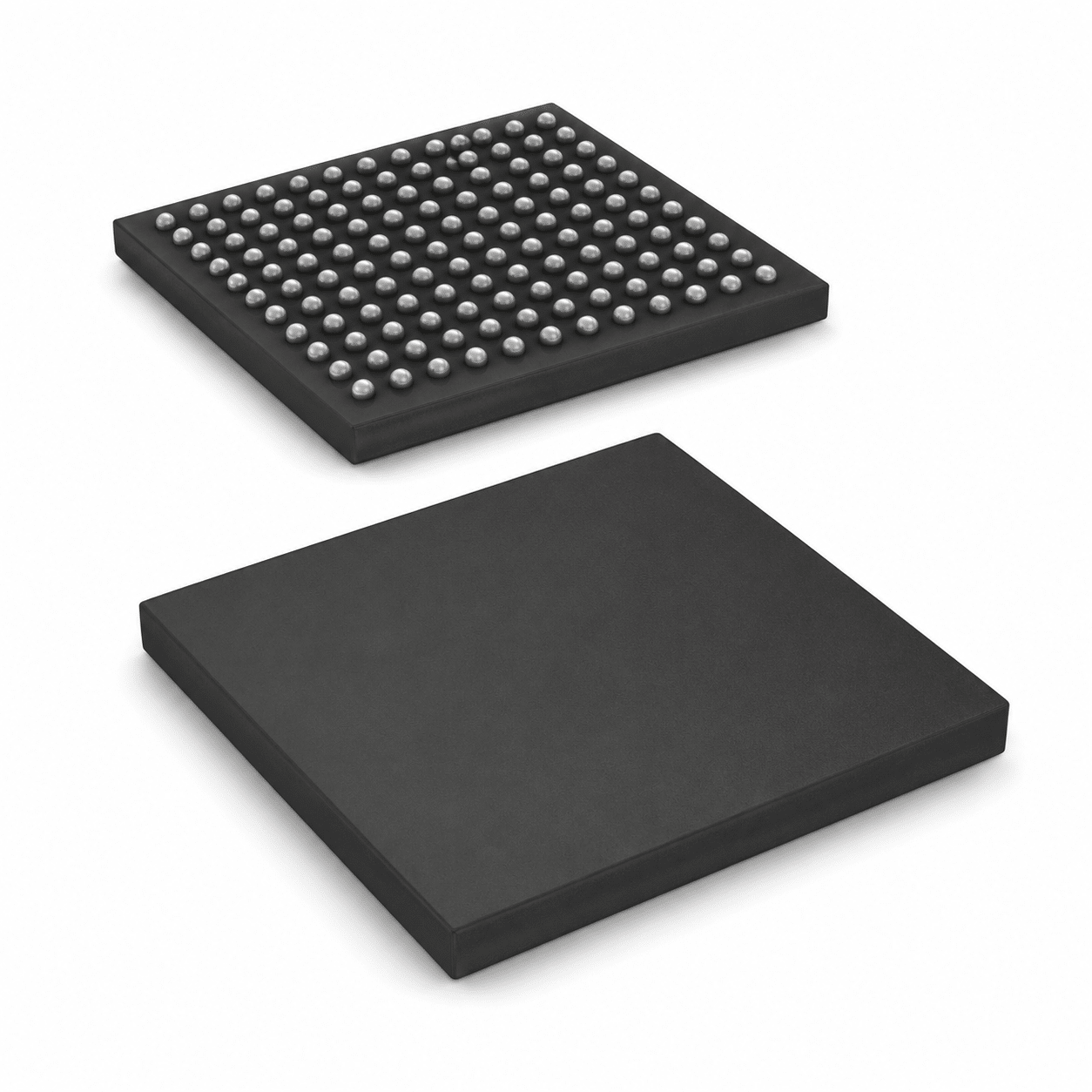
The YURUNOX Broadcom catalog includes the BCM54616C0KFBG as a Gigabit Ethernet PHY example. Its role is the physical transceiver path, not frame forwarding. In a real design, check the exact suffix, package, temperature grade, MAC interface timing, reference clock, magnetics, layout guidance, reset sequence, straps, and software driver.
Package appearance does not prove that two similar markings have the same pinout, firmware requirement, or lifecycle. Review the full top mark and trace data before accepting material.

A switch IC turns ports into a traffic system
The board photograph makes the integration question tangible: the switch silicon sits among power circuitry, clocks, magnetics, connectors, and management components. Even when multiple GPHYs are integrated, a stable product still depends on port mapping, strap states, EEPROM or flash contents, CPU connectivity, thermal design, and software configuration.
That is why replacing a switch is usually a larger engineering change than replacing a simple PHY. VLAN behavior, buffer policy, table size, SDK access, boot flow, and field-update strategy can all move with the silicon.
04 / Architecture cases
Use specific packet paths instead of generic rules
The following are transparent engineering scenarios built from documented functions. They are not claimed YURUNOX customer results or interoperability tests.
Industrial controller: one host MAC, one 1000BASE-T port
An MCU or application processor already provides an Ethernet MAC and DMA engine. The product needs one RJ45 port, and all received frames belong to the host. No external port must forward to another external port while the CPU sleeps.
The missing function is the physical link. A single-port PHY direction such as the BCM54210 class is the architectural starting point. The real selection work is RGMII or SGMII compatibility, I/O voltage, clock direction, delay ownership, reset and strap behavior, magnetics, cable reach, temperature, EMC, and driver support. Adding a switch would introduce forwarding state and software without solving a stated multi-port need.
Gateway: four 1GbE access ports and one 2.5GbE host or uplink path
Frames must move between access ports and toward an uplink according to VLAN and QoS rules. If the host received and retransmitted every local frame, CPU load and latency would depend on software scheduling. A hardware switch with integrated GPHYs, such as the BCM53134 architecture, can learn and forward traffic locally.
The catch is aggregate traffic. Four access ports can offer 4 Gb/s toward a 2.5 Gb/s egress, producing a 1.6:1 nominal oversubscription ratio and 1.5 Gb/s excess arrival rate during a synchronized burst. The documented 128 KB total packet buffer is not automatically available to one queue. Use the calculator below only to understand the scale, then obtain buffer allocation and traffic-management details for the actual configuration.
High-density system: multi-terabit forwarding with optical or direct-attach ports
A BCM56980-class switch provides high-capacity forwarding and high-speed SerDes connectivity, but the front-panel medium still determines the rest of the link. The design may need pluggable optics, direct-attach cable, retimers, gearboxes, or external PHY functions based on reach, lane rate, FEC, connector, and signal-integrity requirements.
Here, asking only "PHY or switch?" is too narrow. The switch is mandatory for forwarding, while additional physical-layer devices remain possible per port. Build a lane map from the switch SerDes to every connector, including speed conversion, breakout mode, reference clocks, FEC ownership, firmware, thermal load, and supported module or cable list.
Managed access product: 24 Gigabit ports, secure boot, and local applications
A BCM53650-class SoC can combine access switching, embedded GPHYs, a multi-core CPU, secure boot, and high-speed uplinks. This can lower device count and shorten board-level interconnects. It also couples forwarding silicon, CPU software, boot chain, thermal design, and vendor SDK lifecycle.
The practical comparison is not "one chip is simpler." Compare total board area, rail count, boot time, software ownership, SDK and documentation access, field recovery, security update responsibility, CPU headroom, packet buffer behavior, and second-source strategy. Integration moves work; it does not remove it.
05 / Quantify the burst
Oversubscription and buffer upper-bound calculator
This simplified model converts a port-count headline into a first engineering question: if ingress demand exceeds one egress rate, how quickly could a stated total buffer fill?
Enter a nominal traffic case
Use simultaneous ingress ports at one assumed line rate and one congested egress. The result ignores Ethernet overhead, flow control, packet-size effects, reserved memory, shared-buffer policy, and traffic on other queues.
Calculated scale
Illustrative upper bound: the entire entered buffer is assumed available to one congested path. A real queue usually receives only part of a shared buffer.
Worked BCM53134 illustration: 4 × 1 Gb/s offered to one 2.5 Gb/s egress creates 1.5 Gb/s excess. If the full documented 128 KiB total packet buffer were hypothetically available to that one path, 128 × 1024 × 8 / 1.5 × 10⁹ is about 699 microseconds. This is an optimistic ceiling, not guaranteed burst absorption.
06 / Count the hidden work
A switch changes the software and failure surface
A PHY driver mainly supervises link behavior. A managed switch adds persistent network state and a control plane. Integration level can expand both roles.
Bring up and supervise each link
- Reset timing, strap sampling, address assignment, and register initialization
- Advertised speeds, master/slave policy, pause behavior, EEE, and link interrupts
- RGMII delays or serial-interface mode, clocks, and MAC/PHY compatibility
- Cable diagnostics, temperature or voltage telemetry if supported
- Low-power states, timestamps, SyncE, MACsec, or firmware where the chosen PHY adds them
Own forwarding policy and recovery
- Port modes, CPU/cascade port, VLAN membership, PVID, and tagging
- FDB aging, multicast handling, STP, link aggregation, ACL, and mirror rules
- Queue mapping, schedulers, shaping, pause/PFC policy, and buffer monitoring
- SDK, driver, switchdev or NOS integration plus configuration persistence
- Secure boot, firmware update, rollback, watchdog, statistics, alarms, and field recovery
The Linux kernel's PHY abstraction treats the PHY and its management bus as a distinct device layer. Its switchdev model represents switch ports and offloaded forwarding separately. These documents are useful architecture references, but they do not prove register compatibility or Broadcom SDK support for any exact part.
| Symptom | Check first | Why |
|---|---|---|
| No link LED or link state | PHY power, reset, clock, straps, MDIO access, magnetics, connector, cable, advertised mode | The physical link has not completed establishment; VLAN and FDB settings cannot fix it. |
| Link is up but host receives nothing | MAC interface mode and timing, MAC/DMA descriptors, CPU port, VLAN tagging, port state | Link-up proves the medium result, not the digital payload path. |
| One external port cannot reach another | VLAN membership, FDB, STP state, ACL, isolation, LAG, multicast and switch counters | The fault is in forwarding policy if both physical links are healthy. |
| Loss only during bursts | Egress rate, queue counters, buffer occupancy, scheduler, pause policy, packet-size mix | Nominal port rate does not guarantee enough aggregate fabric or buffering for a traffic pattern. |
| Errors rise with cable length or temperature | PHY diagnostics, signal quality, magnetics, layout, clocking, power noise, cable category and thermal margin | The physical-layer margin can degrade while the logical architecture remains correct. |
07 / Qualify the exact order
Turn the block diagram into a purchasable specification
A family name and port-speed count are not enough for engineering or procurement. Send the information that determines the complete part, documentation set, software path, and acceptance plan.
- Functional role: standalone PHY, integrated switch, access-switch SoC, or high-capacity switch ASIC.
- Media and reach: copper standard, fiber/module type, backplane, DAC, cable category, distance, and connector.
- Port map: access, uplink, CPU, cascade, management, breakout, and inactive ports.
- MAC-side interfaces: RGMII/SGMII/QSGMII/USXGMII/XFI or SerDes lane mode, voltage, clocks, and delay ownership.
- Traffic requirement: line rate, aggregate capacity, oversubscription, burst duration, packet mix, latency, QoS, and loss tolerance.
- Features: VLAN, ACL, table scale, L2/L3, timestamping, SyncE, EEE, MACsec, diagnostics, secure boot, and telemetry.
- Software: host OS, CPU architecture, driver, SDK/NOS version, license or portal access, boot storage, update and recovery.
- Environment: temperature, power budget, cooling, package, PCB constraints, EMC, isolation, and qualification grade.
- Commercial identity: complete ordering code, silicon revision, package, moisture level, date/lot/trace codes, lifecycle and PCN status.
- Acceptance evidence: authorized trace where required, photos/markings, packaging labels, document revision, test plan, and NCNR terms.
Document request: obtain the current product brief or data sheet, hardware design guide, reference schematic, layout guidance, errata, software release notes, supported-interface list, programming or SDK documentation, lifecycle notice, and applicable PCNs. A public portfolio page is discovery evidence, not a complete production approval package.
Prove compatibility
Review interface timing, lane map, clocks, power, thermal behavior, signal integrity, boot sequence, and the exact feature set under the planned configuration.
Prove access and ownership
Confirm that the required driver, SDK, documentation, licenses, release line, and support path are accessible before locking the hardware architecture.
Prove the material identity
Match the full ordering code and revision to trace documents and acceptance terms. Treat availability as order-specific and time-sensitive.
YURUNOX sourcing support
Send the exact Broadcom part or your port architecture
YURUNOX can help review ordering identity, requested documents, traceability, packaging evidence, and commercial terms. Engineering approval remains based on your current Broadcom documentation and system validation.
08 / Common questions
Broadcom Ethernet PHY vs switch FAQs
Can a Broadcom Ethernet switch include PHYs?
Yes. For example, Broadcom's BCM53134 brief describes a six-port switch with four integrated Gigabit copper PHYs. Other switches expose more SerDes or digital interfaces and may require external PHY or media components. Count the integrated PHYs port by port.
Does a quad-port PHY such as BCM84888E switch traffic between its four ports?
No switch fabric is implied by the PHY role. BCM84888E provides four physical transceiver ports and supported MAC-side interfaces. A host controller or switch ASIC must supply the frame handling and forwarding architecture.
Is MDIO the data connection between a MAC and a PHY?
No. MDIO/MDC is commonly a management bus for registers and status. Normal frame payload uses a supported MAC-side data interface such as RGMII, SGMII, USXGMII, or XFI.
Does link-up prove the switch and software are configured correctly?
No. Link-up mainly proves that the physical partners established a link. The MAC interface, CPU port, DMA, VLAN, FDB, ACL, and host network configuration can still prevent usable traffic.
Is port speed the same as switching capacity?
No. Port speed describes one link. Offered load can exceed an egress rate or the switch's aggregate resources. Check forwarding capacity, lane map, packet buffer, queue policy, and the actual traffic pattern.
Can I replace a PHY with a switch to add more ports?
Only after redesigning the architecture. A switch adds forwarding state, CPU or management interfaces, software, clocks, power, layout, and qualification work. It may also integrate some PHYs, but it is not a pin-compatible port multiplier.
Which Broadcom documents are needed before production?
Use the exact current data sheet or product brief, hardware design and layout guidance, errata, supported software and release notes, interface or module support list, lifecycle notices, and relevant PCNs. Restricted documents or SDK access may require supplier or Broadcom portal coordination.
Can YURUNOX select the final architecture?
YURUNOX can support part identification, sourcing, documentation requests, traceability, and order terms. The buyer's engineering team must approve the architecture and validate electrical, thermal, software, traffic, and compliance performance in the target system.
Primary references
Sources and scope
- Broadcom Mass Market PHY/PoE Product Selector Guide — BCM54210 PHY role and MAC-side interface direction.
- Broadcom BCM84888E product page — four-port multi-gigabit PHY features and interfaces.
- Broadcom BCM53134 Product Brief — switch, GPHY, interfaces, table, queue, and 128 KB total buffer claims used in the worked illustration.
- Broadcom BCM53650 Product Brief — access-switch SoC, embedded CPU, secure boot, GPHY, access, and uplink direction.
- Broadcom BCM56980 Data Sheet — 12.8 Tb/s multilayer switch family context.
- Linux kernel PHY Abstraction Layer and switchdev model — software architecture context, not Broadcom compatibility proof.
Technical and lifecycle details can change. Product examples explain boundaries and do not represent substitutes, stock promises, or a completed design qualification.