

How to Compare Electronic Component Quotes Beyond Unit Price
First prove that every quote describes the same acceptable purchase. Normalize the exact part, quantity, condition, delivery point, source evidence, inspection scope, and commercial terms. Then compare total delivered cost—not the unit-price column alone.

Full MPN, suffix, package, grade, configuration, and pack type.
Physical stock, allocation, source, ship date, and delivery point.
Traceability, labels, inspection scope, reports, and exceptions.
Validity, payment, NCNR, warranty, claims, and cancellation.
Material, freight, duties, inspection, handling, and delay exposure.
Use a normalize → gate → compare workflow.
A low quote deserves attention, but it does not deserve approval until it is complete and comparable. Use the same internal fields for every supplier response.
- Normalize: put identity, quantity, supply, evidence, delivery, and terms on one basis.
- Gate: hold any offer that fails a non-negotiable technical, source, quality, delivery, or contract requirement.
- Compare: rank only the acceptable offers by total cost and the trade-offs your team has approved.
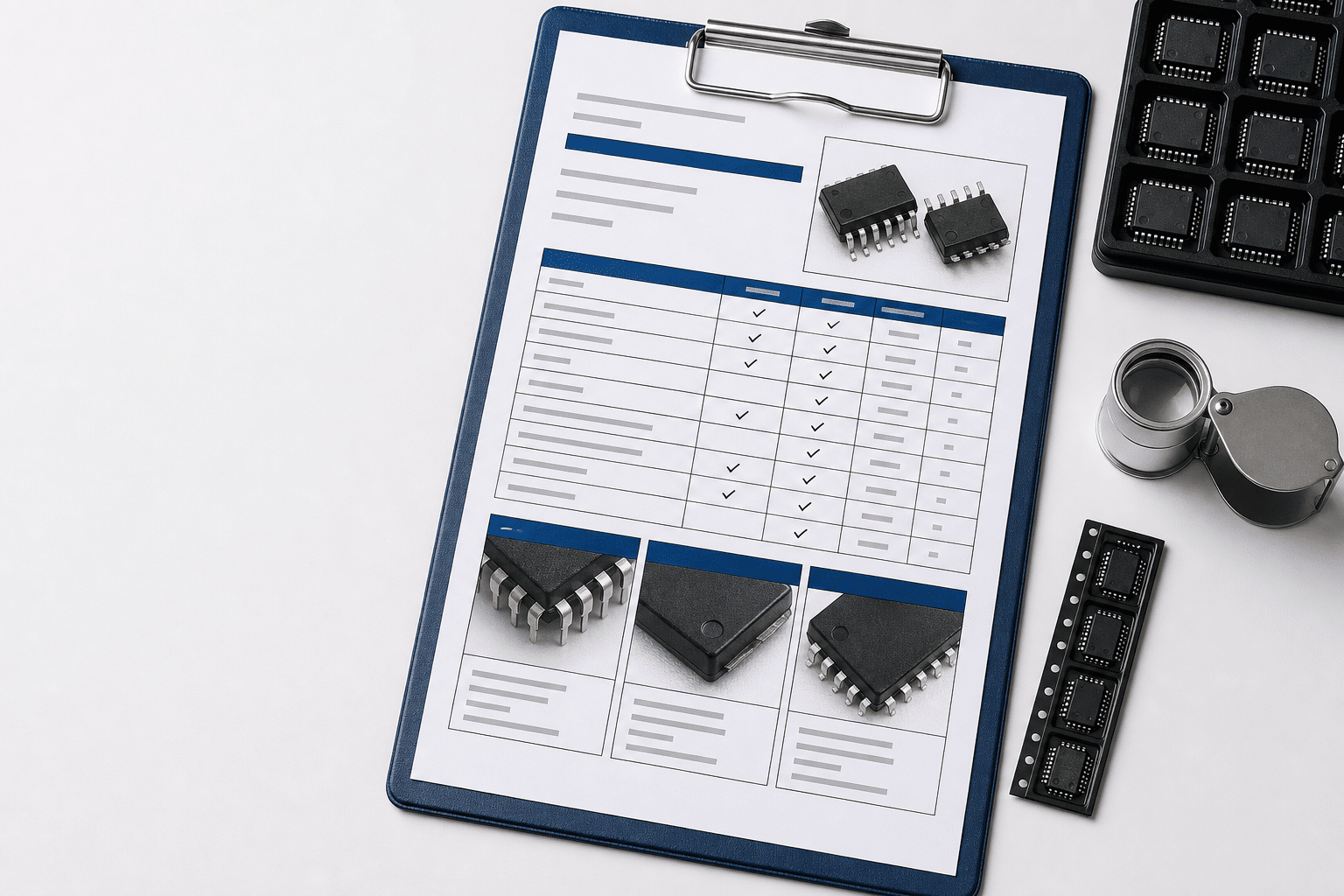
Unit price can hide a different part, a different promise, or a different risk.
The price field does not tell you whether the supplier controls the stock, whether the suffix and pack match, what inspection is included, or who pays freight, duties, and claims costs.
| A quote matches on | What to record | Why it changes the decision |
|---|---|---|
| Exact orderable identity | Manufacturer, full MPN and suffix, package, grade, configuration, revision when relevant, and pack type. | A family number can include devices with different electrical, qualification, temperature, programming, or packing characteristics. |
| Quantity and packaging | Offered quantity, MOQ, SPQ, reel/tray/tube, partial-reel rule, unit of measure, and lot mixing. | A low price may require excess inventory or a pack format that creates handling, receiving, or cash exposure. |
| Condition and lot data | New/unused status, manufacturer sealing where applicable, date/lot information, MSL or storage condition, and remarketing status. | Condition can affect traceability, solderability, moisture handling, inspection depth, warranty, and end-customer acceptance. |
| Delivery basis | Ship-from point, Incoterm and named place, currency, shipping mode, insurance, taxes/duties treatment, and committed date. | Different delivery terms move cost, risk, work, and timing between buyer and seller. |
| Evidence and terms | Source statement, traceability, inspection/test scope, reports, validity, payment, NCNR, cancellation, warranty, claims, and returns. | These fields define whether the offer can be approved and what happens if the source, lot, or delivery fails. |
Review seven dimensions before ranking the offers.
Some fields are hard requirements. Others can be traded after the quote passes. Decide which is which before supplier prices influence the discussion.
Technical identity
Is this the exact approved manufacturer part, package, grade, configuration, and pack format?
Availability and timing
Can the supplier commit the useful quantity at the required point and date?
Source and traceability
Can the supply path be documented to the level your application requires?
Lot quality and inspection
What will be checked, on what sample, with which method, and who approves release?
Lifecycle and compliance
Does the offer fit the design lifecycle, PCN/PDN review, customer flow-downs, and applicable trade or material requirements?
Commercial terms
What is the buyer committed to, how long is the offer valid, and which remedy exists if the transaction changes or fails?
Total delivered cost
What does acceptable material cost at the usable delivery point after freight, insurance, duties/taxes, finance, inspection, handling, storage, and expedites are considered?
Freeze the exact part before comparing the price.
The full orderable manufacturer part number is the anchor. A missing suffix can change package, packing, temperature grade, qualification, lead finish, speed, memory density, voltage, programming, or security configuration.
An alternate can still be useful. It should appear as a separate option with its own manufacturer, MPN, technical differences, approval status, evidence, price, and lead time. Do not create a paper saving by silently comparing a different item.
- Match the full MPN to the controlled BOM or approved source.
- Record manufacturer, package, grade, configuration, and pack format separately.
- State whether mixed date codes, mixed lots, cut tape, or partial reels are allowed.
- Route every alternate through the buyer’s engineering approval process.
- Mark missing identity fields as unconfirmed instead of filling them with assumptions.
“In stock,” “available,” and “lead time” are different promises.
Ask what event sits behind each phrase. A database result, broker response, incoming lot, manufacturer planning estimate, and physically controlled inventory should not receive the same delivery score.
“In stock”
Ask where the material is held, whether the supplier physically controls it, how much is allocable, whether it is subject to prior sale, and which committed ship date can be written.
Buyer treatment: claim pending confirmation“Available”
Ask available from whom, in what quantity and condition, for how long the offer can be reserved, and what must happen before the supplier controls the stock.
Buyer treatment: do not equate with owned inventory“Factory lead time”
Ask whether it is current manufacturer information for the exact MPN, a general family estimate, or a planning assumption without a purchase-order commitment.
Buyer treatment: planning data until confirmed“Delivery in 10 days”
Ask whether that means ship date or arrival at the named receiving point, which shipping method is included, and what event starts the clock.
Buyer treatment: normalize to one delivery pointAvailability is not lifecycle status.
A part can be active but allocated, or obsolete while aftermarket stock still exists. Record manufacturer lifecycle status and the supply claim separately. For new designs, do not treat a cheap NRND or last-time-buy lot as routine long-term availability.
One positive document cannot answer every risk question.
An ISO 9001 certificate describes a quality-management system; it is not a certificate of authenticity for one named lot. A RoHS declaration addresses restricted-substance information in its stated scope; it does not prove source traceability or current inventory. A certificate of conformance, inspection report, and test report answer different questions.
Match evidence depth to the application, scarcity, channel, value, and consequence of failure. Ask for records your team can review, and write any unavailable document or exception into the quote.
Legal entity, location, contacts, authorization or relationship where applicable. Supports due diligence; does not prove one lot’s origin.
Source statement, CoC, permitted purchase-chain records, lot/date information, label photos, seals, and chain explanation.
Receiving, quantity, package, label, marking, visual or microscopic review, sample basis, acceptance criteria, and nonconformance process.
Risk-based method, sample plan, lab qualification where required, results, limitations, and reporting. No test is a blanket guarantee.
Claim period, evidence needed, return path, exclusions, and replacement or credit responsibility.

Compare the cost at the usable delivery point.
The material value is only one part of the commercial decision. Normalize currency, quantity, Incoterm and named place, freight, insurance, duties or taxes where applicable, payment cost, inspection, handling, and expedite exposure.
Incoterms® rules allocate buyer/seller tasks, costs, and risk at defined points. They do not replace separate agreements on part identity, title, payment, warranty, or remedies. Always compare the same named place and delivery expectation.

Packaging and shipment details can change the real cost.
Reels, trays, cut tape, dry packing, ESD protection, relabeling, split shipments, expedited freight, insurance, customs documents, and receiving exceptions should be visible before the quote is ranked—not discovered after the purchase order.
Review global shipment planning →A weighted score should compare acceptable offers—not rescue an unacceptable one.
Agree the non-negotiable gates before prices are ranked. When a critical gap cannot be priced honestly, hold or escalate the quote instead of hiding the problem inside a weighted average.
Exact identity
Full MPN, manufacturer, package, grade, configuration, and approved alternate status are clear.
Supply confidence
Physical stock or a credible written fulfillment path supports the required quantity and date.
Source and evidence
Traceability and inspection evidence meet the application’s agreed risk level.
Commercial acceptance
Currency, Incoterm, payment, NCNR, warranty, claims, validity, and cancellation are accepted.
Lifecycle and compliance
Lifecycle, PCN/PDN review, customer requirements, and required documents are resolved.
Why the lowest unit price may not win.
This composite example is not a market price, supplier rating, or customer result. It shows why incomplete information should not earn a price advantage.
Quote B is not automatically the purchase order. It is simply complete enough to compare. Quote A may become competitive after it supplies the missing information and passes the same gates.
Move from demand to approval in five controlled steps.
The goal is not a larger spreadsheet. It is a clean handoff from RFQ to quote, approval, purchase order, receiving, and future supplier review.
Full MPN, quantity, pack, required date, location, application risk, and alternate policy.
Use the same fields and units. Mark missing data as unconfirmed.
Check identity, supply basis, source, lot data, inspection, lifecycle, and documents.
Apply hard gates, calculate total cost, then score only acceptable offers.
Put approved exceptions and commitments into the PO, order confirmation, receiving, and claim records.
Electronic component quote-comparison request.
Send the same fields to every supplier and ask them to identify every exception or alternate on a separate line.
Please quote the exact manufacturer MPN and suffix shown below.

PART IDENTITY
Manufacturer:
Full MPN / suffix:
Package / grade / configuration:
Approved alternates: none unless separately identified for review

DEMAND
Required quantity:
Minimum usable quantity:
Accepted pack format / MOQ / SPQ:
Required date and receiving location:
Split shipment allowed: yes / no

SUPPLY AND CONDITION
Physical stock, incoming stock, allocation, or lead-time basis:
Condition and date / lot information:
Source and traceability evidence available:

QUALITY AND DOCUMENTS
Inspection / test scope included:
Report, photos, labels, CoC, or other records available:
Any unavailable document or exception:

COMMERCIAL AND DELIVERY
Currency, unit price, and extended total:
Quote validity:
Incoterm + named place:
Freight, insurance, duties / tax treatment:
Payment, deposit, NCNR, cancellation, warranty, claims, and returns:

Please identify every alternate, exception, conditional date, mixed lot, partial quantity, or excluded requirement on a separate line.
Avoid the shortcuts that make a cheap quote look complete.
Technical shortcuts
- Ranking a generic family against an exact suffix.
- Treating a similar package, grade, or programmed state as identical.
- Letting an online stock display stand in for physically controlled inventory.
- Accepting a lead time without its start event, date, and delivery point.
Evidence and commercial shortcuts
- Assuming “original,” ISO 9001, RoHS, a CoC, or a product photo proves every claim.
- Comparing EXW, FOB, CIF, DAP, or DDP without the named place and cost allocation.
- Letting unit price override unapproved NCNR, deposits, warranty, or returns exposure.
- Using a weighted score before the hard gates are passed.
Send the part list, required quantity, target date, and evidence expectations.
YURUNOX can organize the offered part identity, supply basis, source information, available inspection evidence, commercial terms, and shipment plan so your team can review one comparable response.
- Full manufacturer MPN or BOM
- Required and minimum useful quantity
- Need-by date and destination
- Approved alternates and lifecycle limits
- Traceability, inspection, and document needs
Use the same requirement through inspection and delivery.
Questions buyers ask before accepting a component quote.
How do I compare electronic component quotes fairly?
Why is one electronic component quote much cheaper?
Does ISO 9001 prove that electronic components are genuine?
What should “in stock” mean on a component quote?
What is NCNR in an electronic component quote?
How do Incoterms change a component quote comparison?
What documents should I request for obsolete or hard-to-find components?
Technical references
- SAE AS5553 — reliable-source procurement, authenticity/conformance assurance, and counterfeit-part controls.
- U.S. International Trade Administration: Pro Forma Invoice — quote fields including items, unit and extended price, Incoterm, payment, shipping date, and validity.
- U.S. International Trade Administration: Determine Total Export Price — landed-cost elements and the need to treat customs costs as estimates.
- International Chamber of Commerce: Incoterms® and Commercial Contracts — tasks, costs, risk, and limits of Incoterms® rules.
- ISO: ISO 9001 explained — quality-management-system scope and certification context.
- Texas Instruments: Product life cycle — manufacturer example of Active, NRND, Last Time Buy, and Obsolete status.
- ERAI — electronic-supply-chain supplier screening, counterfeit reporting, and risk-mitigation resources.