

How to Decode STM32 Part Numbers and Package Suffixes
Direct answer: decode an STM32 part number with the Ordering information table for that exact device family. The code can identify the device, pin count, Flash, package, temperature grade and supply options. The last characters may also control a product version or programmed content, not just packing.
Start with the full manufacturer part number (MPN). Keep every suffix when comparing a BOM, supplier quote and purchase order.

How Is STM32F103C8T6TR Decoded Field by Field?
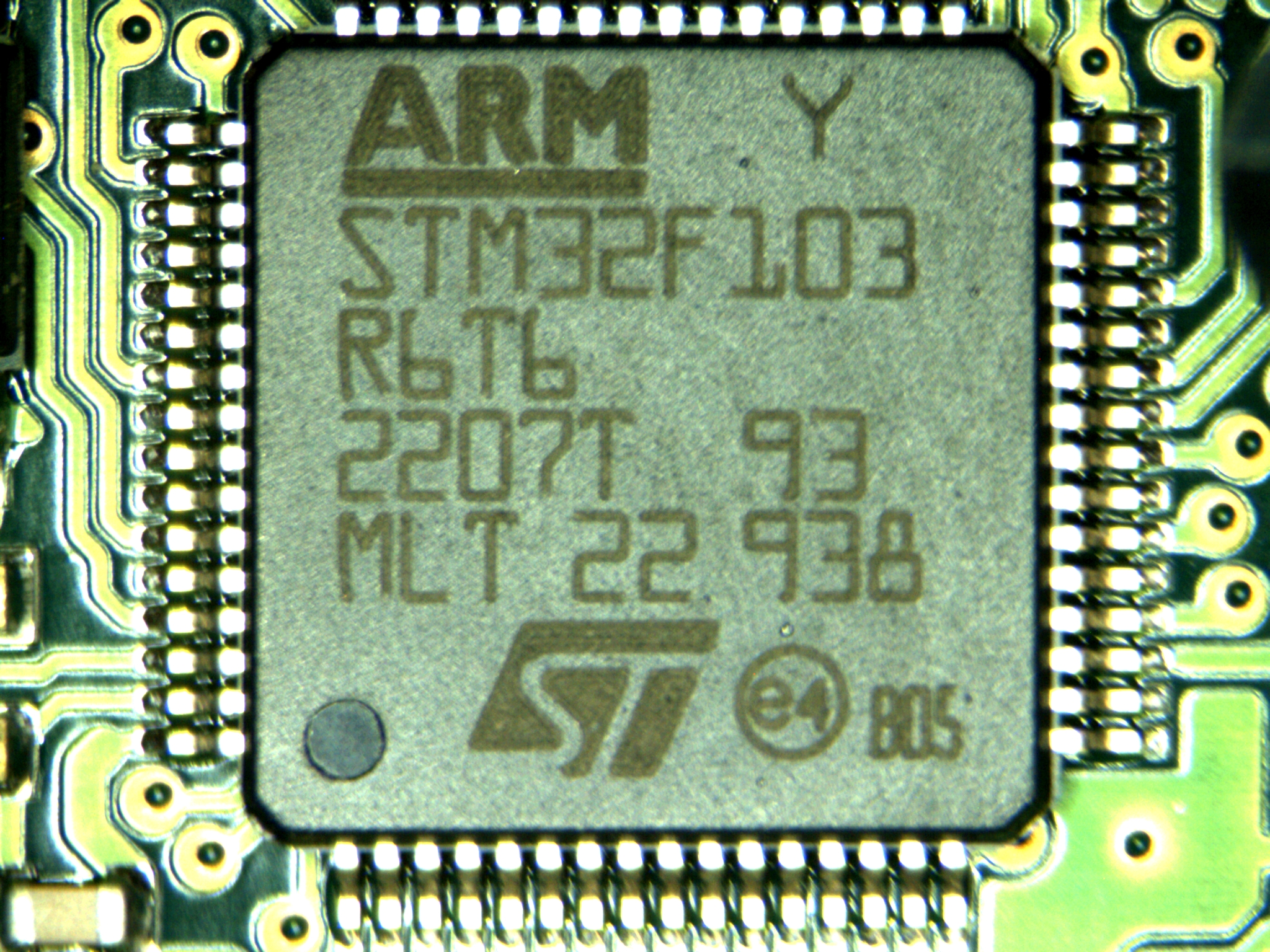
This is a documented F103 example, not a universal STM32 decoder. In the standard STM32F103C8T6TR order code, T identifies the IC package; the later TR identifies tape-and-reel packing. They answer different questions.
STM32Device family32-bit MCUFProduct typeGeneral-purpose103SubfamilyPerformance lineCPin-count code48 pins8Flash code64 KbytesTPackageLQFP6Temperature grade-40 to 85°CTRPackingTape & reelSource: ST STM32F103x8/xB datasheet, DS5319 Rev 20, section 7. Temperature suitability also requires the operating and thermal limits.
STM32F103C8T6 is itself a valid orderable part number; it is not automatically an incomplete one. ST lists it separately from STM32F103C8T6TR. Do not add or delete TR without confirming which supply configuration the factory needs. See ST's orderable entries.Which Identifier Is This: Family Reference, Order Code, or Top Marking?
| Starting record | What it establishes | Evidence required next | Stop boundary |
|---|---|---|---|
Family or product referenceSTM32F103 | Points to a product family and its documentation. | Current product page, exact family datasheet and complete orderable MPN. | Do not issue or approve a PO from the family name alone. |
Complete manufacturer order codeSTM32F103C8T6TR | States the offered device configuration, including documented options. | Approved BOM comparison, current ST ordering table and supplier offer. | Do not treat a documented code as proof of availability, authenticity or suitability. |
| Package top marking or photo | Supports visual identification and receiving inspection. | Manufacturer marking guidance, labels and traceability records. | Do not reconstruct supply history or the full MPN from a photo alone. |
| Supplier SKU or internal item number | Links a seller or company record to a line item. | Explicit cross-reference to the unabridged manufacturer MPN. | Do not substitute it for the manufacturer's order code. |
A search result that says only "STM32F103, 48-pin" is not enough to approve an order. Preserve separate fields for the manufacturer MPN, supplier SKU and your internal item number so the quotation, PO and receiving record can be reconciled.
Why Is One STM32 Decoding Chart Not Enough?
A familiar-looking number can hide an unfamiliar field. These two ST examples show exactly where a simple "ignore the final letters" shortcut breaks down.
When Does an N Suffix Change the Pinout?
ST describes alternative pinouts for some low-pin-count STM32G081 devices. These are marked with an N suffix and provide an additional USB Type-C Power Delivery (UCPD) port. This is a product distinction, not just a shipping-media preference.
Evidence: ST's STM32G081KB product description and DS12231 Rev 5, pinout figures and ordering information.
In this scheme, K means 32 pins and B means 128 Kbytes of Flash. The options field can combine a product-version identifier with packing information; it can also identify custom Flash content.
Decision: when a quote changes the version field, ask the engineer to compare the exact pinout, schematic nets and firmware use. A matching lead count does not close that review.
Why Does a Wireless Module Need a Different Field Map?
For STM32WB1MMCH6TR, the two adjacent M characters have different jobs: the first identifies 77 pins; the second identifies a module. C identifies 320 Kbytes of Flash, and H identifies an LGA77, 6.5 × 10 mm package.
Source: ST STM32WB1MMC datasheet, DS14096 Rev 8, table 5.
Why this changes the buying decision: the extra field means you cannot apply the character positions of a discrete F1 MCU to this module. Nor can you read every H as the same package type.
For an alternate wireless module, the review extends beyond memory and solder pads. Include antenna integration, module software, host-board layout and the applicable radio documentation. A successful text decode only identifies the candidate; it does not approve the complete product design.
An ordering scheme explains field meanings. It does not establish that every theoretical combination is offered, currently available or approved for your application. Confirm the complete order code with ST's product information and the supplier's exact offer.
What Do STM32 Package Letters Mean for PCB and Assembly Fit?
A package letter points you to a package family. The drawing supplies the details that make it fit a PCB: body size, lead or ball pitch, height, orientation and terminal layout. Read the pin-count field and package field together.
On a small screen, scroll the table sideways to see all three columns.
| Code | In the STM32F091xB/xC scheme | What to verify before changing it |
|---|---|---|
T | LQFP: low-profile quad flat package | Lead count, body dimensions, pitch and the full lead-to-signal assignment. |
U | UFQFPN: ultra-thin fine-pitch quad flat no-lead package | Pad geometry, exposed-pad requirements and assembly process. |
H | UFBGA: ultra-thin fine-pitch ball grid array | Ball map, pitch, board escape routing and inspection method. |
Y | WLCSP: wafer-level chip-scale package | Bump layout, footprint, board and handling requirements. |
Mapping source: ST STM32F091xB/xC datasheet, table 81. Compare H here with the LGA module example above: identical letters do not create identical packages.

Which Package-Drawing Details Must Be Compared?
For a proposed package change, attach the original and candidate drawings to the alternate review. Compare the maximum dimensions, not only a catalog's nominal body size. Then compare every connected pin or ball against the board schematic, including supplies, ground, reset, boot selection, oscillator and analog signals.
Ask manufacturing to review the land pattern, stencil, moisture sensitivity, soldering profile, placement orientation and inspection plan. Engineering can accept a circuit function while production still rejects its physical delivery or assembly requirements. Those are separate approvals.
What Does the Temperature Code Actually Guarantee?
The temperature field identifies a specified grade. It does not tell you how hot the silicon will become inside a sealed enclosure with loaded outputs and nearby heat sources.
ST's STM32G031 thermal guidance links a suffix to an ambient-temperature condition at maximum dissipation and a maximum junction temperature. Actual selection also requires power and thermal analysis. See DS12992 Rev 4, section 6.10.2.
Purchasing consequence: do not accept a lower or unexplained temperature grade because the rest of the code matches. Record the proposed change and let the design owner verify operating limits and qualification requirements.
How Are Ambient and Junction Temperatures Related?
70°C + 0.35 W × 60°C/W
= 91°C
These assumed inputs show a 21°C rise above ambient. They are not specifications or measurements for any STM32 part.
Use the selected device's limits and appropriate thermal data for the actual board. Junction-to-ambient thermal resistance depends on the test environment and board conditions; this simple estimate does not replace validation.
Does TR Change the Device or Its Packing?
A device's package is the housing and terminal system mounted on the board. Its packing is the tray, tape or other media used to transport and feed it. One can change without the other.
The STM32F091 ordering table explicitly identifies TR as tape-and-reel packing and a blank packing option as tray packing. This family-specific distinction is a better guide than assuming that every STM32 without TR comes in the same shipping format. Source: ST, table 81.
Ask whether the offered material is an original full reel, a partial reel, cut tape, a distributor re-reel or a tray. Those commercial conditions need their own confirmation; the text of an MPN alone does not prove the condition of the stock being offered.
Which Packing Details Must Production Confirm?
- Required packing type and acceptable partial quantities.
- Reel or tray quantity, MOQ and order multiples.
- Tape width, component orientation and feeder requirements where relevant.
- Original labels and continuity of lot/date information.
- Moisture-barrier packaging and handling evidence when required.
Keep these requirements consistent across the quote, PO and receiving instructions.

What Should a Buyer Do If a Lower Quote Drops TR?
An EMS buyer requests STM32F103C8T6TR, but the quote returns STM32F103C8T6 and describes it as "same part." The right response is not an automatic rejection or an automatic substitution. First reconcile the exact orderable code and the actual packing being offered.
If the factory can use the proposed media, purchasing can evaluate the total delivered cost, handling and traceability after the relevant approval. If it cannot, the price comparison is not like-for-like. Do not silently restore the requested suffix in your system while accepting a differently identified supply.
What Should Be Checked When One Character Changes?
Select the field that differs between the approved MPN and the supplier's proposed MPN. This guide routes the review; it does not decode arbitrary STM32 numbers or certify interchangeability.
When several fields change, review each one. If you cannot identify a suffix from the exact datasheet, keep it unresolved and request clarification. Do not remove unfamiliar characters to make the numbers match.
Review required / no automatic approval
Confirm the assembly-ready supplyReview owners: Manufacturing, purchasing and receiving quality.
Evidence to request: Exact order code, actual packing, quantity per pack, original-label continuity and feeder compatibility.
Before release: Verify that only packing differs. Record the accepted media and any handling conditions in the PO.
How Should an STM32 MPN Be Verified Before Purchase?
Create a short comparison record that links the approved BOM item to the exact supplier offer. Use the current datasheet revision, not an old saved decoder image or a shortened listing title.
- Start from the approved BOM
Record the manufacturer, complete MPN, internal item number, board revision and substitution rule. If the BOM omits packing, resolve it with production before issuing the RFQ.
- Open the matching ST documents
Find the device's current product page, datasheet, reference manual and errata. Save the document identifiers and revisions used in the review.
- Explain every changed field
Compare the codes character by character, then assign each difference to its documented field. Do not assume an unlisted combination exists just because it follows the pattern.
- Check board and thermal compatibility
Review the package drawing, pin map, supplies, boot and reset pins, signal functions and operating limits. Include thermal and assembly implications.
- Check firmware and production test
Confirm memory, peripherals, bootloader, security configuration, programmer support and applicable errata. Decide what validation is needed for this change.
- Review the source and stock condition
Check the approved-source policy, packing, labels, requested lot/date evidence and supply-chain documentation. Follow the program's exception process for independent-source material.
- Release the exact approved configuration
Record engineering, quality and manufacturing approvals as applicable. Update the BOM or approved vendor list, PO, receiving criteria and test records before shipment.
What Should Receiving Reconcile With the Approved MPN?
Compare the PO and approved MPN against the supplier's delivery documents and the physical packing labels. Check quantity, package type, packing condition and any required lot or date information. Photograph and segregate discrepancies before the material reaches the line.
If the top marking is abbreviated or split across lines, use the manufacturer's marking guidance and supporting documents. A similar-looking chip photograph, a recognizable logo or a successful identification readout cannot, by itself, establish the complete supply history.
What Information Should an STM32 RFQ Include?
An exact-part enquiry helps separate a matching offer from an alternate candidate. Include the quantity, required delivery date, destination, packing and traceability requirements, not only a family name.
YURUNOX is an independent electronic-component sourcing partner, not the STM32 manufacturer. Final technical substitution approval belongs with your designated engineering and quality owners.
Review the purchasing process and shipment information when preparing delivery requirements.
Add your requirements here, then copy them into your enquiry. This checklist does not submit or save your data.
Which ST Documents Should Be Rechecked Before Approval?
The examples above are drawn from these ST documents. Recheck the applicable revision, ordering options and product information when approving a purchase or design change.
- STM32F103x8/xB datasheetDS5319 Rev 20, section 7: field definitions and options.
- STM32F103C8 product pageSeparate orderable entries, including C8T6 and C8T6TR.
- STM32G081xB datasheetDS12231 Rev 5, sections 4 and 7: pinouts, version fields and options.
- STM32G081KB product pageManufacturer explanation of alternative pinouts and the N suffix.
- STM32F091xB/xC datasheetDocID026284 Rev 4, table 81: package and packing mappings.
- STM32WB1MMC module datasheetDS14096 Rev 8, table 5: module-specific ordering fields.
- STM32G031x4/x6/x8 datasheetDS12992 Rev 4, section 6.10.2: selecting the product temperature range.
Manufacturer examples are documented facts. The shortage scenario, quote-review scenario and thermal calculation are explicitly illustrative, not YURUNOX customer outcomes or firsthand test results. Photographs are credited at their point of use and do not imply endorsement by their creators or STMicroelectronics.