

Quectel identification and sourcing guide
How to Read Quectel Module Part Numbers
Read a Quectel name in layers: identify the product category and base family, preserve the exact variant, then confirm the complete ordering identity in current official documentation and on the actual supply label.
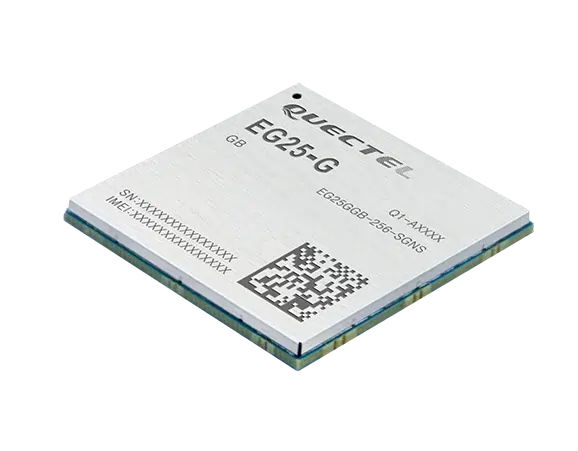
01 / Safe reading method
Move from the family name to an approved ordering identity
This four-layer method is a qualification workflow, not an official Quectel naming grammar. It prevents a useful search clue from becoming an unsupported engineering assumption.
Product category
Use Quectel's product selector to determine whether the model belongs to LPWA, LTE, 5G, GNSS, Wi-Fi/Bluetooth, smart, automotive, satellite, or another catalog area.
Base family
Identify the central series, such as BG95, EC25, RM520N, or LC29H. The family points to a shared documentation set and broad technology or form-factor context.
Exact variant
Keep the suffix, letters, digit order, hyphen, or parentheses. The variant selects a documented radio, regional, operator, or functional configuration within that family.
Full ordering identity
Reconcile the marketing model with the complete manufacturer code, hardware revision, firmware branch, label, packaging, and supplier quotation.
Do not decode by position alone. The suffix in BG95-M3 selects an LPWA family variant; RM520N-GL selects a regional/band configuration; and LC29H (BA) identifies a GNSS functional variant with RTK and dead-reckoning capability. Similar visual positions describe different engineering dimensions.
| Layer | Useful conclusion | Still verify |
|---|---|---|
| Product category | The catalog and document family to open | Exact RATs, bands, functions, interfaces, and lifecycle |
| Base family | A related platform, technology class, or mechanical context | Chipset, pinout, power, drivers, migration limits, and individual variants |
| Variant suffix | This is a distinct documented configuration | Every field in the official variant column, including bands and approvals |
| Full ordering identity | Procurement should quote and receive the accepted build | Firmware, revision, packaging, traceability, controlled alternatives, and factory options |
On narrow screens, scroll the table horizontally.
02 / Know the limits
A model name can route the investigation, but it cannot approve the module
The product name is a strong index. It is not proof of network registration, board compatibility, carrier acceptance, firmware behavior, or supply identity.
What the name helps you find
- The official product category and family page
- A broad technology or performance class
- The presence of a regional, operator, radio-mode, or functional variant
- Potentially related modules that deserve migration review
- The specification, hardware design, software resources, and certification index to request
What requires evidence
- Every LTE, NR, WCDMA, GSM, GNSS, Wi-Fi, or Bluetooth mode and band
- Carrier acceptance, regulatory grants, and end-device certification impact
- Voice, GNSS, eSIM, integrated SIM, QuecOpen, QuecPython, or security options
- Pin mapping, peak current, antennas, host interfaces, thermal design, and reflow
- Firmware interchangeability, driver behavior, hardware revision, lifecycle, and traceability
The official Quectel Product Selector separates cellular, GNSS, Wi-Fi/Bluetooth, smart, automotive, satellite, antenna, and development products, and filters by form factor and region. That catalog placement is more reliable than a memorized prefix legend because the portfolio evolves.
03 / Official worked examples
Four names show why one suffix legend cannot work
Choose an example to see what the base family establishes, what the suffix changes, and which decision still requires an exact official variant table.
Example explorer
This tool explains documented identification boundaries. It does not recommend a substitute or confirm stock.
Selected example
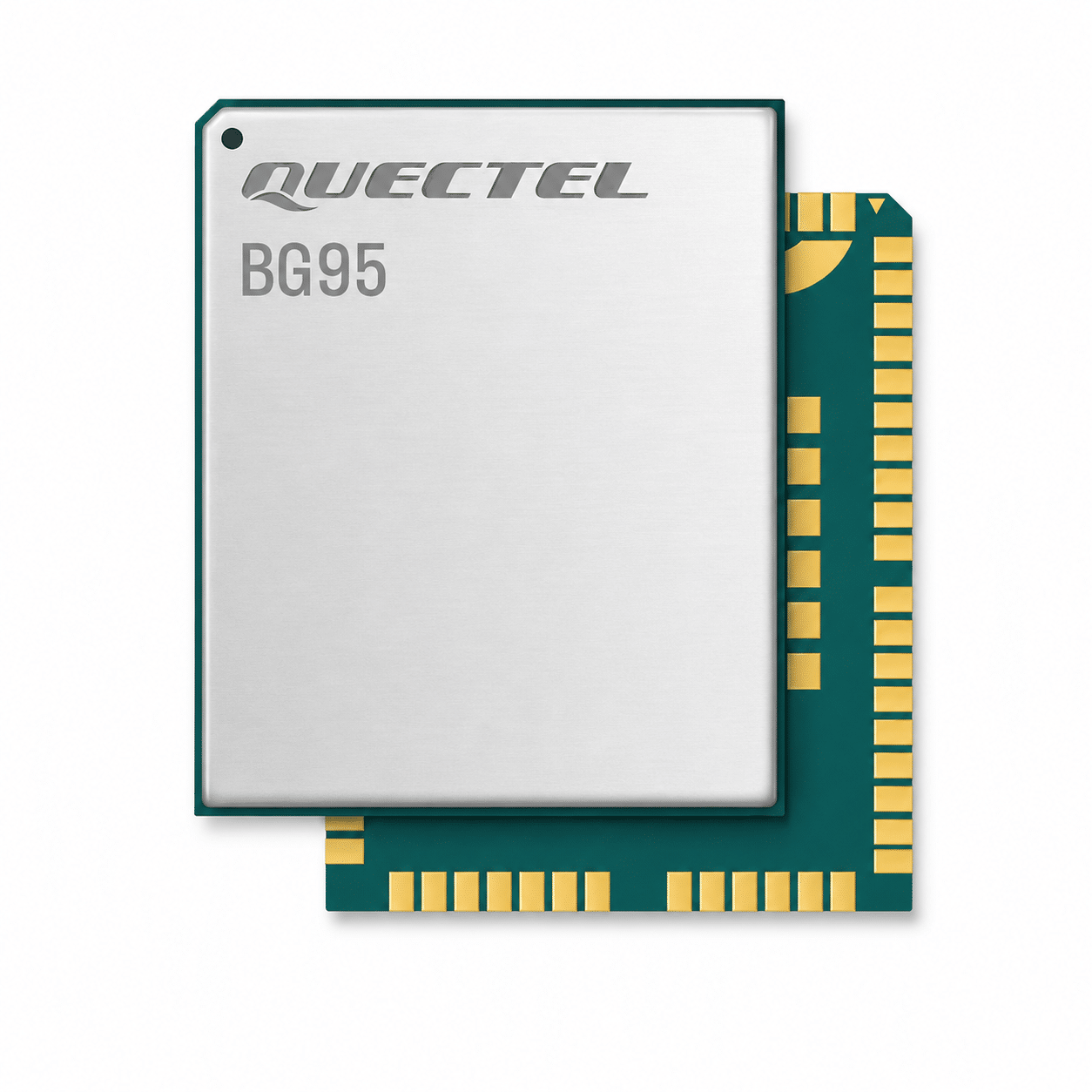
BG95-M3: an LPWA family variant
BG95 identifies Quectel's multi-mode LPWA family. M3 selects a documented combination that includes Cat M1, Cat NB2, and EGPRS in official comparison material. The digit is not LTE Category 3.
LPWA family, LGA/SMT package context, and the BG95 document set.
Radio-mode, band, feature, voice, eSIM, and related configuration details within BG95.
Another BG95 M variant can share dimensions while supporting a different RAT or band combination.
Current BG95 variant specification, hardware design, full order code, approved firmware, bands, operator needs, and label evidence.
Public product pages and brochures are discovery sources. Reconfirm the current exact-part document revision and orderable configuration.
BG95-M3: M3 is a manufacturer variant, not an LTE category
Quectel describes BG95 as a multi-mode LPWA series supporting combinations of LTE Cat M1, Cat NB2, EGPRS, and integrated GNSS. Official comparison material distinguishes BG95-M1, -M2, -M3, and other variants. In that context, M1 is Cat M1-focused while M3 includes Cat M1, Cat NB2, and EGPRS.
The family shares a compact 23.6 mm × 19.9 mm × 2.2 mm outline, but radio modes, bands, voice, eSIM, interfaces, and other features must be read from the exact variant column and hardware design. A purchasing line that says only BG95 is under-specified.
Official reference: Quectel BG95 series.
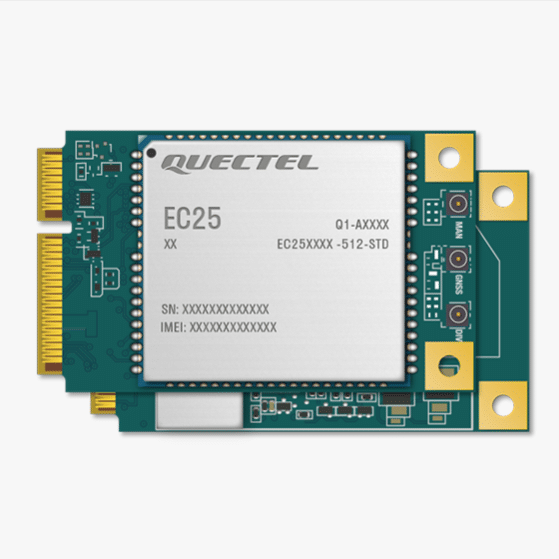
EC25-AU: regional letters select a configuration column
EC25 is an LTE Cat 4 family with a unified 32.0 mm × 29.0 mm LCC form factor. Quectel lists multiple regional and data-only variants, including EC25-AU and EC25-J. Their LTE, WCDMA, GSM/EDGE, carrier, certification, voice, and GNSS details are not identical.
Do not turn AU into a universal rule meaning only Australia. Quectel's EC25 documentation associates AU/AUX with several markets, while J targets Japan. The correct lesson is that the suffix chooses a family-specific specification column. Build a deployment matrix for each country and operator.
Official references: Quectel EC25 series and the EC25 specification V3.0.
RM520N-GL versus RM520N-EU: same M.2 outline, different deployment scope
RM520N is a 3GPP Release 16 5G Sub-6 GHz family in a 30 mm × 52 mm M.2 form factor. Official comparison material describes GL as global-oriented and EU as EMEA/APAC/Brazil-oriented. Their public 5G NR and LTE band lists differ even though dimensions and nominal platform are closely related.
A gateway team must also confirm M.2 keying, antenna-port map, USB or PCIe mode, supply-current margin, driver, network interface mode, thermal solution, GNSS option, firmware, carrier profile, and host-device approval strategy. USB enumeration does not prove commercial network suitability.
Official references: Quectel RM520N series and RM520N specification.

LC29H (BA) changes function, not just geography. Quectel's current LC29H page distinguishes AA for standard-precision dual-band positioning, BA for high-precision GNSS with RTK and dead reckoning, CA for standard precision with dead reckoning, DA for high-precision 1 Hz RTK, and EA for high-precision 10 Hz RTK with dual-antenna heading. Cellular suffix habits do not transfer to GNSS. Review the current LC29H series page and exact hardware resources.
04 / Concrete buyer situations
Small naming shortcuts create large qualification consequences
These are transparent illustrative scenarios built from documented product boundaries. They are not claimed YURUNOX customer results, shipments, or laboratory tests.
A smart-meter BOM says only "BG95"
Purchasing receives offers for several M variants at different prices. Because the BOM dropped the suffix, the supplier cannot know whether Cat M1, NB-IoT, EGPRS fallback, voice, eSIM, a particular band set, or an approved firmware branch is required. The correct action is to stop the quote comparison, reconstruct the exact approved code from the engineering record and target operator matrix, then quote that identity separately from any proposed alternate.
An RM520N-EU offer is presented as an RM520N-GL replacement
The modules share the family and M.2 dimensions, so the mechanical team sees no obvious conflict. The deployment includes North American and European gateways. The official band tables show that GL and EU are not the same regional configuration. Engineering must compare every target carrier, antenna path, band, firmware, driver, thermal condition, and certification plan before any alternate approval. A lower price cannot answer those questions.
An LC29H (AA) is mistaken for an LC29H (BA)
The base name and footprint look related, but the application requires RTK plus dead reckoning in intermittent GNSS coverage. The BA functional variant addresses that architecture; AA is a standard-precision variant. A footprint match cannot create an IMU, correction-data path, RTK behavior, or the required software. The decision must start from the positioning requirement and exact variant documentation.
A marketplace listing truncates the production order code
The listing title and reused photo show a familiar family, but the label, hardware revision, firmware history, packaging, and source are unknown. Request photographs of the actual module and pack label, the complete manufacturer code on a formal quotation, traceability, declared condition, and a mismatch remedy. Keep the offer on hold until every identity field reconciles with the approved material record.
05 / Migration and firmware
Pin compatibility reduces PCB work; it does not create a drop-in guarantee
Quectel intentionally uses unified footprints across selected families. That helps platform migration, but only one slice of compatibility is mechanical.
Power and pins
Compare pin direction, voltage domains, default states, reserved pins, VBAT range, peak current, decoupling, PWRKEY timing, reset, sleep modes, boot straps, and no-connect rules.
Antennas and assembly
Check main, diversity, GNSS, Wi-Fi, or satellite antenna paths, MIMO, connector routing, module height, shield, keep-out area, ground pads, thermal path, moisture handling, and reflow profile.
Interfaces and behavior
Verify USB descriptors, UART levels, PCIe or network mode, SIM voltage, audio, GPIO multiplexing, driver, AT commands, firmware upgrade route, bootloader, and field recovery.
Firmware is part of the procurement decision. A correct marketing model can still arrive with a different carrier branch, customer configuration, USB composition, security behavior, or outdated release. Record the firmware and hardware revision during qualification and incoming inspection. Never flash an image merely because its filename starts with the same family name.
| Area | Evidence to collect | Failure if skipped | Release criterion |
|---|---|---|---|
| Identity and supply | Full MPN, actual label photos, revision, traceability, condition, lifecycle, and source evidence | Wrong variant, old revision, mismatched packaging, reprogrammed or uncertain material | Exact approved identity reconciles across quote, label, packing list, and receiving record |
| RF and network | RAT/band table, operator profile, antenna review, registration, fallback, throughput, roaming, and weak-signal tests | No service, limited coverage, roaming failure, or approval gap | Passes the documented country/operator deployment matrix |
| Hardware | Pinout, supply, interfaces, dimensions, antenna mapping, thermal, moisture, reflow, and reference design | Resets, no enumeration, damaged board, overheating, RF loss, or assembly defects | Schematic/PCB review and representative host test are complete |
| Software and compliance | Firmware, drivers, AT behavior, update path, certificates, carrier approvals, and change-control terms | Feature regression, failed update, legal delay, or an unsupported field configuration | Approved software baseline and exact-variant compliance evidence are recorded |
This matrix defines evidence categories; the buyer's responsible teams set the actual test methods and limits.
06 / Eight-step workflow
Convert the marking into a controlled approved record
Run the workflow before a production RFQ, alternate-source approval, or receiving release. Each step closes a different failure route.
Capture the marking
Photograph the module top, pack label, tray or reel label, 2D code, and any hardware revision before normalizing the text.
Separate family and variant
Keep every hyphen, parenthesis, letter, and digit in the master record. Store search aliases separately.
Open the official family page
Confirm the category and obtain the current exact-family specification, hardware design, and available software references.
Match the exact variant column
Check technologies, bands, region/operator, functions, interfaces, temperature, dimensions, and named approvals.
Reconcile the full order code
Match the web name, manufacturer code, supplier SKU, label, quotation, packing list, invoice, and approved BOM.
Lock the software identity
Record firmware branch and revision, driver, AT manual, network interface mode, carrier profile, and update package.
Qualify source and samples
Review traceability and condition, then run the applicable power, host, RF, network, GNSS, thermal, and update tests.
Release with stated limits
Record approved markets, operators, hardware and firmware ranges, suppliers, substitutions, and change-notification requirements.

Receiving must preserve the identity chain
Do not discard the outer packaging before reconciling the accepted PO, manufacturer code, pack label, sampled module marking, quantity, revision, date/lot information, and agreed source evidence. A clear top-mark photo helps; appearance alone does not prove authenticity, firmware, or suitability.
If any identity field conflicts, hold and segregate the affected material, preserve photographs and labels, and request a documented explanation. The difference may be a legitimate change or a wrong item. Neither conclusion should be guessed from appearance.
07 / RFQ and acceptance
Send enough information to quote the intended module build
A family name invites the nearest-looking offer. A useful RFQ defines the deployment, hardware, software, compliance, supply, and evidence conditions that make an exact part acceptable.
Describe the product and deployment
- Exact Quectel model and full code, or a written request to clarify the complete orderable identity
- Countries, operators, RATs, bands, fallback, roaming, data profile, voice, GNSS, Wi-Fi/Bluetooth, SIM/eSIM, and security
- Host processor, OS, driver, interface mode, approved firmware, update route, and recovery method
- Supply voltage, peak-current capability, temperature, antenna arrangement, module/board form, and mechanical limits
- Regulatory, carrier, industry, customer, and end-product approval requirements
Define the offered material
- Prototype and annual volume, required date, lifecycle horizon, and change-notification terms
- New/factory-sealed condition, pack format, quantity per pack, moisture handling, lot/date policy, and country of origin if required
- Original-label photographs, certificate of conformity, source traceability, specification revision, and certificate list
- Inspection and sample-test scope, acceptance window, identity-mismatch remedy, and NCNR condition
- No substitute, firmware change, mixed lot, repack, or source change without documented approval
YURUNOX sourcing support
Send the exact marking and the deployment requirement
YURUNOX can help structure an exact-part or alternate-source request, reconcile available identity and supply documents, and define quotation and inspection questions. The buyer's engineering and compliance teams approve the module in the target product.
08 / Common questions
Quectel module part-number FAQs
Is there an official universal Quectel part-number decoder?
No public universal decoder covers every product line. Use the official family page and exact variant specification. Product-specific ordering-code explanations should not be generalized to unrelated families.
What do the first letters in a Quectel module number mean?
They often help route you to a product family or catalog area, such as BG95 in LPWA, EC25 in LTE standard modules, RM520N in 5G M.2 modules, or LC29H in GNSS. Confirm the current category in Quectel's official product selector.
Does GL always mean a global Quectel module?
GL is used for a global-oriented configuration in some product names, including RM520N-GL. It is not a universal coverage guarantee. Verify the exact bands, operators, certifications, functions, and firmware for the target deployment.
What is the difference between BG95-M1 and BG95-M3?
They are separate BG95 variants. Official comparison material shows M1 as Cat M1-focused, while M3 includes Cat M1, Cat NB2, and EGPRS. Open the current exact-variant band and feature table before selection.
Are EC25 variants pin compatible?
The EC25 family uses a unified LCC form factor and Quectel describes migration compatibility with selected related modules. This does not prove power, RF, software, operator, certification, or feature equivalence. Review both hardware designs and test the target host.
Can RM520N-GL replace RM520N-EU?
Not automatically. They share a family and M.2 dimensions, but official material lists different target regions and band sets. Carrier firmware, antennas, drivers, thermal behavior, certifications, and commercial approvals also require review.
Why is the distributor code longer than the product-page name?
The web page often shows a market-facing family or variant. A complete order code can include configuration, feature, memory, evaluation-board, packaging, or other production fields. Ask the supplier to map its SKU to the exact Quectel code and actual label.
How should I approve a Quectel alternate source?
Match the complete MPN, hardware revision, firmware, condition, packaging, and traceability; verify official variant documents and certificates; inspect samples; and run representative hardware, network, RF, GNSS, thermal, and update tests. Release only the combination that passed.
Primary references
Official evidence behind the examples
- Quectel Product Selector — current catalog categories, form factors, technologies, and regional filters.
- Quectel BG95 series and 2026 product brochure — LPWA family and variant comparison context.
- Quectel support forum: BG95 ordering codes — a product-specific explanation of selected LA/LB/TE-A fields, not a universal grammar.
- Quectel EC25 series and EC25 specification V3.0 — LTE Cat 4 family, form factor, variants, and exact configuration tables.
- Quectel RM520N series and RM520N specification — M.2 platform and GL/EU regional and band differences.
- Quectel LC29H series — current public distinctions among AA, BA, CA, DA, EA, and other GNSS variants.
Product pages, documents, firmware, approvals, availability, and ordering configurations can change. Reconfirm the current exact-part evidence before purchase or design release. Photographs from other devices illustrate identification and form-factor concepts and do not imply equivalence or manufacturer endorsement.