

How to Read Samsung Memory Part Numbers
Classify the product first, copy the complete identifier, and then use the ordering table for that exact memory family and generation. A DDR4 IC, a SODIMM, an LPDDR device, and an eMMC package do not share one universal character-by-character decoder.
The part number is a key to the documentation—not a substitute for the datasheet. Verify the suffix, package, ballout, speed, temperature option, lifecycle, and platform approval before ordering or approving an alternative.
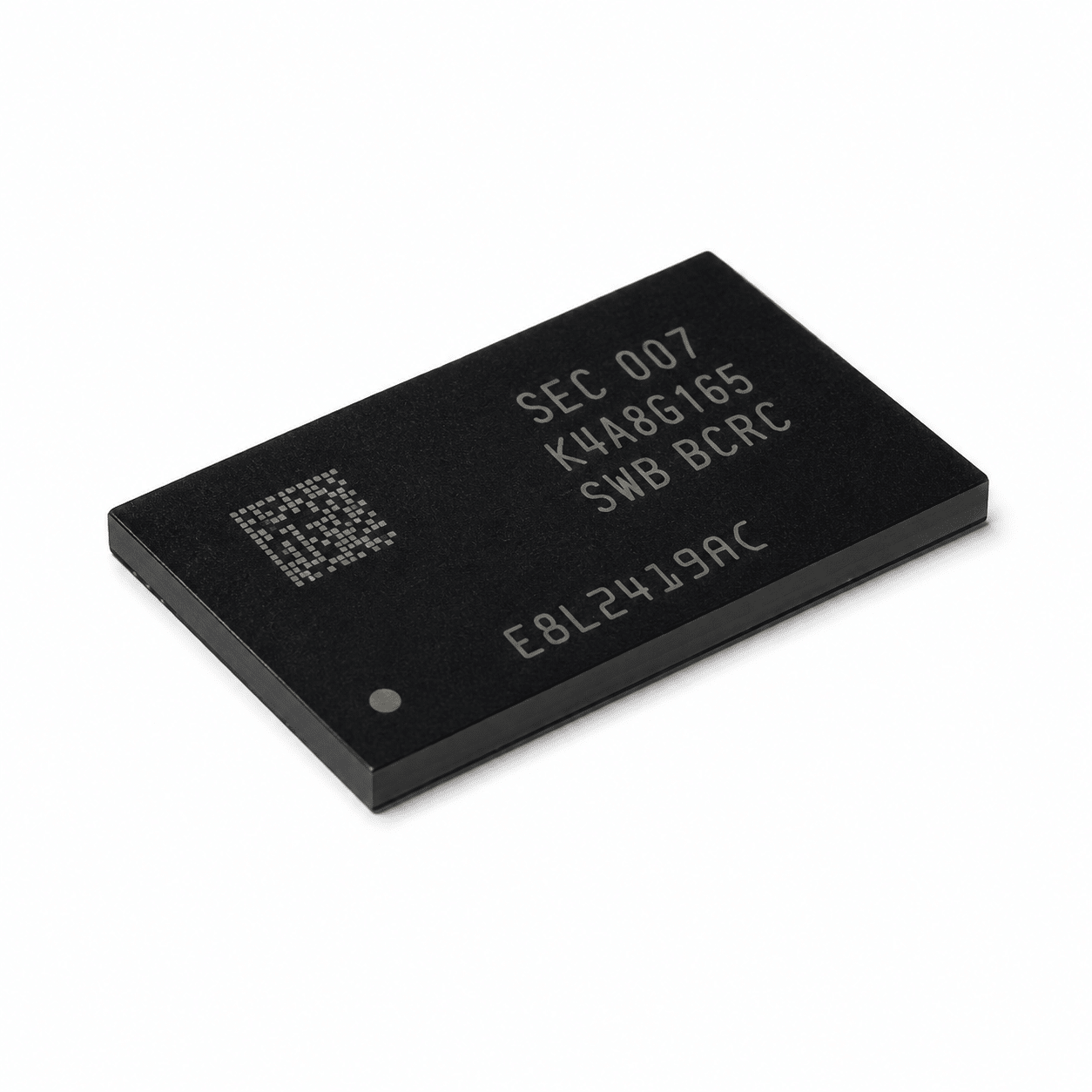
K4A8G165WB-BCRC, not the K4A8G165WC-BCTD worked example below; its suffix must be verified from its own documentation.Image: YURUNOX Samsung product listing.Read the code in two passes: identify the family, then verify the exact orderable part
First determine whether the item is a packaged DRAM IC, an assembled memory module, mobile DRAM, managed storage, or a multichip package. Only then use the applicable family guide. Finish by opening the exact datasheet or product record and checking every engineering attribute that matters.
Preserve identity
Copy capitalization, zeros, hyphen, suffix, and ordering extension. Mark uncertain characters as unknown instead of completing them from memory.
Verify compatibility
Confirm density, organization, supply, speed, package, ballout, temperature, interface, controller support, and lifecycle.
Decode is not approval
A readable code does not prove authenticity, current availability, platform qualification, or interchangeability with a similar suffix.
Start by deciding what physical product the number identifies
The same-looking character position can mean different things across generations and product families. Samsung publishes distinct documentation paths for DDR, LPDDR, modules, eMMC, UFS, MCP products, and SSDs. A prefix can help locate that path, but it cannot safely replace it.
Swipe the table horizontally to compare every product class.
| Example identifier | Product class | Correct next document |
|---|---|---|
K4A8G165WC-BCTD | DDR4 SDRAM component | Matching DDR4 ordering guide plus exact component datasheet |
M471A1K43CB1-CTD | DDR4 SODIMM module | Module table or datasheet, including component composition and SPD context |
K4FBE3D4HB-KUCL | LPDDR5 component | Exact LPDDR product record and generation-specific documentation |
KLMBG4GEUF-B04Q | eMMC 5.1 managed storage | Exact eMMC record, interface specification and host qualification evidence |
KM5V8001DM-B622 | uMCP product | Both DRAM and managed-storage attributes, package interface and lifecycle |
Samsung's current DDR family explanation distinguishes a DRAM chip—one semiconductor device—from a module that assembles multiple chips on a printed circuit board. That distinction changes the BOM line, mechanical interface, qualification evidence and replacement process. Review Samsung's DDR family information.
Capture the exact identifier—not a reconstructed photo guess
Record the complete line from the manufacturer label, distributor record, datasheet title, certificate of conformance, or a clear component photograph. Keep the hyphen and suffix. Distinguish 0/O, 1/I, 5/S, and 8/B. If a top marking is abbreviated or divided across lines, do not silently fill in the missing characters.
Order code and traceability marks are not the same field
Packages can also carry lot, date, assembly, country, or internal traceability marks. Their formats can change by product, site and production period. Treat an extra line as an unidentified traceability field until the applicable marking specification or supplier evidence defines it.
What does K4A8G165WC-BCTD mean?
Samsung's May 2018 DDR4 product guide and the exact K4A8G165WC Rev. 1.5 datasheet support the reading below. This field map applies to the cited DDR4 generation; it must not be copied position by position onto LPDDR, eMMC, UFS, or a newer family.
Select a field to see what it establishes—and what still needs verification
K - Samsung memory
In the cited DDR4 ordering format, K identifies Samsung memory. It helps establish the manufacturer family, but does not identify density, package, speed, or lifecycle by itself.
Source scope: Samsung DDR4 Product Guide, May 2018, interpreted together with the K4A8G165WC 8Gb DDR4 SDRAM datasheet, Rev. 1.5. The guide is historical format evidence, not current availability evidence.
8G is density; 16 is organization
8G means an 8-gigabit DRAM density. It does not mean an 8-gigabyte module. The 16 field means the device presents a x16 data organization. It is an interface width, not a capacity.
A module's usable capacity depends on the number of components, rank/channel organization and controller support. Keep lowercase b for bits and uppercase B for bytes in the BOM, RFQ and inspection record.
The bank field shows the limit of a shortcut decoder
The guide places 5 in an internal-bank-configuration field, but the exact x16 datasheet states that this device has eight banks in two bank groups. Other organizations in the family can use a different architecture. The safe conclusion is “verify bank configuration in the exact datasheet,” not “this character always means a fixed bank count.”
BCTD is part of the engineering definition
For this documented example, B selects the package option, C selects the stated commercial-temperature/normal-power option, and TD selects the speed bin. The ordering table lists K4A8G165WC-BCTD as 96-FBGA and DDR4-2666 with 19-19-19 timing.
Do not approve BCPB, BCRC, or another suffix simply because the base K4A8G165WC matches. Compare the package drawing, ballout, voltage, temperature option, speed/timing tables, controller training, PCB constraints and lifecycle. A faster-rated device may sometimes run at a lower data rate, but that engineering possibility is not automatic purchasing approval.
A Samsung module number describes more than its DRAM chips


Documented module example
M471A1K43CB1-CTD appears in Samsung's May 2018 DDR4 product guide as an 8GB SODIMM with 1G x64 organization, one rank of x8 components, and eight 8Gb C-die devices.
The uppercase B in 8GB means bytes. The individual component devices are described in gigabits. Eight 8Gb x8 devices provide the module's raw capacity and 64-bit data path.
This is a historical guide entry. Confirm the exact module datasheet, current lifecycle and platform qualification before purchase.
Swipe the table horizontally to compare a module and a component.
| Decision factor | Packaged DRAM component | Memory module |
|---|---|---|
| Physical object | One soldered IC package | PCB assembly with multiple devices and a connector |
| Capacity language | Often die density in Gb | Total module capacity in GB |
| Organization | x4, x8, x16, x32, depending on family | Rank count, data width and component composition |
| Mechanical check | Package dimensions, ballout and footprint | SODIMM/UDIMM/RDIMM type, keying, height and connector |
| Platform evidence | Controller and PCB timing/ballout validation | SPD, ECC/registered status, rank layout and system qualified list |
LPDDR, eMMC and uMCP cannot be decoded with the DDR4 table
LPDDR: let the exact product record define the device
Samsung's current record identifies K4FBE3D4HB-KUCL as a 32Gb x32 LPDDR5 device rated at 4266 Mbps in a 200-FBGA package. Those are exact-product facts. They are not evidence that the older DDR4 K4A... position map applies to this LPDDR code. Mobile DRAM selection also depends on channel organization, supply rails, package/ballout, temperature, data-rate support, initialization, controller training and firmware. Open Samsung's K4FBE3D4HB-KUCL record.
eMMC: capacity is only one attribute
eMMC combines NAND flash with controller functions and exposes a managed host interface. Samsung's record for KLMBG4GEUF-B04Q lists a 32GB eMMC 5.1 product with HS400, an 11.5 × 13 × 0.8 mm package and a stated product status. A different 32GB eMMC 5.1 device is not automatically interchangeable.
Compare package and ballout, supply options, temperature, supported modes, boot configuration, firmware behavior, endurance information and the host's validated-device list. The suffix must be covered by the approval evidence. Review the exact Samsung eMMC record.

KLMCG8GEAC-B001, not the 32GB example in the text.Photo: Toniperis / Wikimedia Commons · CC BY-SA 4.0. Uncropped; resized for display.
uMCP: one order code covers two memory subsystems
Samsung describes uMCP as mobile DRAM and managed eStorage integrated in one package. The archived KM5V8001DM-B622 record lists 128GB of eStorage and 32Gb of DRAM—uppercase B and lowercase b describe different quantities inside one product. The same record marks the product as discontinued. That makes it a useful lifecycle-aware example: a correct decode does not answer whether a device is suitable for a new design. See Samsung's exact uMCP record.
Use this five-step workflow for an unfamiliar Samsung memory code
- Transcribe the complete code. Preserve capitalization, zeros, hyphens, suffixes and ordering extensions. Mark uncertain characters instead of guessing.
- Classify the physical item. Decide whether it is a packaged DRAM IC, assembled module, LPDDR device, eMMC/UFS product, MCP, or SSD. Use the package and official search results only as supporting clues.
- Find the family-specific ordering guide. Match the generation and publication period. A DDR4 guide can explain a DDR4 example; it should not be extended silently to LPDDR5 or UFS.
- Open the exact datasheet or product record. Confirm density/capacity, organization, voltage, speed, timing, package, ballout, temperature and interface.
- Check lifecycle and supply evidence separately. Record current status from an authoritative source, then assess source basis, traceability, date-code limits and the organization's approved alternative process.
Stop condition: when no exact record can be found, report an “unverified identifier.” Ask for the manufacturer's exact datasheet and original label evidence. Do not assemble a confident decode from unrelated third-party tables.
A shortened quote creates an avoidable approval gap
The approved BOM lists K4A8G165WC-BCTD, but a quote says only K4A8G165WC. The base code suggests the family, density and organization, yet it leaves the package, temperature/power option and speed bin incomplete. A buyer cannot close that gap by assuming the approved suffix.
Decision consequence: request the complete manufacturer part number, label photographs, exact datasheet revision and a written declaration of any deviation. Engineering can then compare the complete offered suffix against the approved device. The scenario is a composite teaching example; it is not presented as a YURUNOX shipment or customer outcome.
Compare the full device definition before accepting a replacement
Swipe the table horizontally to view all evidence requirements.
| Check | Why it matters | Evidence to request |
|---|---|---|
| Family and generation | DDR4, LPDDR5, eMMC and UFS have different interfaces and qualification paths. | Exact manufacturer datasheet and product-family page |
| Density or capacity | Gb die density and GB product capacity are different quantities. | Ordering table plus organization/capacity field |
| I/O organization and rank | x4/x8/x16/x32, rank and channel layout affect controller and PCB compatibility. | Block diagram; module composition and SPD for modules |
| Package and ballout | A matching package name does not guarantee the same dimensions or pin assignment. | Package drawing, ball map and footprint comparison |
| Rails and logic levels | Generations and mobile devices can require different or multiple supplies. | Recommended operating and power-sequence sections |
| Speed and timing | Suffixes select bins; the controller and board must still support the timing. | Speed-bin table and platform memory configuration |
| Temperature/power option | Options can differ under the same base code. | Full orderable suffix and temperature specification |
| Managed-storage behavior | Controller firmware, boot mode and host validation affect eMMC/UFS replacement. | Product specification, firmware notes and approved-host list |
| Lifecycle and traceability | A technically valid code can be EOL or outside the approved channel. | Current lifecycle evidence, invoice trail and lot/date documents |
“Equivalent” is not a complete specification. Require a side-by-side comparison of exact manufacturer documents and approval through the organization's engineering change process. Keep the original approved part and offered alternative visible in the same record.
Troubleshoot the evidence before forcing a decode
Swipe the table horizontally to see the safe next action.
| Problem | Likely cause | Safe next action |
|---|---|---|
| No exact search result | Character error, abbreviated top mark, obsolete record, or traceability code | Re-photograph under angled light; compare the box/reel label; request the exact datasheet |
| Multiple Samsung pages | The base string occurs in family, regional, archived or lifecycle pages | Match the complete suffix, package, capacity and generation |
| Decoder and datasheet disagree | The decoder belongs to another generation or simplifies a field | Treat the exact datasheet as authoritative and document decoder scope |
| Capacity is eight times wrong | Gb and GB were mixed | Write the unit explicitly and recalculate from organization or device count |
| Same base, different suffix | Package, temperature/power or speed option differs | Compare the full ordering table; do not approve by base code |
| Technical match, supply blocked | Product is discontinued, restricted or outside the approved channel | Review lifecycle and qualified alternatives without weakening traceability |
Put the exact Samsung memory definition into the RFQ
A useful RFQ describes the application and acceptance boundary—not a shortened number. Include the complete manufacturer part number, acceptable or prohibited suffix substitutions, immediate and annual quantity, required delivery, product class, temperature, packaging, date-code policy, traceability, compliance documents and approval authority.
Specify the IC
Density, organization, DDR generation, voltage, speed bin, temperature option, package, ballout and board/controller baseline.
Specify the assembly
Form factor, capacity, rank, ECC/registered status, speed, SPD/platform qualification, height and system restrictions.
Specify the managed product
Interface revision, capacity, package, temperature, boot/firmware constraints, endurance requirement and host validation.
Decoding supports inspection; it does not authenticate the part
At receipt, reconcile the purchase order, packing list, outer label, reel/tray label and component marking. Check that suffix, quantity, lot/date information, package style and moisture controls agree with the approved documents. Photograph discrepancies before opening sealed packaging when possible.
Escalate inconsistent markings, mixed labels, erased surfaces, unusual font/alignment, damaged packaging, or missing traceability through the responsible quality process. Electrical or destructive authentication requires a defined laboratory plan and acceptance criteria. A decoder alone cannot establish die identity, prior use, storage history, solderability, reliability or compliance.
Send the complete code and the evidence boundary
Provide the exact Samsung part number, photographs, required specifications, platform details, lifecycle need, quantity and traceability standard. State whether alternatives are allowed. YURUNOX is an electronic-component sourcing partner; your engineering and quality teams retain final approval responsibility.
Samsung memory part numbers: FAQ
What does K4 mean in a Samsung memory part number?
In Samsung's cited DDR4 ordering format, K identifies Samsung memory and 4 identifies DRAM. Apply that reading within the applicable DDR4 guide. Do not assume every current or historical K4 identifier follows the same remaining field map.
Does 8G mean 8GB?
No. In K4A8G165WC-BCTD, 8G denotes an 8Gb DRAM density: gigabits, not gigabytes. The exact datasheet lists 512M x16 organization, which totals 8Gb.
Does x16 mean the chip has 16GB of capacity?
No. x16 describes the number of data I/Os. Capacity comes from address depth multiplied by data width; 512M x16 equals 8Gb for this exact device.
What does BCTD mean in K4A8G165WC-BCTD?
Within the cited DDR4 guide, B is the package option, C is the commercial-temperature/normal-power option, and TD is the speed-bin code. The exact datasheet confirms 96-FBGA and DDR4-2666 with 19-19-19 timing for BCTD.
Can I replace the same Samsung DDR4 base code with another speed suffix?
Not automatically. Compare the complete code, package and ballout, voltage, temperature option, speed/timing tables, controller support, lifecycle and platform qualification. Record the decision through the applicable engineering approval process.
Are Samsung module numbers and chip part numbers the same?
No. A module number identifies an assembled PCB with form factor, rank, total capacity and SPD context. A component number identifies one packaged IC. Use module documentation or the component markings to learn the chip composition.
How can I identify a Samsung memory part from a photograph?
Capture every marking line and the package from clear angles, preserving punctuation and capitalization. Compare the result with an exact Samsung product record or datasheet, and use the tray/reel or box label to resolve abbreviated top marks. Keep uncertain characters marked as unknown.
Can I decode eMMC or UFS with a DDR4 part-number table?
No. eMMC and UFS are managed-storage products with controller, interface, firmware, capacity, package and lifecycle attributes. Use the matching eStorage family documentation and exact model record.
Technical references
Use the current applicable revision and exact orderable-part record before design release, purchase or substitution.
- Samsung DDR4 SDRAM Memory Product Guide, May 2018 — historical ordering-format and module/component examples.
- Samsung K4A8G165WC 8Gb DDR4 SDRAM datasheet, Rev. 1.5 — organization, bank architecture, package and speed-bin evidence.
- Samsung DDR family — current family context and chip/module distinctions.
- Samsung K4FBE3D4HB-KUCL product record — exact LPDDR example.
- Samsung KLMBG4GEUF-B04Q product record — exact eMMC example.
- Samsung KM5V8001DM-B622 product record — uMCP and discontinued-status example.
Examples are documented manufacturer specifications or clearly labeled educational scenarios—not YURUNOX test reports, customer outcomes, authenticity findings, availability promises or substitute approvals.