

The global semiconductor industry posted total sales of about $558 billion in 2023, with growth expected through 2024,2026 as demand climbs for advanced chips used by electronics manufacturers, according to the Semiconductor Industry Association.
So which electronic chip suppliers for manufacturers actually deliver on price, lead time, and authenticity?
The strongest options split into three groups: authorized distributors like Digi-Key, Mouser, and Avnet for traceable stock; direct manufacturers like Texas Instruments, STMicroelectronics, and Infineon for volume OEM contracts; and specialized brokers for hard-to-find or end-of-life parts.
This guide ranks suppliers by what matters to a procurement team in 2026, real lead times, minimum order quantities, counterfeit protection, and franchise status, so you can match the right partner to your production scale.
Quick Takeaways
- Match supplier class to your annual volume tier before comparing prices.
- Use authorized distributors like Digi-Key, Mouser, or Avnet for guaranteed-genuine parts.
- Negotiate direct OEM contracts with TI or NXP for high-volume programs.
- Turn to independent brokers for hard-to-find or end-of-life components.
- Evaluate suppliers on lead times, MOQs, counterfeit protection, and franchise status.
How To Choose The Best Chip Supplier For Your Manufacturing Needs
The best chip supplier depends on three factors: your annual volume tier, whether the source is authorized, and how much lead-time risk you can absorb. There’s no single “best” brand.
A startup buying 500 units a year needs a different supplier than an OEM running 2 million boards. Match the supplier class to your production reality first.
Three supplier classes dominate the market for electronic chip suppliers for manufacturers. Each fits a specific situation:
- Authorized distributors (Arrow, Avnet, Mouser, Digi-Key) buy directly from chipmakers and carry a paper trail of authenticity. Best for guaranteed-genuine parts and full traceability. Arrow and Avnet each stock hundreds of thousands of semiconductor SKUs (stock-keeping units, meaning unique part numbers).
- Franchised OEM partners work under contract with a single manufacturer like Texas Instruments or NXP. Best for high-volume programs where you negotiate price-down agreements directly tied to one brand’s roadmap.
- Independent brokers source from the open market and excess inventory. Best when a part hits end-of-life (EOL) or allocation, and authorized stock shows zero. Higher counterfeit risk—demand decap testing.
Volume drives the decision. A franchised partner often sets minimum order quantities (MOQs) of 10,000+ units before pricing improves.
Below that, distributors win on flexibility. The global semiconductor industry hit about $558 billion in sales in 2023, and the 2024,2026 growth cycle means leading-edge parts can swing from glut to shortage in a single quarter.
Lock your tolerance early.
One insider rule: never single-source a part with a lead time over 26 weeks. If a microcontroller quotes that long from one franchised channel, qualify a second authorized distributor before you tape out the design. Doing it after production starts costs 10x more in re-spins.
The rest of this playbook breaks down each class, names vetted suppliers, and shows how to verify authorization before you wire a deposit.

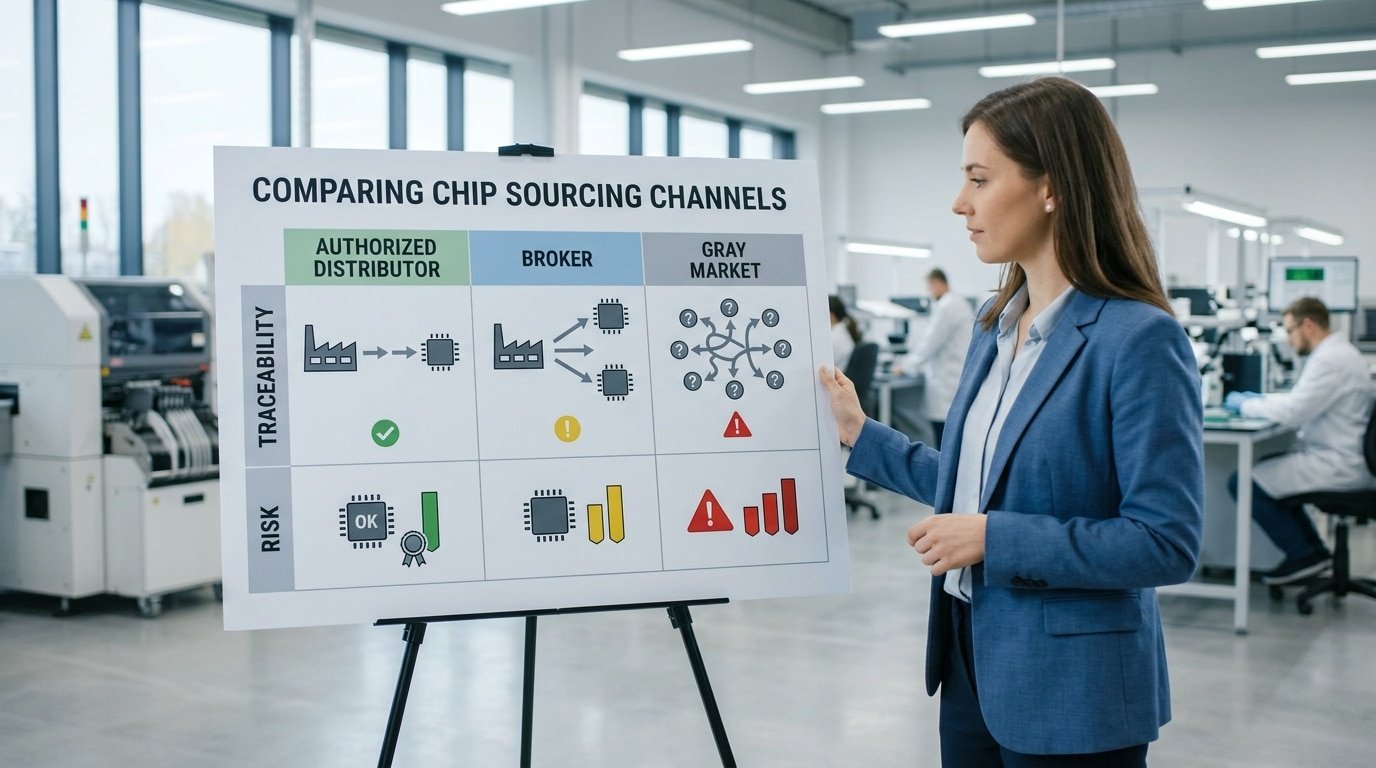
Authorized Distributors Vs Brokers Vs Gray Market Suppliers
So here’s the deal. Buy from authorized distributors when you actually care about tracking a part’s history and keeping your warranty intact.
Use carefully checked independent brokers only for old or hard-to-get parts you really can’t find anywhere else. As for the open gray market, just stay away from it completely.
The whole thing basically comes down to one point, a documented trail showing where the chip traveled from the maker straight to your loading dock.
An authorized distributor signs an official agreement directly with the chip manufacturer. Arrow Electronics and Avnet are two of the biggest companies out there, and each one stocks hundreds of thousands of semiconductor SKUs, which are basically individual part numbers, pulled straight from the factory.
That official relationship hands you full tracking of every batch plus the manufacturer’s warranty. Digi-Key operates the very same way.
Buy a part from them, and honestly, you can trace its date code and wafer lot all the way back to the place where it was made.
An independent broker, though, carries no such agreement. They pull parts from leftover inventory, factory overruns, or other brokers. The good ones run incoming inspection and X-ray screening. The real danger lives out in the open gray market, where parts pass through unknown hands and fakes slip in.
| Channel | Lot Traceability | Warranty | Price vs. Authorized | Counterfeit Risk |
|---|---|---|---|---|
| Authorized Distributor | Full, factory-level | Manufacturer-backed | Baseline | Near zero |
| Vetted Broker | Partial, batch-level | Broker-only, limited | +approximately 10% to +approximately 400% on allocated parts | Moderate, screened |
| Open Gray Market | None | None | Varies wildly | High |
The legal danger is genuinely real. Buy from an unauthorized source, and the chip maker simply cancels your warranty.
And if a fake part fails inside a medical or automotive product, the blame shifts right over to you. To trim this risk, source through TrustedParts.com, which is a search engine that pulls together inventory only from authorized electronic chip suppliers for manufacturers.
In my experience, smart buyers keep brokers around for one job only. That job? Finding hard-to-get parts during shortages, and always backed up with independent lab testing.
Top Vetted Chip Suppliers And Distributors Serving Manufacturers
For most manufacturers, the shortlist splits into two groups: authorized distributors who stock and resell parts from many brands, and the chip makers themselves.
Arrow Electronics and Avnet lead the distributor side, each carrying hundreds of thousands of semiconductor SKUs (stock-keeping units, meaning unique part numbers) with global logistics by the mid-2020s.
Pick distributors for mixed bills of materials. Buy direct from makers only at high volume.
Authorized Distributors
| Distributor | Core Strength | Best Fit |
|---|---|---|
| Digi-Key | Same-day shipping on small quantities, deep prototype stock | R&D teams, low-volume OEMs |
| Mouser | Over 1,200 component brands, strong new-product introductions | Design engineers sourcing the newest parts |
| Arrow | Supply-chain programs, bonded inventory, EOL management | Mid-to-large contract manufacturers |
| Avnet | Design support, embedded engineering services | Manufacturers needing reference designs |
| Future Electronics | Demand creation, passive and discrete depth | Production buyers with steady forecasts |
Mouser stocks parts from over 1,200 brands, which makes it the go-to when you need a chip released last quarter. Digi-Key wins on speed for one-off orders.
A practical tip: split your BOM by maturity, buy prototype quantities from Digi-Key or Mouser, then move production volume to Arrow or Avnet for bonded stock and better pricing tiers.
Chip Makers Worth Sourcing Direct
- Nvidia — GPUs and AI accelerators; serves data-center and edge-AI builders.
- Intel — x86 processors and FPGAs; PC and server OEMs.
- Texas Instruments — analog and power management; industrial and automotive makers.
- Qualcomm — Snapdragon SoCs and modems; mobile and IoT device builders.
- Micron — DRAM and NAND memory; storage and computing assemblers.
- Broadcom — networking and connectivity chips; infrastructure manufacturers.
Direct accounts usually require minimum annual spend in the six figures, so smaller manufacturers route the same parts through distributors.
With global semiconductor sales near $558 billion in 2023 and growth through 2026, these electronic chip suppliers for manufacturers each hold allocation power during shortages, another reason to keep a distributor relationship as backup.
Matching Supplier Type To Your Production Volume And Lead Time
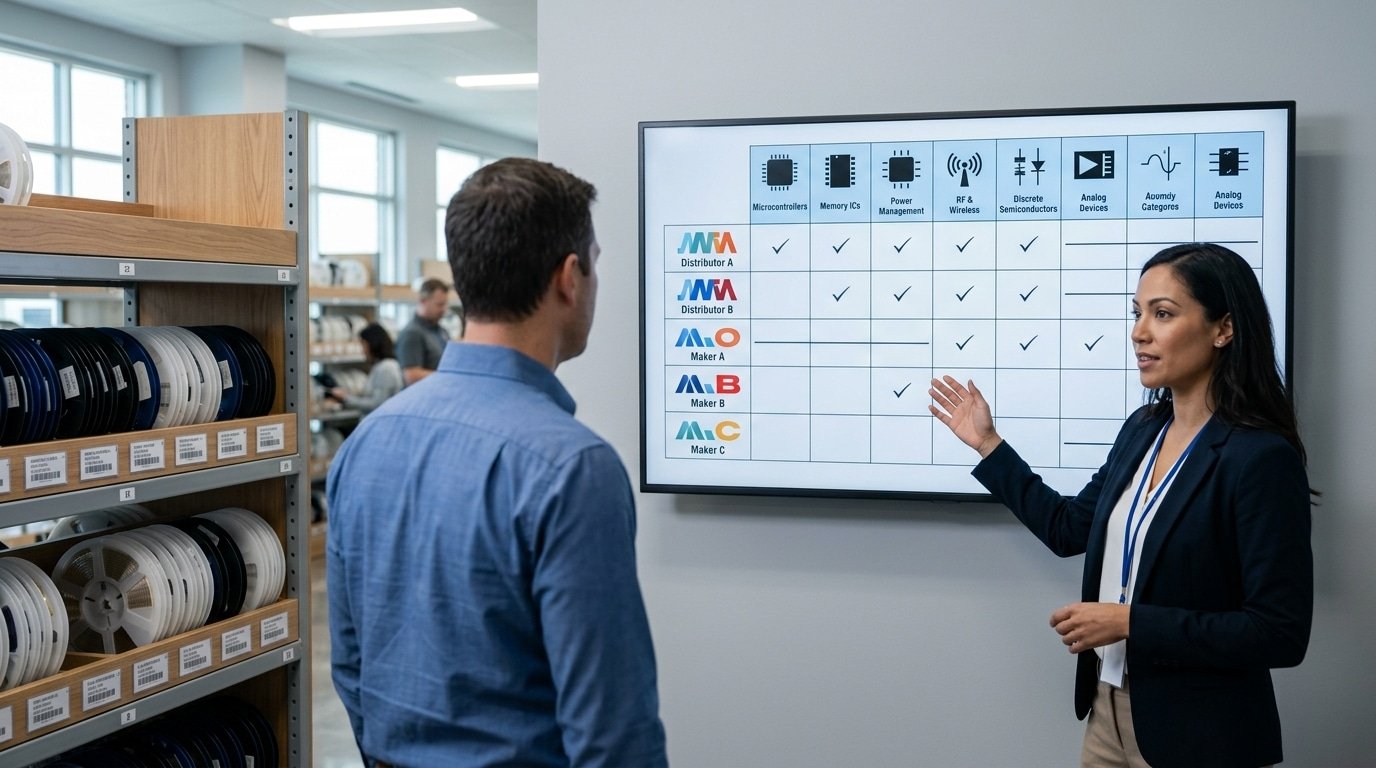
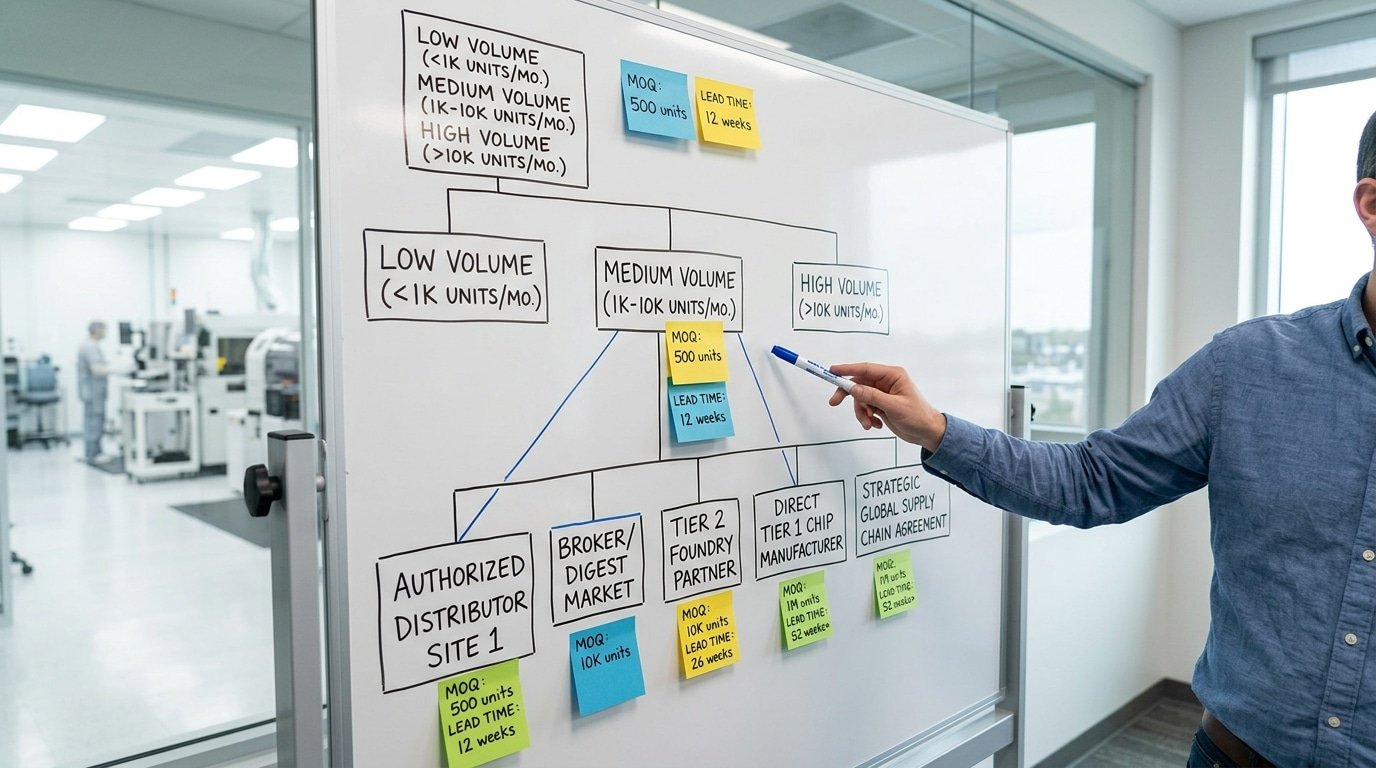
Match your channel to how many units you actually need. Prototype and new product introduction runs really belong with catalog distributors like Mouser, which stocks parts from over 1,200 chip brands according to Mouser and will sell you just a single piece.
High-volume production, on the other hand, belongs with manufacturer franchise distributors. These are the folks who negotiate price breaks and set up scheduled deliveries for you. Brokers only really come into play during allocation, which is basically when the official authorized channels run dry.
Volume sets everything. A prototype run of 10 to 50 boards rarely hits any minimum order quantity, the smallest batch a supplier is willing to sell.
So you pay the full catalog price and just accept it. Once you cross roughly 1,000 units a year on a given part, though, franchise distributors will open a quote desk and cut you tape-and-reel pricing. That is often 15 to approximately 30% below catalog for passives and common logic.
Decision Matrix By Scenario
| Scenario | Best channel | Typical MOQ | Why |
|---|---|---|---|
| Prototype (1–50 units) | Catalog distributor (cut-tape) | 1 piece | No commitment, ships fast, and you can trace every part fully |
| Low-volume NPI (50–1,000) | Authorized distributor quote desk | Reel quantity (e.g. 3,000) | Volume pricing kicks in and the fab gets to see real demand |
| High-volume production (10k+) | Franchise + manufacturer rep | Contract / blanket PO | Scheduled orders, priority when parts get scarce, lowest cost per unit |
| Allocation / EOL gap | Vetted independent broker | Lot-based | A last-resort way to fill the gap, but it needs inspection on arrival |
Lead times, meaning how long you wait for parts, split by chip category. Standard passives and basic jellybean logic ship same-day right off the shelf.
MCUs and power management ICs run 12 to 26 weeks when the factories that make the chips tighten up. Custom or automotive-grade parts built on older process technology can stretch past 40 weeks during shortages.
Allocation is the moment you switch. When your franchise distributor pushes your delivery date out by months, electronic chip suppliers for manufacturers in the broker market become a stopgap. Not a strategy.
Lock in a second authorized source before that ever happens. The 2021 to 2022 crunch taught buyers a hard lesson. Single-sourcing a approximately $0.40 MCU can idle a whole assembly line worth millions.
Here is one practical rule I stand by. Never qualify a broker in the middle of a crisis. Pre-vet two independent distributors during calm periods, so the paperwork and inspection steps are ready to go when you need them.
How To Verify A Supplier Is Authorized And Counterfeit-Free
Confirm authorization in four steps: cross-check the supplier on the chip maker’s official franchise list, request a Certificate of Conformance (CoC), demand lot and date-code traceability back to the factory, and require inspection to AS6081 or IDEA-STD-1010. If a vendor can’t supply all four, treat them as counterfeit-risk.
⚠️ Common mistake: Chasing the lowest unit price from an independent broker for a high-volume program. This happens because brokers advertise attractive prices on hard-to-find parts, but unauthorized stock carries counterfeit risk and no manufacturer paper trail. The fix: match supplier class to volume—route 2-million-board runs through authorized distributors or direct OEM contracts (TI, NXP) for traceability, reserving brokers only for genuine end-of-life or hard-to-find shortages.
Start at the source. Every major chip maker publishes a “where to buy” or authorized distributor page.
Pull up TI, NXP, or Microchip’s site and search the supplier name directly. TrustedParts.com aggregates inventory only from authorized distributors, so a part listed there carries a clean chain of custody.
A broker offering “factory-fresh” parts that no franchise list confirms is your first red flag.
A Certificate of Conformance proves the lot matches the spec sheet. Demand one tied to a specific lot number,not a blanket template. Genuine CoCs reference the original component manufacturer (OCM), the date code, and the country of origin.
Inspection standards that catch fakes
Two standards govern counterfeit detection. AS6081, published by SAE International, sets sampling and test protocols for independent distributors.
IDEA-STD-1010 defines visual inspection,checking for resurfaced markings, blacktopping (a fake coating that hides remarked dies), and inconsistent lead finishes. A scanning electron microscope or X-ray fluorescence (XRF) test exposes recycled parts that passed a quick eyeball check.
Counterfeit losses are real. The Semiconductor Industry Association has estimated fake chips cost U.S. makers billions annually, and demand keeps climbing as the industry tops approximately $558 billion in sales.
Red flags that signal a risky broker
- Refuses to name the OCM or share lot traceability documents
- Offers obsolete parts at prices far below market with “unlimited” stock
- Ships from a freight-forwarder address with no physical warehouse
- Pushes you to skip incoming inspection to “save time”
- Provides CoCs without a verifiable lot or date code
When you vet electronic chip suppliers for manufacturers this way, you shift counterfeit risk off your production line and onto a documented audit trail.
Costly Sourcing Mistakes Manufacturers Make And How To Avoid Them
The four most expensive sourcing mistakes are chasing the lowest unit price into gray-market traps, single-sourcing a critical MCU, ignoring end-of-life (EOL) notices, and skipping incoming inspection. Each one can turn a small saving into a six-figure loss. Below is the failure pattern, the real cost, and the fix.
Chasing the lowest price into counterfeit traps
A quoted price approximately 60% below distributor catalog isn’t a deal,it’s a warning. Counterfeit or recycled parts often ship from unauthorized brokers. When a fake op-amp fails in the field, you pay for the recall, not just the part.
Fix: Buy only from authorized channels or brokers who run X-ray and decapsulation testing. Aggregators like TrustedParts.com pull pricing only from authorized distributors, so you compare clean stock instead of mystery inventory.
Single-sourcing a critical microcontroller
One MCU. One supplier. One allocation event, and your whole line stops. During the 2021,2023 shortage, lead times on some MCUs stretched past 52 weeks. A stalled SMT line can cost thousands per hour in idle labor and machine time.
Fix: Qualify a second source or pin-compatible alternate during design, not after the crisis hits.
Ignoring end-of-life and PCN notices
A Product Change Notification (PCN),a vendor’s formal warning that a part is changing or ending,is your free heads-up. Miss it, and you face a last-time-buy deadline with no warning. The semiconductor market reached about $558 billion in 2023, and EOL churn affects mature parts every quarter.
Fix: Subscribe to PCN alerts from your electronic chip suppliers for manufacturers and review them monthly.
Skipping incoming inspection
No incoming inspection means defects surface at final test,or at the customer. Catch a bad reel at receiving and you scrap one reel. Catch it after assembly and you scrap whole boards.
Fix: Sample-test every new date code; verify lot numbers against the supplier’s certificate of conformance.
Building Supply-Chain Resilience With Multi-Sourcing And Allocation Plans
Never let one supplier own a critical part. Resilient manufacturers run dual-source on every high-risk line item and tri-source on the parts that would stop production if they vanished. The goal is simple: if one source goes on allocation, your line keeps moving.
Start by ranking your bill of materials (BOM) by risk, not by spend. A approximately $0.30 power management IC with one approved source is more dangerous than a approximately $5 part with three.
Tag each line as single, dual, or tri-source. During the 2021,2023 shortage, lead times on some automotive microcontrollers stretched past 52 weeks, and single-sourced BOMs were the first to halt assembly lines.
Qualifying Pin-Compatible Second Sources
A second source means a part that drops into the same footprint with matching pinout and electrical behavior. Texas Instruments, STMicroelectronics, and Microchip often make functionally equivalent parts you can cross-reference. Qualify the alternate early:
- Pull the datasheet side-by-side — check pinout, voltage range, and timing specs match within tolerance.
- Build a small validation run — populate 20–50 boards with the alternate and run full functional test.
- Lock the cross-reference in your PLM so purchasing can switch sources without an engineering hold.
Qualifying a second source costs engineering time upfront, but it converts a future 40-week scramble into a same-week swap.
Allocation Clauses And Buffer Stock
Write contingency terms into your supply agreements before a crunch hits. Ask your distributor for an allocation clause that guarantees a minimum monthly quantity based on your trailing 12-month usage. Authorized distributors like Arrow Electronics offer buffer-stock and scheduled-order programs that hold inventory against your forecast.
Hold physical buffer on parts with long lead times. A common rule: keep 8,12 weeks of safety stock on single-sourced or long-lead components, less on commodity parts with deep market supply.
The semiconductor market reached roughly $558 billion in 2023 and continues climbing through 2026, so demand spikes on advanced nodes remain a live risk for electronic chip suppliers for manufacturers.
Leading OEMs de-risked their BOMs by redesigning single-sourced parts out entirely during the last shortage, swapping scarce chips for available equivalents at the design stage.
US And Regional Suppliers For Domestic And Specialty Sourcing
Source domestically when you need ITAR compliance, shorter shipping risk, or CHIPS Act funding eligibility. For everyone else, US fabs cost more per part but cut weeks off lead times and lower the chance of a single chokepoint stalling your line.
The case for buying American got stronger after the 2022 CHIPS and Science Act put approximately $52.7 billion toward domestic fabrication and research. New plants from SIA member companies in Arizona, Texas, Ohio, and New York are ramping through 2025,2026.
Texas Instruments runs analog and power fabs in Texas and Utah. GlobalFoundries makes RF and specialty silicon in upstate New York and Vermont.
ON Semiconductor and Microchip add domestic capacity for power and microcontroller parts.
Domestic sourcing matters most in three situations:
- ITAR or defense work — International Traffic in Arms Regulations require US-controlled supply chains for many military and aerospace programs. Foreign-fabbed parts can disqualify a bid.
- Shipping-risk reduction — A part made in Texas reaches a California plant in days, not a six-week ocean transit through one Pacific port.
- Funding eligibility — Some grants and customer mandates now require a percentage of domestic content.
Match the supplier to the part type. High-volume commodity logic and memory stay cheaper from large fabs in Taiwan or South Korea. But niche analog, discrete power, RF, and custom ASIC work fits regional and US specialty houses well.
| Need | Domestic / specialty fit |
|---|---|
| Analog and power | Texas Instruments, ON Semiconductor, Microchip (US fabs) |
| RF and specialty | GlobalFoundries, Qorvo |
| Custom ASIC | Regional design houses with US foundry partners |
| High-volume commodity logic | Offshore leading-edge fabs (lower cost) |
Practical tip: ask any electronic chip supplier for manufacturers to confirm the fab location, not just the company headquarters. A US-headquartered brand may still fabricate the exact part you want overseas.
Frequently Asked Questions About Chip Suppliers
These four questions drive most search traffic around sourcing chips. Each answer below is short, specific, and built for quick scanning before you commit a purchase order.
Who is the biggest supplier of microchips?
By revenue, Nvidia leads the pack in 2025, followed by Samsung, Broadcom, and Intel. But “biggest” depends on the category.
For analog and microcontroller parts that most electronics manufacturers actually buy, Texas Instruments, STMicroelectronics, Infineon, and Microchip dominate the catalog. The Semiconductor Industry Association reported global sales near $558 billion in 2023, with growth continuing through 2026.
Who supplies chip makers and OEMs?
Two layers exist. Chip makers themselves (the fabless and integrated firms above) sell to authorized distributors.
Then distributors like Arrow Electronics and Avnet,each stocking hundreds of thousands of semiconductor SKUs,resell to OEMs and contract manufacturers. Most OEMs buy through these distributors, not directly from the chip maker, unless their annual volume clears the manufacturer’s direct-account threshold.
Which country has the biggest chip manufacturers?
Taiwan leads in advanced fabrication. As of 2021, only three firms could fabricate leading-edge logic chips: TSMC (Taiwan), Samsung (South Korea), and Intel (United States), per the semiconductor industry record.
For sheer supplier count, China hosts the most trading companies,platforms list over 2,000 chip suppliers,though many resell rather than fabricate.
How do I start a new supplier relationship?
- Request a sample order first. Test 50–100 units before any production commitment.
- Confirm authorization on the chip maker’s official distributor list.
- Negotiate NCNR terms (non-cancellable, non-returnable) only after qualifying parts.
- Set a quarterly business review to track on-time delivery and quality PPM.
Treating electronic chip suppliers for manufacturers as a vetted, scored relationship,not a one-off transaction,cuts your counterfeit and shortage risk sharply.
Choosing Your Chip Supplier Strategy And Next Steps
Start with a 30-day supplier audit. Score every active vendor against the four-step authorization check, map each critical part to a backup source, and assign volume tiers to the right channel.
Manufacturers who run this audit before their next buy cycle catch gray-market exposure and single-source risk before it triggers a line-down event.
Your strategy rests on three decisions you’ve already learned to make. First, the vetting playbook: confirm authorization on the chip maker’s official distributor list, demand date-code and lot traceability, and require a certificate of conformance for any part touching a safety-rated assembly.
Skip the certificate? You inherit the counterfeit liability.
Second, the channel decision matrix. Catalog distributors like Mouser, which stocks parts from over 1,200 brands, fit prototype and low-volume runs.
Authorized broadliners such as Arrow and Avnet, each carrying hundreds of thousands of semiconductor SKUs, handle production volume with allocation support. Independent distributors fill obsolescence gaps,only after inbound inspection.
Third, resilience. The global chip market hit roughly $558 billion in 2023 and keeps climbing through 2026, which means tight allocation will return. Dual-source every critical line item. Hold a buffer of 12,16 weeks for parts with single-fab dependency.
Your Next-Step Checklist
- Audit now: Run every supplier through the authorization checklist (use a search tool like TrustedParts that aggregates only authorized stock).
- Tier your sourcing plan: Group parts by annual spend, then assign each to catalog, broadline, or independent channels.
- Flag single-source risk: Any part with one supplier and a lead time over 20 weeks needs a qualified second source this quarter.
- Document failure cost: Calculate your hourly line-down cost so buyers can justify paying for traceability over the cheapest quote.
The right mix of electronic chip suppliers for manufacturers isn’t one vendor,it is a tiered system that protects margin and uptime together. Build it deliberately, and review it every two quarters as your volume and BOM shift.
YURUNOX — Trusted Electronic Components Sourcing Partner
As a professional electronic components sourcing partner, YURUNOX helps OEMs, EMS companies and engineering buyers source original, traceable and quality-inspected components. Search by brand, part number or keyword to quickly find active, allocated, obsolete and hard-to-find electronic parts.
- ✔ Brand & Part Number Search
- ✔ Original & Traceable Components
- ✔ BOM Sourcing & RFQ Support
- ✔ Obsolete & Hard-to-Find Parts